How to Gender Betta Fish
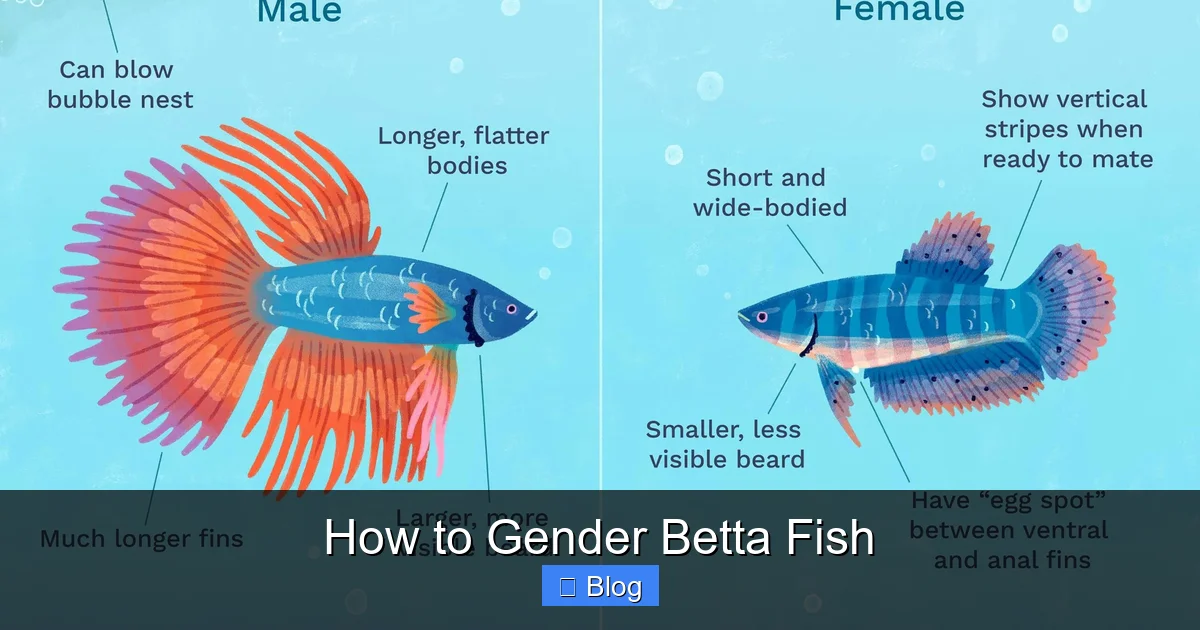
Determining the sex of a betta fish is crucial for proper tank management and breeding, but it’s not always obvious. While males are famously aggressive and have long, flowing fins, females can sometimes display similar traits. This guide breaks down the definitive physical characteristics and subtle behavioral signs to help you accurately gender your betta, from fry to adult, and avoid common mistakes that lead to misidentification.
Key Takeaways
- Fin Length & Shape is Primary: Males have long, flowing fins (often 2-3x body length), while females have shorter, more functional fins. However, some females (plakat females) and long-finned females can blur this line.
- Body Shape is a Key Indicator: Males are typically longer and more slender; females are shorter, rounder, and have a larger, more pronounced body, especially when viewed from above.
- The Egg Spot is a Female Tell: A small, white dot (ovipositor) between the ventral fins is a definitive sign of a female, though it may not appear until sexual maturity.
- Behavior is Telling but Not Foolproof: Males flare aggressively at reflections and build bubble nests. Females may flare mildly and show vertical “barring” stripes when stressed or ready to breed.
- Age Matters: Young bettas (under 3-4 months) are extremely difficult to sex reliably. Wait until they are fully mature for accurate identification.
- Never Rely on a Single Trait: Always use a combination of physical attributes (fins, body, egg spot) and behavioral observations for the most accurate gendering.
📑 Table of Contents
- Why Knowing Your Betta’s Sex is So Important
- Physical Differences: The Body & Fin Blueprint
- Behavioral Clues: Watching Your Betta in Action
- The Age Factor: Why Baby Bettas Are Nearly Impossible to Sex
- Common Mistakes & Misconceptions in Betta Gendering
- A Step-by-Step Guide to Gendering Your Betta
- Conclusion: Embracing the Nuance of Betta Sexing
Why Knowing Your Betta’s Sex is So Important
So, you’ve got a beautiful betta fish, and you’re charmed by its vibrant colors and graceful fins. But have you ever wondered, “Is it a he or a she?” This isn’t just a question of curiosity—it’s a cornerstone of responsible betta ownership. Correctly identifying the sex of your betta directly impacts its health, happiness, and safety. The most critical reason? Tank mates. Male bettas are famously territorial and aggressive towards other males, often to the point of fatal fighting. Keeping two males together is a recipe for disaster. But it’s not just males you need to worry about; a male in a community tank might harass females relentlessly. Conversely, a female might be bullied by more aggressive tank mates if not properly matched. Beyond companionship, knowing the sex is essential if you ever consider breeding. It helps you prepare for breeding behaviors like bubble nest building or the development of the “egg spot.” Ultimately, understanding your betta’s biology allows you to provide the right environment, choose compatible friends, and appreciate the subtle differences between the sexes. Let’s dive into the fascinating details of how to tell them apart.
Physical Differences: The Body & Fin Blueprint
When you look at a betta, the first things you notice are its fins and body shape. These are your primary clues for gendering, but they require a trained eye. We’ll start with the most famous difference.

Visual guide about How to Gender Betta Fish
Image source: qwikbetta.com
The Iconic Fins: Length, Shape, and Ray Count
This is the classic giveaway, but it’s also where many beginners get tripped up. Male bettas are the showstoppers of the fish world. Their fins are their crowning glory—long, flowing, and elaborate. A male’s caudal (tail) fin is often two to three times the length of its body, with delicate, feathery edges. The dorsal fin is large and flowing, and the ventral fins are long and sword-like. In contrast, a female betta’s fins are built for practicality, not pageantry. They are shorter, thicker, and have a much more functional look. Her caudal fin is typically shorter and more rounded or spade-shaped, and her ventral fins are shorter and less dramatic. To be precise, you can often count the fin rays: males have longer, more numerous rays in their caudal fins, while females have shorter, stubbier ones. Important exception: Plakat (PK) bettas are a short-finned variety bred for fighting and color. In Plakats, males have short fins like females, so you must rely on other characteristics like body shape and egg spot to tell them apart.
Body Shape & Size: The Silhouette Speaks
If you can get a clear side view and a top-down view of your betta, its body shape tells a story. Male bettas are generally built for agility and display. They are longer, more slender, and have a streamlined, torpedo-like profile. Their bodies appear sleek and muscular. Female bettas, on the other hand, are built for egg carrying. They tend to be shorter, deeper-bodied, and more robust. From above, a female’s body often looks wider and more triangular or “husky,” especially in the abdominal area. This becomes even more pronounced when a female is gravid (full of eggs). She will have a very rounded, distended belly that can look almost balloon-like. A male’s body remains relatively uniform in width from head to tail.
The Definitive Clue: The Egg Spot (Ovipositor)
This is the single most reliable physical indicator of a female betta, but it has a catch. The egg spot is a small, white, raised bump or dot located between the two ventral fins (the ones under the head). It’s technically an ovipositor—the organ she uses to lay eggs. Here’s the critical detail: this spot does not develop until the betta reaches sexual maturity, which is typically around 3-4 months of age. A young female fry will not have it. Once it appears, it’s a surefire sign you have a female. Males never develop an egg spot. Sometimes, the spot can be very tiny or pale, so look carefully. A magnifying glass can help. If you see this spot, you can be 99% certain your betta is female.
Gill Covers & Other Subtle Signs
Beyond the major features, there are finer details. Male bettas often have slightly larger, more pronounced gill covers (opercula) that can make their heads look a bit broader. When they flare (a behavior we’ll discuss later), the gill covers extend dramatically, making them look much larger. Females have less dramatic gill covers. Another subtle clue is the “beard”—the membrane under the gill cover that extends when flaring. Males have a much more prominent, often colorful beard, while a female’s is minimal or nonexistent. Finally, look at the scales. Males often have a smoother, more iridescent scale pattern, while females can sometimes have a slightly more textured or matte appearance, especially on the body.
Behavioral Clues: Watching Your Betta in Action
Physical traits are your first tool, but observing behavior provides powerful supporting evidence. Betta behavior is deeply tied to their reproductive roles.

Visual guide about How to Gender Betta Fish
Image source: fishkeepingguide.net
The Male’s Domain: Flaring, Nesting, and Guarding
Male bettas are the quintessential territorial defenders. Their most common behavior is flaring—spreading their gill covers and fins to appear larger and more intimidating. Males flare at anything they perceive as a rival: their own reflection, another betta, a brightly colored object, or even your finger. This flaring is intense, sustained, and often accompanied by a posture where they puff up their entire body. The other hallmark male behavior is bubble nest building. Even without a female present, a male betta will often create a cluster of bubbles on the water’s surface, gluing them together with saliva. This is a nest he prepares for future eggs. He will diligently maintain and defend this nest area. If you see consistent bubble-nesting, you almost certainly have a male.
The Female’s Response: Barring, Submissiveness, and Readiness
Female bettas are generally less overtly aggressive, but they have their own behavioral language. One of the most telling signs is vertical barring. When a female is stressed, feels threatened, or is ready to breed, she will develop dark, vertical stripes running down her body. This is a natural camouflage response and a sign of submission. A male will rarely show this pattern. In the presence of a male (during a controlled breeding setup), a receptive female will display a softer, submissive behavior—she may lower her head, curve her body, and gently flare her gills in a non-aggressive way. If she is not receptive, she may actively fight back, flaring and chasing the male, but her body will still be more compact and less dramatically flared than a male’s. Females also sometimes engage in a “flaring dance” with each other in a sorority tank, which is a social hierarchy-establishing behavior, not pure aggression.
Important Caveats: Behavior Can Be Misleading
While behavior is a great clue, it’s not infallible. Some females, particularly those with longer fins or more dominant personalities, can flare quite persistently and may even build small, poor-quality bubble nests (though never a robust one like a male’s). Conversely, a young or submissive male might not flare as much initially. The key is to look at patterns. A dedicated, daily bubble nest builder is almost certainly male. A fish that consistently shows vertical stress bars when a mirror is held up is very likely female. Never diagnose based on a single observation. Combine these behavioral patterns with the physical traits discussed earlier.
The Age Factor: Why Baby Bettas Are Nearly Impossible to Sex
This is one of the most common points of confusion for new betta keepers. You cannot reliably sex a betta fry (baby fish). It is nearly impossible to determine the sex of a betta under 3-4 months of age. Juvenile bettas of both sexes look remarkably similar. They have relatively short, underdeveloped fins, lack an egg spot, and have similar slender body shapes. Their behavioral differences are also minimal at this stage. Attempting to sex them before they are mature will lead to frequent and frustrating mistakes. The betta’s sexual characteristics develop as they approach maturity, which is influenced by factors like water temperature, nutrition, and overall health. The egg spot is one of the last things to develop. Therefore, if you are buying bettas to set up a community tank or a sorority, you must source them from a reputable seller who guarantees their sex or purchase fully mature fish where the differences are clear. Patience is truly a virtue when it comes to gendering young bettas.

Visual guide about How to Gender Betta Fish
Image source: petshun.com
Common Mistakes & Misconceptions in Betta Gendering
Even with all this knowledge, pitfalls exist. Let’s debunk some myths and highlight frequent errors.
Mistake #1: “Long Fins Always Mean Male”
This is the biggest misconception. While most long-finned bettas (like Halfmoon or Crowntail) are male, female bettas can absolutely have long fins. Breeders have developed long-finned female varieties. A female with a long, flowing caudal fin can easily be mistaken for a male at a glance. This is why you must check for the egg spot and body shape. A long-finned fish with a rounded, deep body and an egg spot is a female. A long-finned fish with a slender body and no egg spot is a male.
Mistake #2: Ignoring Body Shape for Fin Focus
Conversely, some people see a short-finned betta (like a Plakat) and immediately think “female.” But Plakat males are very common and popular. A short-finned betta with a slender, streamlined body, a large beard, and aggressive flaring behavior is almost certainly a male. You cannot rely on fin length alone for Plakats or for any betta where the fin characteristics are ambiguous.
Mistake #3: Misinterpreting Flaring Behavior
As mentioned, a flaring fish isn’t always a male. A female in a sorority tank will flare at her tank mates to establish rank. A female presented with a male may flare defensively. The nature of the flare matters. A male’s flare is often more about display and territory. A female’s flare, especially when coupled with vertical barring, is often a sign of stress or rejection. Context is everything.
Mistake #4: Rushing the Judgment with Young Fish
We’ve stressed this, but it bears repeating. Labeling a juvenile betta as a specific sex before it’s 4 months old is a guess, not a fact. You will be wrong a significant percentage of the time. If you are setting up a community tank, wait for maturity or buy from a trusted, sexed source.
A Step-by-Step Guide to Gendering Your Betta
Ready to put it all together? Follow this systematic approach for the most accurate identification.
Step 1: The Initial Observation (From a Distance)
First, watch your betta in its normal environment without disturbing it. Note its typical behavior. Does it constantly flare at its reflection in the glass? Does it spend time building bubble nests at the surface? These are strong male indicators. Does it often display vertical dark stripes? That leans female. Get a sense of its overall demeanor.
Step 2: The Physical Examination (Gentle & Brief)
Now, you’ll need a closer look. You can use a clean, clear cup or container to gently catch the betta for a brief examination, or do it during a water change. Be quick and gentle to avoid stress. Look for the following in order:
- Check for the Egg Spot: This is your first and most definitive check. Look carefully between the ventral fins for a small white dot. If it’s there, it’s a female. If not, proceed.
- Assess Fin Length and Ray Structure: Are the fins extremely long and flowing (male) or shorter and more functional (female)? Are the fin rays long and wispy or short and thick?
- Evaluate Body Shape: Look at the fish from above and from the side. Is the body long, slender, and torpedo-shaped (likely male) or shorter, deeper, and rounder (likely female)? Is the belly flat or distended?
- Look for a Beard: Gently encourage the betta to flare (by showing it a mirror or another betta in a cup, briefly). Does it have a large, colorful beard under the gill cover? That’s a male trait.
Step 3: Behavioral Confirmation
After the physical check, confirm with a targeted behavior test. Hold a small mirror against the outside of the tank for 10-15 seconds. Observe the flaring response.
- Strong, Persistent Flare: Body puffed up, all fins fully extended, gills wide open. This is classic male behavior.
- Mild or Submissive Flare: Fins may be partially spread, but the body posture is lower, and vertical barring may appear. This points to female.
- No Reaction: Could be a very young fish, a submissive male, or a relaxed female. Doesn’t give a clear answer.
Step 4: The Final Verdict & When to Doubt
Now, synthesize your findings. If you have a long-finned fish with no egg spot, a slender body, and a big flaring response, it’s a male. If you have a shorter-finned (or even long-finned) fish with a visible egg spot, a deep body, and shows stress bars when flared, it’s a female. When in doubt, especially with Plakats or long-finned fish, assume it could be either sex. The safest course is to treat it as a potential male for tank-mating purposes (i.e., no other males, be cautious with females) until you are 100% certain. If you are breeding, you need absolute certainty, so wait for the egg spot to appear on a suspected female.
Conclusion: Embracing the Nuance of Betta Sexing
Gendering a betta fish is part science, part art. It’s a skill that develops with patience and careful observation. Remember the golden rule: never rely on a single characteristic. The egg spot is the most reliable physical marker for females, but it takes time to appear. Fin length is a strong hint for males, but exceptions exist. Body shape provides crucial context, and behavior offers the final piece of the puzzle. The most common errors come from rushing to judgment, especially with young fish or unusual fin types. By taking a methodical approach—checking for the egg spot, assessing fins and body, and observing behavioral responses—you can become proficient at determining your betta’s sex. This knowledge empowers you to create a safe, stress-free home for your aquatic companion, whether it’s a solitary king, a member of a sorority, or a future parent. The next time you gaze into your betta’s tank, you’ll see more than just a beautiful fish; you’ll see a complex creature with a biological story you can now begin to understand.
Frequently Asked Questions
At what age can you reliably sex a betta fish?
You can reliably sex a betta fish at around 3 to 4 months of age. Before this, juveniles of both sexes look very similar and lack definitive markers like the female egg spot. Attempting to sex younger fry is highly inaccurate.
Can a female betta have long fins like a male?
Yes, absolutely. While most long-finned bettas are male, female bettas can also be bred to have long, flowing fins. In these cases, you must rely on other indicators like the presence of an egg spot, a rounder body shape, and behavioral patterns to confirm she is female.
What is the one surefire way to tell a female betta?
The presence of an egg spot (a small, white, raised bump between the ventral fins) is the single most definitive indicator of a female betta. However, this spot only develops once the fish reaches sexual maturity, around 3-4 months old. Males never develop an egg spot.
Do all male bettas build bubble nests?
Most male bettas will build bubble nests at some point, especially when they are healthy and water conditions are good. However, not all males build large, obvious nests constantly. Some may make small, temporary ones, and environmental factors like strong water surface agitation can discourage nesting. The absence of a nest doesn’t guarantee a fish is female, but consistent, robust nest-building is a very strong male indicator.
Why is my betta flaring so much? Is it a sign of aggression or sex?
Flaring is a natural behavior where a betta spreads its gills and fins to appear larger. Both males and females flare. Males typically flare more aggressively and persistently at reflections or intruders as a territorial display. Females may flare when stressed, when showing vertical barring, or during social interactions with other females. The context and accompanying body language (like a puffed-up male vs. a barred female) help determine the reason.
I have a short-finned betta. How can I tell if it’s male or female?
Short-finned bettas (Plakats) require extra attention because you cannot use fin length as a primary clue. You must focus on other traits: look carefully for the egg spot (if present, it’s female), check the body shape (males are longer and slimmer, females are shorter and deeper-bodied), and observe behavior (males flare more intensely and may build bubble nests). Without an egg spot, sexing a Plakat can be challenging and may require expert opinion or waiting for breeding behavior to manifest.