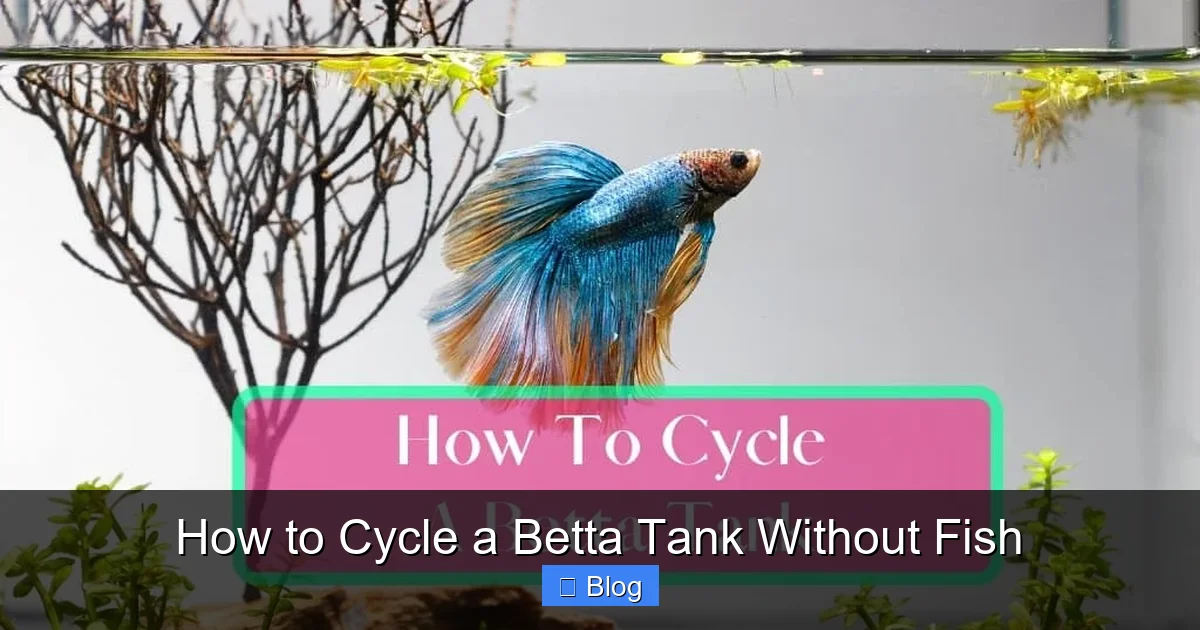
How to Cycle a Betta Tank Without Fish
Cycling a betta tank without fish is the safest, most humane way to establish a healthy aquarium. This process involves adding an ammonia source to feed beneficial bacteria, which convert toxic waste into less harmful compounds. You must test water parameters regularly with a liquid test kit to track ammonia, nitrite, and nitrate levels. Patience is key—the cycle typically takes 4-6 weeks. Once ammonia and nitrite consistently read zero and nitrate is present, the tank is safe for your betta. This fishless method prevents stress or harm to your fish and sets a strong foundation for a thriving aquatic environment.
Key Takeaways
- Fishless cycling is essential: It prevents exposing your betta to toxic ammonia and nitrite spikes, ensuring its long-term health and safety.
- You are the ammonia source: You must manually add pure ammonia, fish food, or shrimp to feed the beneficial bacteria colony.
- Testing is non-negotiable: Use a liquid water test kit (not strips) to monitor ammonia, nitrite, nitrate, and pH multiple times per week.
- Patience and consistency are critical: The nitrogen cycle takes 4-6 weeks. Do not rush it by adding your betta early.
- Live plants can assist but not replace cycling: Fast-growing plants can absorb some ammonia, but you still need a fully established bacterial colony.
- A “cycled” tank has zero ammonia & nitrite: The cycle is complete when adding more ammonia causes ammonia and nitrite to spike and then drop to zero within 24 hours, leaving only nitrate.
- Proper preparation before adding your betta: Once cycled, perform a large water change to lower nitrates, acclimate your fish slowly, and avoid overstocking or overfeeding.
📑 Table of Contents
- The Unseen Foundation: Why Your Betta’s Life Depends on This Process
- Demystifying the Nitrogen Cycle: The Chemistry of Life
- Step-by-Step: The Fishless Cycling Protocol for Your Betta Tank
- Water Testing Demystified: Your Most Important Tools
- Boosting the Cycle: The Role of Live Plants
- Common Pitfalls and How to Avoid Them
- The Grand Finale: Is Your Tank Ready for Your Betta?
The Unseen Foundation: Why Your Betta’s Life Depends on This Process
You’ve admired the flowing fins of a betta at the pet store. You’ve picked out the perfect gravel, a beautiful piece of driftwood, and a tank that will become a miniature masterpiece. But before you even think about pouring that first cup of water into the aquarium, you need to understand one of the most critical, yet invisible, steps in fishkeeping: the nitrogen cycle. And specifically, how to cycle a betta tank without fish. This isn’t just a technicality; it’s the single most important thing you can do for your future pet’s health and happiness.
Bettas, with their delicate labyrinth organs and often stressful histories from the store, are particularly sensitive to poor water quality. A tank that isn’t cycled is essentially a toxic soup waiting to happen. Fish produce waste (ammonia) that is immediately lethal. In a mature aquarium, a army of invisible beneficial bacteria—Nitrosomonas and Nitrobacter—works 24/7 to convert that ammonia first into nitrite (also toxic) and then into nitrate (much less harmful, which plants use or you remove with water changes). Without this bacterial colony established and thriving before your betta arrives, you are sentencing it to a slow, painful poisoning. Fishless cycling is the humane, scientific, and responsible way to build this army first, then invite your betta into a safe, stable home.
Demystifying the Nitrogen Cycle: The Chemistry of Life
Before we dive into the “how,” let’s quickly clarify the “what.” Understanding the three stages of the nitrogen cycle transforms a confusing process into a manageable, logical sequence. Think of it as a tiny, self-sustaining ecosystem you are booting up.
Visual guide about How to Cycle a Betta Tank Without Fish
Image source: images.nexusapp.co
Stage 1: The Ammonia Crisis (Weeks 1-2)
You add an ammonia source to your tank. This feeds the first type of beneficial bacteria, Nitrosomonas. As they multiply to consume the ammonia, you will see a sharp rise in your water test’s ammonia reading (0-5+ ppm). This is normal and expected. The goal here is not to keep ammonia at zero, but to allow the bacteria to grow in large enough numbers to eventually process it all quickly. During this stage, you must not add any fish.
Stage 2: The Nitrite Nightmare (Weeks 2-4)
As the Nitrosomonas bacteria consume ammonia, they produce nitrite as a waste product. Now, a second type of bacteria, Nitrobacter, must establish itself to eat the nitrite. You will see your ammonia levels start to fall, and your nitrite levels spike dramatically—often higher than the initial ammonia spike. Nitrite is even more toxic than ammonia to fish, as it binds to their hemoglobin and prevents oxygen transport. This is the most dangerous phase, which is precisely why we do it without fish. Your job is to keep feeding ammonia (if nitrite drops to zero) to feed the Nitrobacter as they slowly build their population.
Stage 3: The Nitrate Equilibrium (Weeks 4-6+)
Once the Nitrobacter population is strong, nitrite levels will plummet. The only remaining waste product from the cycle will be nitrate. Nitrate is far less toxic and is removed by regular water changes (ideally keeping it below 20 ppm) or absorbed by aquatic plants. At this point, your tank is considered “cycled.” The cycle is complete when you can add a dose of ammonia (2-4 ppm) and see it, and any resulting nitrite, drop back to zero within 24 hours, leaving only a rise in nitrate.
Step-by-Step: The Fishless Cycling Protocol for Your Betta Tank
Now, the actionable guide. This method uses pure, unscented ammonia (like the kind used for cleaning, but 100% pure, no additives, no surfactants). It’s the cleanest, most controllable method.
Visual guide about How to Cycle a Betta Tank Without Fish
Image source: images.nexusapp.co
Step 1: Setup and Initial Water Preparation
Set up your entire aquarium: tank, filter, heater (set to 78-80°F/25.5-26.5°C, optimal for bettas and bacterial growth), substrate, and decorations. Do not add any live animals. Fill with dechlorinated water. Prime your filter with filter media from an established tank if possible (this can speed up cycling, called “seeding”). If not, start with a brand new filter. Turn everything on and let it run for 24 hours to ensure everything is working and the water temperature is stable.
Step 2: Introducing the Ammonia Source
This is the crucial step. You need to raise the ammonia concentration to about 2-4 ppm.
- Best Method: Pure Ammonia. Buy 100% pure ammonia (often “clear” ammonia) from a hardware or grocery store. Read the label—it must list only “ammonium hydroxide” as the ingredient. Add it drop by drop, testing after each few drops, until your ammonia test reads between 2-4 ppm. For a 5-gallon betta tank, this is typically 5-10 drops, but it varies wildly by brand. This is why testing is mandatory.
- Alternative: Fish Food. Add a pinch (about the size of a pea) of flake or pellet food. It will decompose and produce ammonia. This is less precise and can foul the water with decaying solids, but it works. You’ll need to add more food every few days as it decomposes.
- Alternative: Shrimp or Snail Pieces. A small piece of frozen shrimp or a dead bladder snail can be placed in a media bag or on a spoon and left to decompose. Again, less precise and can cause a mess.
Pro Tip: Once you hit 2-4 ppm ammonia, write down the exact number of drops or amount of food you used. This is your baseline for future doses.
Step 3: The Maintenance and Dosing Routine
For the next few weeks, you become the tank’s maintenance crew.
- Test Daily (at first): For the first week, test ammonia and nitrite every day. Once you see nitrite appear, you can test every other day.
- Re-dose Ammonia: Whenever your ammonia test reads 0.5 ppm or lower, add more of your ammonia source to bring it back to 2-4 ppm. This constant food supply keeps the first bacteria colony alive and growing while the second one establishes. Do not re-dose if ammonia is still high (above 1 ppm).
- No Water Changes (Initially): Do not perform water changes for the first 2-3 weeks unless the ammonia or nitrite levels become dangerously high (>5 ppm). The bacteria are living in your filter media and on surfaces; removing water removes their food and slows the process. After nitrite appears, you can do small (10-20%) water changes if nitrate starts to climb too high (>40-50 ppm) before the cycle finishes, but try to minimize them.
Step 4: The Waiting Game and Signs of Progress
This is the hardest part: waiting. You will see a clear pattern emerge on your test results log:
- Ammonia rises and stays high for 1-2 weeks.
- Ammonia begins to fall as nitrite starts to rise.
- Ammonia hits zero. Nitrite peaks (this can be very high, 5+ ppm) and stays high for 1-3 weeks.
- Nitrite finally starts to fall. Nitrate begins to rise steadily.
- Ammonia: 0 ppm. Nitrite: 0 ppm. Nitrate: >20 ppm. The cycle is complete.
The entire process typically takes 4-6 weeks, but can be faster (3 weeks with seeded media) or slower (8+ weeks in colder water).
Water Testing Demystified: Your Most Important Tools
You cannot cycle a tank blindfolded. Guessing based on water clarity is a recipe for disaster. You need objective data.
Visual guide about How to Cycle a Betta Tank Without Fish
Image source: images.nexusapp.co
Why a Liquid Test Kit is Non-Negotiable
Test strips are notoriously inaccurate, especially for ammonia and nitrite, which are the most critical parameters. They also fade quickly. Investing in a reputable liquid test kit like the API Freshwater Master Test Kit is the single best piece of equipment you can buy for this process. It costs more upfront but will last for years and provide the precise readings you need. It includes tests for ammonia, nitrite, nitrate, pH, and alkalinity.
How to Test Properly and Interpret Results
Follow the kit’s instructions exactly. Take your water sample from the middle of the tank, away from the filter output and decor. Rinse your test tubes with tank water between tests. Write down every single result in a notebook or spreadsheet. This log is your map through the cycle. Watch for the pattern described in the previous section. The moment you see nitrite appear is a huge milestone—it means the first bacteria colony is established and working!
Understanding the “Danger Zones”
During fishless cycling, high ammonia and nitrite are expected and necessary. You are not trying to keep them at zero; you are trying to build a system that *processes* them. The danger zones are for when you have fish present. For the cycling process itself, the only real failure points are: 1) pH crashing too low (below 6.5 can stall the cycle), or 2) giving up and adding fish before the cycle is truly complete. If your pH is dropping, do a partial water change with properly conditioned water to stabilize it.
Boosting the Cycle: The Role of Live Plants
Many betta keepers love a planted tank. Can you add live plants during the fishless cycle? Absolutely, and it can help! But it’s crucial to understand their role.
Plants as Ammonia Absorbers
Aquatic plants can directly absorb ammonia and nitrite from the water column through their leaves and roots. Fast-growing plants like Elodea, Hornwort, Water Sprite, and Duckweed are particularly effective at this. Adding a handful of these to your cycling tank can help lower the initial ammonia spike, potentially making the process slightly faster and less harsh on the system.
Plants Are NOT a Replacement for Bacteria
This is the most important caveat: Plants do not perform the nitrification process (ammonia -> nitrite -> nitrate). Only bacteria do that. A heavily planted tank can still have zero beneficial bacteria and will instantly poison a fish with ammonia. Plants are a fantastic supplement—they help with water quality and provide hiding spots—but you must still follow the full fishless cycling protocol and test for ammonia and nitrite. Do not assume your plants have “cycled” the tank. They are managing the symptoms (ammonia levels) but not building the essential bacterial infrastructure in your filter.
Best Practices for Plants During Cycling
Add your plants after the initial 24-48 hour period to allow any dust to settle. Anchor them in the substrate or attach them to hardscape. They will likely melt a bit initially as they adjust to your water parameters and the lack of fish waste (their usual fertilizer). This is normal. As the cycle progresses and nitrate builds up, you’ll see new growth, which is a great sign of a balanced system.
Common Pitfalls and How to Avoid Them
Even with the best intentions, mistakes happen. Here are the most common errors in how to cycle a betta tank without fish and how to sidestep them.
Mistake 1: Using the Wrong Ammonia
The Error: Using ammonia with added fragrances, dyes, or surfactants (soaps). These can kill the bacteria you’re trying to grow or harm your future betta.
The Fix: Read the ingredient label meticulously. It must say “100% Ammonium Hydroxide” or “pure ammonia.” No other ingredients. When in doubt, skip it and use the fish food method, understanding it’s less precise.
Mistake 2: Over-Dosing Ammonia
The Error: Dumping in a large amount of ammonia at the start to “get it over with.” This can shock the system, push ammonia and nitrite to lethal levels for bacteria (yes, they have limits), and stall the cycle.
The Fix: Start with a target of 2-4 ppm. Add small amounts and test. It’s better to have a slightly lower concentration that the bacteria can handle than a massive overdose that suppresses their growth.
Mistake 3: Premature Water Changes
The Error: Performing large, frequent water changes during the first few weeks because the water looks “dirty” or because you’re worried about high ammonia/nitrite. This removes the bacteria’s food source and drastically slows or stops the cycle.
The Fix: Resist the urge! Unless your ammonia or nitrite is skyrocketing above 5-6 ppm (which is rare with proper dosing), leave the water alone for the first 2-3 weeks. After nitrite appears, small water changes to control nitrate are acceptable.
Mistake 4: Adding the Betta Too Early
The Error: Seeing ammonia drop to zero and thinking the tank is ready, then adding the betta. This is the “false cycle” or “partial cycle.” Without a robust Nitrobacter colony to handle nitrite, adding a fish will cause a lethal nitrite spike as the new ammonia from the fish’s waste has nowhere to go but into toxic nitrite.
The Fix: Only consider the cycle complete when you can dose the tank to 2-4 ppm ammonia and have it, and any resulting nitrite, convert to nitrate within 24 hours. This proves both bacterial colonies are fully established and working in concert.
Mistake 5: Using Filter Media from a Diseased Tank
The Error: Trying to speed up the cycle by taking filter sponge or media from a tank that had sick fish. You risk transferring pathogens, parasites, or diseases directly into your new, vulnerable betta tank.
The Fix: Only use “seeded” media from a healthy, disease-free tank that you trust completely. If you have any doubt, it’s safer to cycle from scratch or use a commercial bacterial supplement (which can help but is not a magic bullet).
The Grand Finale: Is Your Tank Ready for Your Betta?
You’ve waited patiently. Your logs show the beautiful pattern: ammonia 0, nitrite 0, nitrate rising. You’ve successfully completed the fishless cycle. Now what?
Confirming a Complete Cycle
Before you even think about the pet store, perform this final test:
- Test your water. Confirm ammonia and nitrite are at 0 ppm.
- Add a small amount of your ammonia source to bring the level to about 2 ppm.
- Wait exactly 24 hours.
- Test again.
If your ammonia is back to 0 ppm and your nitrite is also 0 ppm, with nitrate having increased, you have a fully cycled tank. This is the gold standard proof. If there is any detectable ammonia or nitrite, wait another 24 hours and test again. The cycle is not complete until this 24-hour conversion happens.
The Final Pre-Fish Water Change
Your nitrate level has likely climbed during the cycle (maybe 40-80 ppm). While nitrate is less toxic, such high levels are not ideal for a new betta. Perform a large water change, 50-75%, using properly conditioned, temperature-matched water. This will dilute nitrate to a safer level (below 20 ppm) and give you a fresh start. After this change, test the water one more time to ensure ammonia and nitrite are still zero.
Introducing Your Betta: The Acclimation Process
Now for the exciting part! But don’t just dump your betta in.
- Float the bag: Place the sealed bag in the tank for 15-20 minutes to equalize temperature.
- Drip acclimation (recommended): Using airline tubing, create a slow drip (1-2 drops per second) from the tank into the bag for 30-45 minutes. This slowly adjusts your betta to your tank’s water chemistry (pH, hardness, etc.).
- Gently net the fish: After acclimation, net your betta from the bag and gently place it into the tank. Do not pour the bag water into your tank. It may contain store waste or medication residues.
For the first few days, monitor your betta closely. Feed sparingly (a few pellets once a day) to minimize initial waste. Continue testing the water every few days for the first week to ensure the bacterial colony is handling the new bioload. You’ve done the hard work. Enjoy your stunning, healthy betta in its properly cycled home!
Frequently Asked Questions
How long does it take to cycle a betta tank without fish?
Typically, the process takes 4 to 6 weeks. This timeframe allows the two types of beneficial bacteria to fully establish and process waste efficiently. Using seeded filter media from a healthy tank can shorten this to 2-3 weeks, while colder water temperatures can extend it beyond 6 weeks. Patience is the most important ingredient.
Can I use fish food to cycle my betta tank?
Yes, you can use fish food as an ammonia source, but it’s less precise than pure ammonia. You add a small pinch, which decomposes and releases ammonia. The downside is it can create excess decaying matter in the tank, requiring potential water changes later to remove solids. Pure ammonia is the preferred method for control and cleanliness.
What ammonia concentration should I aim for when fishless cycling?
Aim for an initial ammonia concentration of 2-4 ppm (parts per million). This is enough to feed the bacteria without overwhelming the system. Once the cycle is in progress, you should re-dose ammonia whenever the level drops to 0.5 ppm or lower to keep the bacterial colony fed and growing.
Do I need a filter to cycle a betta tank?
A filter is highly recommended and practically essential. The vast majority of beneficial bacteria live in your filter media (sponges, ceramic rings, bio-balls) due to the high surface area and constant flow of oxygenated water and waste. While bacteria exist on surfaces in the tank, a filter provides the ideal, concentrated home for them. A simple sponge filter is perfect for a betta tank.
How do I know for sure my betta tank is fully cycled?
The only definitive test is the “24-hour conversion test.” With ammonia and nitrite at 0 ppm, add enough ammonia to raise the level to 2-4 ppm. After exactly 24 hours, test the water again. If both ammonia and nitrite are back at 0 ppm and nitrate has risen, your tank is fully cycled and ready for your betta.
Can I add live plants to the tank while I’m fishless cycling?
Yes, you can and should add live plants! Fast-growing plants like hornwort or water sprite will help absorb some ammonia, potentially softening the initial spike. However, plants do not replace the bacterial cycle. You must still follow the full fishless cycling process and test for ammonia and nitrite. Plants are a supplement, not a substitute, for the nitrogen cycle.