How to Cycle a Betta Tank with Fish
Cycling a betta tank with fish inside is a delicate but necessary process when your fish can’t be moved. It requires a strict regimen of water testing, frequent partial water changes, and the use of powerful water conditioners to detoxify ammonia, nitrite, and nitrate. The goal is to establish a robust population of beneficial bacteria *while* keeping your betta safe from the toxic byproducts of its own waste. Patience and diligence are non-negotiable; rushing this process can lead to severe stress, illness, or death for your sensitive betta fish.
So, you have a betta fish. Maybe you brought home a beautiful half-moon or a vibrant veiltail from the store, placed it in a brand-new tank with fresh water, and now you’re reading about this mysterious “nitrogen cycle.” Or perhaps you’ve had your betta in a small, uncycled setup and are finally upgrading to a proper aquarium. You’ve discovered the harsh truth: that crystal-clear water is a toxic soup of ammonia, and your fish is swimming in its own waste. Panic sets in. The standard advice says to “cycle the tank before adding fish.” But your fish is already in there. What now?
Welcome to the high-stakes, high-diligence world of how to cycle a betta tank with fish. This is fish-in cycling, and for a betta owner, it’s a path filled with potential pitfalls but also a clear, actionable roadmap if you know the steps. Bettas are notoriously hardy in some ways—they can survive in a small cup—but their labyrinth organ makes them sensitive to poor water quality. A botched cycle can lead to burned fins, lethargy, clamped fins, and fatal ammonia poisoning. But with the right tools, knowledge, and a commitment to daily monitoring, you can successfully establish a biological filter around your living, breathing betta, transforming its temporary home into a permanently healthy ecosystem. This guide will walk you through every single step, from the absolute basics to the final test, ensuring your betta not only survives the cycle but thrives afterward.
Key Takeaways
- Fish-in cycling is risky but sometimes unavoidable: This method is only for bettas already living in an uncycled tank. It exposes your fish to toxic ammonia and nitrite, requiring constant vigilance to mitigate harm.
- A water conditioner is your #1 tool: You must use a premium conditioner like Seachem Prime that detoxifies ammonia, nitrite, and nitrate for 24-48 hours, buying you critical safety time between water changes.
- Testing is not optional: You must own and use a reliable liquid test kit (like API Master Test Kit) to monitor Ammonia, Nitrite, Nitrate, and pH every 24 hours. Test strips are not accurate enough.
- Partial water changes are your primary defense: Perform 25-50% water changes daily or even twice daily when ammonia or nitrite reads above 0.25 ppm. This dilutes toxins and provides immediate relief.
- The cycle is complete when: You can add 2 ppm of ammonia and see it convert to nitrite, then to nitrate, within 24 hours, with 0 ppm ammonia and nitrite reading *before* the next scheduled water change.
- Never clean filter media in tap water: Your filter houses the essential bacteria. Rinse it only in old tank water during a water change to preserve the bacterial colony.
- Patience is the final ingredient: A safe fish-in cycle takes 4-8 weeks. Do not be tempted to cut corners or add more fish until the cycle is fully established and stable.
📑 Table of Contents
Why Fish-In Cycling is Different (and Dangerous)
Before we dive into the “how,” we must understand the “why.” The nitrogen cycle is a natural process where beneficial bacteria convert fish waste (ammonia) into less harmful substances. In a perfect world, you’d set up the tank, add an ammonia source (like pure ammonia or fish food), let the bacteria grow for 4-6 weeks, and then add your betta. This is a “fishless cycle” and is the safest method for the fish.
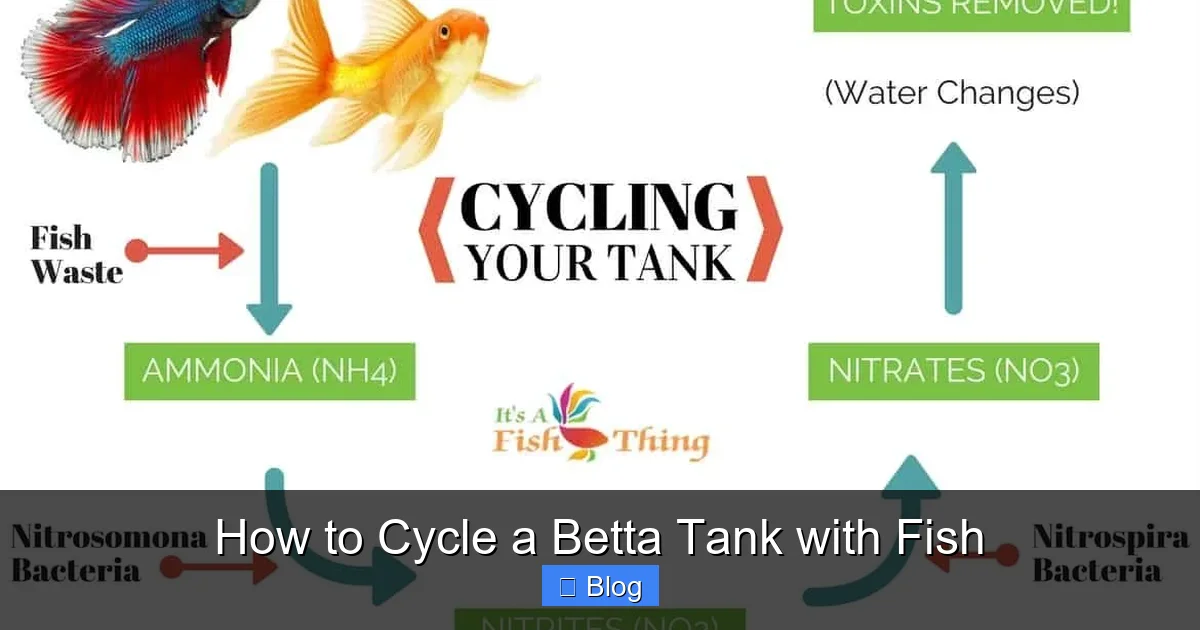
Fish-in cycling flips this script. Your betta is the source of ammonia from day one. As soon as it eats and excretes, toxic ammonia (NH3/NH4+) begins to build up. The beneficial bacteria you need—Nitrosomonas (which eats ammonia) and Nitrospira (which eats nitrite)—are not yet present in sufficient numbers. This creates a dangerous gap: your fish is producing poison, and there’s no one to clean it up. The goal of fish-in cycling is to manage this gap, keeping toxin levels as low as humanly possible while you slowly build up the bacterial colony in your filter and on surfaces. It’s a balancing act between your betta’s metabolism and your intervention.
The Betta’s Unique Vulnerability
Bettas (Betta splendens) are anabantoids, meaning they have a labyrinth organ that allows them to breathe atmospheric air. This adaptation lets them survive in low-oxygen, stagnant water—the very conditions that lead to rapid ammonia buildup. However, it doesn’t make them immune to ammonia toxicity. Ammonia burns gills and fins, damages internal organs, and suppresses the immune system. Betta fins, especially the long, flowing varieties, are particularly susceptible to ammonia burn, appearing ragged or torn. Their small size often means they’re kept in smaller tanks, where toxin concentration spikes faster and higher. Therefore, when cycling a betta tank with fish, the acceptable toxin thresholds are even lower than for hardier species. We aim for undetectable ammonia and nitrite at all times.
Essential Tools & Supplies: Your Cycle Survival Kit
You cannot embark on a fish-in cycle without the proper equipment. This isn’t a “nice-to-have” list; it’s a “must-have” list. Scrimping here is the fastest route to a sick or dead betta.
Visual guide about How to Cycle a Betta Tank with Fish
Image source: nanotankgarden.com
- A Reliable Liquid Test Kit: This is the single most important investment. Do not use test strips. They are notoriously inaccurate, especially for ammonia and nitrite. You need a kit like the API Freshwater Master Test Kit or the Salifert Ammonia Test. You will be testing every 24 hours, sometimes more. The kit must test for Ammonia (NH3/NH4+), Nitrite (NO2-), Nitrate (NO3-), and pH.
- A Premium Water Conditioner: Not all dechlorinators are equal. You need one that detoxifies more than just chlorine. Look for a product that specifically states it converts toxic ammonia (NH3) to less toxic ammonium (NH4+) and detoxifies nitrite. Seachem Prime is the gold standard. One dose detoxifies ammonia, nitrite, and nitrate for 24-48 hours. This is your chemical safety net between water changes.
- A Siphon & Gravel Vacuum: For performing partial water changes quickly and efficiently, removing waste from the substrate without disturbing everything.
- Clean, Dedicated Buckets: You need at least one bucket for removing old water and another for adding new, treated water. Never use buckets that have held soap or chemicals.
- Aquarium Salt (Optional but Helpful): A small dose (1 tbsp per 5 gallons) during the cycle can help reduce stress and assist with osmoregulation. Do not use if you have a scaleless fish like a catfish, but it’s fine for a betta.
- An Established Filter (or Media): Your filter is the heart of the bacterial colony. If you have a friend with a healthy, cycled tank (with no diseases), you can ask for a handful of their dirty filter media or a piece of their sponge. This “seeding” can jumpstart your cycle by weeks. If not, you’ll be starting from scratch.
The Step-by-Step Fish-In Cycle Protocol
Now, the procedure. This is a daily routine you must commit to for the next month or more. Set a daily alarm if you have to.
Visual guide about How to Cycle a Betta Tank with Fish
Image source: i.pinimg.com
Day 0: The Setup & Initial Dose
Assuming your betta is already in the tank:
- Test the water. Get a baseline reading for ammonia, nitrite, nitrate, and pH. Ammonia will likely be 0.5 ppm or higher immediately. Nitrite should be 0. Nitrate might be 0 or low.
- Perform a 25% water change with dechlorinated water (conditioned with Prime) to get ammonia as low as possible before we start. This gives your betta a cleaner starting point.
- Add Prime. Dose the entire tank volume according to the bottle instructions (typically 1 ml per 10 gallons). This detoxifies the existing ammonia and nitrite for the next 24-48 hours.
- Ensure your filter is running. If you have a hang-on-back (HOB) or canister filter, make sure it’s flowing. If you have a sponge filter, ensure it’s bubbling. The bacteria need oxygenated water to thrive. Do not run a carbon filter during the cycle unless you’re using it to remove medications—carbon can adsorb the ammonia you’re trying to feed the bacteria. If your filter has a carbon cartridge, you can remove it or replace it with bio-media (ceramic rings, bio-balls).
The Daily Routine: Test, Change, Condition
For the next 4-8 weeks, this is your cycle:
- TEST FIRST, EVERY MORNING. Before you do anything else, test your ammonia and nitrite. Record the numbers in a notebook or spreadsheet. This data is your guide. Do not skip this.
- Interpret the results & act:
- If Ammonia > 0.25 ppm OR Nitrite > 0.25 ppm: You must perform a partial water change immediately. The size depends on the reading.
- 0.5 ppm Ammonia: 25% change.
- 1.0+ ppm Ammonia or any detectable Nitrite: 50% change.
- If Ammonia & Nitrite are both 0 ppm: This is great! You can likely skip a water change today, but still test. Nitrate will be building—if it’s over 40 ppm, do a 25% change to lower it.
- If Ammonia > 0.25 ppm OR Nitrite > 0.25 ppm: You must perform a partial water change immediately. The size depends on the reading.
- Perform the water change. Use your siphon to vacuum the gravel, removing visible waste. Match the temperature of the new water as closely as possible to the tank. Add new water to a clean bucket, dose it with Prime (for the amount of water you’re adding, not the whole tank), then slowly pour it back into the tank.
- Re-dose Prime for the entire tank volume. After the water change, add another dose of Prime to the entire tank. Remember, its detoxifying power lasts 24-48 hours. This ensures any new ammonia produced by your betta since the last change is neutralized until your next scheduled change.
- Do NOT overfeed. Feed your betta only what it can eat in 2-3 minutes, once a day. Excess food decomposes and creates more ammonia. You can even slightly underfeed during the cycle; a healthy betta can handle it for a few weeks.
Understanding the Readings: The Nitrite Spike
After 1-3 weeks, you will see a terrifying but normal pattern. Your ammonia readings will start to drop (from 1-2 ppm down to 0.25 or 0). You’ll feel a surge of hope. Then, the next day, your nitrite test will skyrocket to 1.0, 2.0, even 5.0 ppm. This is the “nitrite spike.” Nitrosomonas bacteria have finally proliferated and are converting ammonia to nitrite. Nitrite is even more toxic than ammonia—it binds to hemoglobin in the blood, causing “brown blood disease” and suffocation. This is the most dangerous phase.
Your protocol does not change. High nitrite = immediate 50% water change + Prime. You must keep nitrite at 0.25 ppm or, ideally, 0. The detoxifying power of Prime is crucial here, as it converts toxic nitrite (NO2-) to harmless nitrite oxide. Continue daily testing and changes based on nitrite readings. This phase can last 1-3 weeks. Your betta may show signs of stress (paling, lethargy). This is why the daily water changes are critical—to physically remove the toxin.
The Light at the End of the Tunnel: Nitrate Rise & Cycle Completion
As the nitrite spike finally begins to fall (back towards 0.25 ppm and then 0), you will see your nitrate (NO3-) readings rise steadily. This is the final product of the cycle, created by Nitrospira bacteria. Nitrate is much less toxic and can be managed with regular water changes (we aim to keep it below 20-40 ppm).
How do you know the cycle is truly complete? You need to see a consistent pattern for at least 3-5 days:
- Ammonia: 0 ppm (before your next water change)
- Nitrite: 0 ppm (before your next water change)
- Nitrate: Rising from 0 to a measurable level (5-20 ppm) due to your betta’s waste.
To be absolutely sure, you can do an “ammonia addition test.” After a 50% water change to get ammonia to 0, add 2 ppm of pure ammonia (or a measured amount of fish food) to the tank. Within 24 hours, your test should show 0 ammonia and 0 nitrite, with a rise in nitrate. If it does, your bacterial colony is fully established and can handle your betta’s daily waste load without intervention.
Monitoring, Maintenance, and Troubleshooting
Even with perfect protocol, things can go sideways. Here’s how to read the situation.
Visual guide about How to Cycle a Betta Tank with Fish
Image source: down-my.img.susercontent.com
Interpreting Your Betta’s Behavior
Your fish is your best indicator. During the cycle, some mild stress is inevitable. Watch for:
- Acceptable: Slight paling, less active exploration, resting more at the bottom or top.
- Danger Signs: Gasping at the surface (ammonia/nitrite burning gills), clamped fins, significant loss of color, frayed or torn fin edges (ammonia burn), lying on its side, not eating. If you see danger signs, test immediately and perform a 50% water change regardless of test results. The test might not have caught a spike yet.
What If the Cycle Stalls?
Sometimes, after the ammonia drops and nitrite rises, the nitrite just… stays high. It doesn’t fall. This is a stall, often because the Nitrospira bacteria haven’t caught up. Keep performing the necessary water changes to keep nitrite at 0.25 ppm or lower. Ensure your filter is running well and providing oxygen. You can add more bio-media to increase surface area. Do not add more fish. The cycle will finish when the bacteria population finally explodes. This can take an extra 2-4 weeks of patience.
Filter Maintenance During the Cycle
This is critical. Your filter media (sponges, ceramic rings) is where the good bacteria live. Never, ever rinse it under tap water. The chlorine will kill the bacteria. During a water change, if it’s very clogged, gently swirl and squeeze the sponge in the bucket of old tank water you just removed. That’s it. Let it sit in that dirty water for a minute while you finish the change, then put it back. You are merely unclogging it, not sterilizing it.
After the Cycle: Transitioning to Normal Maintenance
Congratulations! You’ve navigated the treacherous waters of a fish-in cycle. Your betta has survived. Now what?
Once you have consistent 0 ppm ammonia and nitrite, your maintenance routine simplifies dramatically. You can now:
- Reduce water changes to 25% once or twice a week, depending on nitrate buildup.
- Feed your betta a high-quality diet without fear of overloading the cycle.
- Consider adding live plants. They will help absorb nitrate and provide additional biological filtration, but they are not a substitute for a cycled filter.
- If you wish, you can now carefully add compatible tankmates (like a snail or a few ghost shrimp), but do so slowly and monitor parameters closely for a week.
Continue to test weekly for a month to ensure stability. Your filter is now a living ecosystem. Protect it. Your betta’s long-term health depends on the stability you’ve worked so hard to achieve.
Conclusion: The Reward for Diligence
Cycling a betta tank with fish inside is not a “set it and forget it” process. It is an active, daily commitment to your pet’s safety. It requires you to be a detective (reading tests), a medic (performing emergency changes), and a guardian (protecting the bacterial colony). It is stressful for both you and your fish. But by following this protocol—using Prime as your chemical shield, testing relentlessly, changing water based on data, and preserving your filter media—you can successfully bridge the gap between a toxic new tank and a stable, healthy home.
The moment you see those three beautiful zeros—ammonia 0, nitrite 0, and a steady, manageable nitrate—is one of the most rewarding milestones in the aquarium hobby. You didn’t just buy a fish and a tank; you built a miniature, self-sustaining world for it to live in. Your betta, once stressed and fragile, will now display its full color and personality, flaring at its reflection and gliding gracefully through crystal-clear, biologically safe water. That is the ultimate goal, and with this guide, you have the map to get there. Be patient, be consistent, and your betta will thank you for years to come.
Frequently Asked Questions
Is fish-in cycling cruel to my betta?
It is not ideal, as it exposes the fish to toxins, but it is not inherently cruel if done correctly with daily monitoring, immediate water changes based on test results, and the consistent use of a detoxifying water conditioner like Seachem Prime. The goal is to minimize toxicity at all costs. The truly cruel act would be to ignore the cycle entirely and perform no maintenance.
How long does it take to cycle a betta tank with fish?
>Typically 4 to 8 weeks. The timeline depends on tank size, filter efficiency, temperature (warmer water speeds bacterial growth), and whether you used any “starter” bacteria or seeded media. The cycle is not complete until you achieve consistent 0 ppm ammonia and nitrite readings for several days.
Can I use bottled bacteria products like Turbo Start to speed it up?
Yes, products containing live nitrifying bacteria (like FritzZyme Turbo Start, Seachem Stability, or Microbe-Lift) can help seed the tank and may shorten the cycle by 1-2 weeks. However, they are not a magic bullet. You must still follow the entire testing and water change protocol. These bacteria need an ammonia source to eat and can die if stored improperly or if tank conditions are poor.
Can I add live plants to help with the cycle?
Live plants can absorb some ammonia and nitrate, providing a minor辅助 benefit. However, they are not a primary method for cycling a tank with fish. The beneficial bacteria in your filter and on surfaces are far more efficient at processing large amounts of waste quickly. Do not rely on plants to replace water changes or testing during a fish-in cycle.
How often should I do water changes during the cycle?
It depends entirely on your daily test results. The rule is: if ammonia or nitrite is above 0.25 ppm, do a partial water change (25-50%). With a betta, you may need to do 25% changes daily or even 50% changes twice a day during high spikes. Once ammonia and nitrite consistently read 0, you can reduce to 25% once or twice a week to control nitrate.
When can I add other fish or tankmates after a fish-in cycle?
Only after the cycle is fully established (consistent 0 ammonia & nitrite) and you have performed a few normal weekly water changes to ensure the bio-load is stable. Even then, add only one very small, peaceful tankmate (like a single ghost shrimp or a nerite snail) at a time, and monitor parameters closely for another 2 weeks before considering more. Bettas are often solitary, so research compatibility thoroughly.