Can I Use Filtered Water for Betta Fish

Filtered water can be used for betta fish, but it is not a simple, ready-to-use solution. While it removes many harmful tap water contaminants like chlorine and heavy metals, it often lacks essential minerals and can have an unstable pH. You must test its parameters and re-mineralize it with a proper betta-specific water conditioner or mineral supplement to create a safe, stable aquatic environment. Never assume filtered water is betta-ready straight from the filter.
Key Takeaways
- Filtered water is not automatically safe: It removes chlorine/chloramine (good) but also strips beneficial minerals and can have variable pH, requiring treatment.
- Always test your water: Use a liquid test kit to check pH, GH (general hardness), and KH (carbonate hardness) before adding fish to any filtered water.
- Re-mineralization is critical: Use a product like Seachem Equilibrium or a betta-specific water conditioner that adds essential minerals back into the water.
- Know your filter type: Simple carbon filters differ vastly from reverse osmosis (RO) systems; RO water requires the most intensive remineralization.
- Consistency is key: Bettas thrive in stable water parameters. Avoid frequent, dramatic changes in water chemistry by preparing large batches of treated water consistently.
- Bottled “spring” water is often a poor choice: Its inconsistent mineral content and pH make it less reliable than properly treated filtered tap water.
- Water changes are non-negotiable: Regardless of water source, perform regular 25-50% water changes to maintain pristine water quality for your betta.
📑 Table of Contents
- The Great Betta Water Debate: Is Filtered Water the Answer?
- Understanding Water Chemistry: What Your Betta *Really* Needs
- Types of “Filtered Water”: It’s Not All Created Equal
- The Step-by-Step Guide: How to Properly Prepare Filtered Water for Your Betta
- Common Mistakes & Pitfalls to Avoid at All Costs
- Comparing Your Options: Filtered vs. Tap vs. Bottled
- The Final Word: It’s About Stability, Not Just Purity
The Great Betta Water Debate: Is Filtered Water the Answer?
So, you’ve got your beautiful betta fish, a stunning tank setup, and the perfect food. But there’s one thing that keeps you up at night: the water. We all know that water quality is the single most important factor in a betta’s health and longevity. Poor water leads to stress, disease, and a shortened lifespan. In your quest for the perfect aquatic environment, you’ve likely heard one piece of advice over and over: “Use filtered water.” But what does that really mean? Can you just pour water from your Brita pitcher into the tank? Is that fridge dispenser water okay? The answer, like most things in the pet hobby, is: it’s complicated.
Let’s cut through the noise. This article is your definitive, no-nonsense guide to using filtered water for betta fish. We’ll break down what “filtered water” actually is, the science behind why your betta needs more than just chlorine-free water, and provide you with a step-by-step, actionable plan to prepare water that will help your little friend thrive, not just survive. Think of this as your masterclass in betta husbandry, starting with the very liquid that fills their world.
Understanding Water Chemistry: What Your Betta *Really* Needs
Before we talk filters, we need a quick chemistry lesson. Don’t worry; we’ll keep it simple. Your betta fish, native to the slow-moving, plant-rich waters of Southeast Asia, lives in water that has a very specific chemical signature. Replicating that signature in your glass box is crucial. There are three primary measurements you must understand:
Visual guide about Can I Use Filtered Water for Betta Fish
Image source: infishtank.com
1. Chlorine & Chloramine: The Instant Killers
These are disinfectants added to municipal tap water to make it safe for humans. For fish, they are toxic, attacking their gills and skin. Chlorine evaporates relatively quickly when water is exposed to air, but chloramine is much more stable and requires a chemical neutralizer. This is the #1 reason people consider filtered water. A good carbon-based filter (like a Brita or Pur pitcher) will remove virtually all chlorine and a significant portion of chloramine. However, you cannot be 100% certain without testing, and some cheaper filters are less effective.
2. pH: The Acidity/Alkalinity Scale
pH measures how acidic or alkaline the water is on a scale of 0-14, with 7 being neutral. Bettas prefer a slightly acidic to neutral range, typically pH 6.5 to 7.5. The danger lies not in a single number, but in pH swings. Rapid changes in pH shock a fish’s system, which can be fatal. Filtered water often has a neutral or slightly variable pH, depending on the source and filter media. It can also be more prone to “pH crashes” because it lacks the mineral buffers (KH) that stabilize pH.
3. GH & KH: The Essential Minerals
This is where most betta keepers get it wrong. GH (General Hardness) measures the concentration of dissolved calcium and magnesium ions. KH (Carbonate Hardness) measures the water’s buffering capacity—its ability to resist pH changes. Both are vital.
- GH: Bettas come from soft water. A GH of 3-5 dGH (degrees of General Hardness) is ideal. Too hard (high GH) can cause stress and mineral buildup. Too soft (near 0) can leach essential minerals from the fish’s body.
- KH: This is your pH stabilizer. A KH of 3-5 dKH is a good target. Low KH means your pH can plummet overnight as the fish’s waste produces acid. High KH makes pH stubbornly high and hard to adjust.
Here’s the critical point: The filtration process that removes chlorine also removes these precious minerals. Filtered water is often too soft and has no buffering capacity (KH of 0). This creates a volatile, unstable environment that is just as dangerous as chlorinated water.
Types of “Filtered Water”: It’s Not All Created Equal
When we say “filtered water,” we need to define our terms. The technology and result vary wildly.

Visual guide about Can I Use Filtered Water for Betta Fish
Image source: infishtank.com
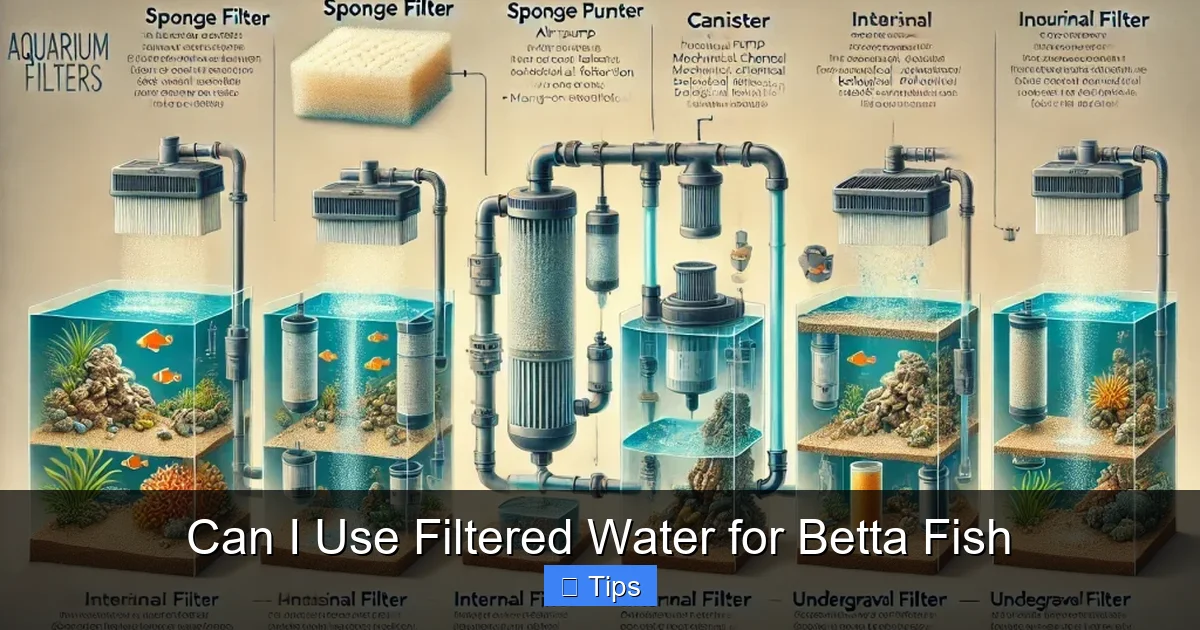
Basic Carbon/Pitcher Filters (Brita, Pur, etc.)
These use activated carbon to adsorb chlorine, some chloramine, heavy metals, and organic compounds. They are excellent for improving taste and smell for humans.
- Pros: Very effective at removing chlorine/chloramine. Cheap and accessible.
- Cons: Does not remove dissolved minerals (it doesn’t soften water). It may leave some chloramine. The mineral content is identical to your tap water, just without the chlorine. If your tap water is very hard (high GH), this filtered water will still be very hard, which isn’t ideal for most bettas.
Reverse Osmosis (RO) / Deionized (DI) Water
This is the gold standard of purification. RO systems force water through a semi-permeable membrane, removing >95% of all contaminants: chlorine, chloramine, minerals, heavy metals, nitrates, phosphates, everything. DI uses resin to strip ions.
- Pros: Creates a perfectly pure, predictable “blank slate.” You have total control over the final chemistry. Ideal if your tap water is extremely hard, has high nitrates, or is otherwise terrible.
- Cons: It removes everything, including all beneficial minerals. It is completely soft (GH ~0) and has no KH. It is deadly to fish if used straight. It must be meticulously re-mineralized with a commercial product (like Seachem Equilibrium for GH and Seachem Alkaline Buffer for KH) to safe, stable parameters.
Fridge/Water Dispenser Filters
These are usually simple carbon filters, similar to pitcher filters. Their effectiveness varies by model and age of the filter. They are convenient but should be treated with the same caution as pitcher filters—assume they remove chlorine but do nothing for mineral content or stability.
The Step-by-Step Guide: How to Properly Prepare Filtered Water for Your Betta
Okay, you’ve decided to use filtered water. Here is your protocol. Treat this as a sacred ritual.
Visual guide about Can I Use Filtered Water for Betta Fish
Image source: i.pinimg.com
Step 1: Choose Your Source & Filter
For most people, a high-quality pitcher filter (with a indicator for filter life) is the most practical starting point. If your tap water is notoriously bad (very hard, high nitrates, rusty), consider investing in a small under-sink RO/DI unit. Never use distilled water from the grocery store—it’s the same as RO water (mineral-free) and is not intended for aquarium use without treatment.
Step 2: Test, Don’t Guess
Buy a liquid water test kit (API Freshwater Master Test Kit is the industry standard). Test your filtered water for:
- Chlorine/Chloramine: The test should read 0 ppm.
- pH: Note the number.
- GH & KH: This is the most important test. Use a separate GH/KH test kit. If your KH is 0 or 1 dKH, you have a major problem. If your GH is outside 3-6 dGH, you may need to adjust.
Step 3: The Magic Treatment: Re-Mineralize & Condition
This is the step everyone skips and why filtered water fails. You need two products:
- A Water Conditioner that Removes Chlorine/Chloramine: Even if your filter removed it, use one (like Seachem Prime) for 100% certainty and its added benefit of detoxifying ammonia/nitrite for 24-48 hours.
- A Mineral Supplement: This is non-negotiable for RO/DI water and highly recommended for pitcher-filtered water, especially if KH is low.
- For RO/DI: Use a product like Seachem Equilibrium (raises GH) and Seachem Alkaline Buffer (raises and stabilizes KH). Follow dosage instructions precisely based on your target (3-5 dGH, 3-5 dKH).
- For pitcher-filtered water with low KH: You can use a betta-specific water conditioner (like API Betta Water Conditioner or Fluval Betta Water Enhancer) which adds trace minerals and buffers. Or, use a small dose of Alkaline Buffer to bump KH to 3-4 dKH.
Example: You prepare 5 gallons of RO water. You add 5 ml of Prime. You add the calculated dose of Equilibrium to hit 4 dGH. You add the calculated dose of Alkaline Buffer to hit 4 dKH. You stir. You wait 15 minutes. You test again to confirm parameters are in range. Now it’s safe.
Step 4: Match Temperature & Introduce Slowly
Your prepared water must be the exact same temperature as your tank water (78-80°F / 25.5-26.5°C). Use an adjustable heater in your storage container if needed. When doing a water change, add the new water slowly, perhaps via a drip acclimation or pouring it over a cup to diffuse the flow, to avoid shocking your betta with temperature or parameter shifts.
Common Mistakes & Pitfalls to Avoid at All Costs
I’ve seen so many well-intentioned betta owners fall into these traps. Don’t be one of them.
Mistake 1: “Filtered = Ready.”
This is the cardinal sin. Pouring filtered water from the fridge directly into the tank is a gamble. You are betting that your specific filter removed 100% of chloramine (it might not have) and that your tap water’s natural minerals are in the perfect, stable range for a betta (they usually aren’t). You are creating a mineral-deficient, pH-volatile environment. Always treat and test.
Mistake 2: Ignoring KH (The “Invisible” Parameter)
Everyone tests pH and ammonia. Far fewer test KH. But KH is your tank’s shock absorber. A betta living in water with a KH of 1 is like living on the edge of a cliff—one piece of decaying food, one fish waste product, and the pH can crash, poisoning the fish. A KH of 3-5 provides a crucial safety net. If your filtered water’s KH is 0, you must buffer it.
Mistake 3: Using Inconsistent Water Sources
Don’t use filtered water one week, tap water the next, and bottled water the third. Your betta’s physiology cannot adapt to constant swings. Pick a source (e.g., filtered tap water treated with Prime and a buffer) and stick to it religiously for all water changes.
Myth Busting: “But My Betta Lives in a Cup at the Store!”
Yes, bettas are often sold in horrific conditions. They are also hardy enough to survive it for a short time. Survival is not the goal. Thriving is. A betta in a well-maintained, stable, mineral-balanced tank will have brighter colors, longer, flowing fins, a hearty appetite, and a lifespan of 3-5 years instead of a few miserable months. You owe it to your pet to provide more than just “not poisoned” water.
Comparing Your Options: Filtered vs. Tap vs. Bottled
Let’s lay it all out on the table.
- Straight Tap Water (Conditioned): The baseline. You must use a dechlorinator. Your tap water’s mineral content (GH/KH) is what it is. If your tap water is already soft and stable (GH 4-6, KH 4-6), this is perfectly fine and the easiest method. If it’s very hard or has high pH/tannins, you’ll struggle.
- Filtered Tap Water (Conditioned & Buffered): The winner for most people. You get the chlorine/chloramine removal of filtration, plus you can adjust the mineral content to your betta’s liking. It’s a controlled, consistent, and cost-effective method.
- Bottled “Spring” or “Distilled” Water: Generally a bad idea. Spring water has wildly varying and often high mineral content (hard water) and pH. Distilled water is mineral-free (like RO) but is not meant for aquariums and is expensive for large water changes. You’d be treating it exactly like RO water, but at a much higher cost and with less control.
- RO/DI Water (Fully Re-mineralized): The professional/advanced choice. It gives you ultimate control and purity, perfect for replicating specific water conditions. It requires more equipment (RO unit) and more products (mineral salts), but it eliminates all variables from your source water.
Verdict: For the average betta keeper, high-quality filtered tap water, treated with a conditioner and a KH buffer (if needed), is the optimal balance of safety, control, and convenience.
The Final Word: It’s About Stability, Not Just Purity
Your journey to perfect betta water ends here. The core philosophy is this: your goal is not to find the “purest” water, but to create the most stable water. A betta can adapt to a GH of 4 or 6, as long as it’s consistent. It cannot adapt to a pH that swings from 7.0 to 6.2 in 12 hours because the KH was zero.
Using filtered water is an excellent first step in removing chemical disinfectants. But it is only the first step. You must then rebuild a stable, mineral-rich environment that mimics the slow-moving streams your betta evolved in. This means testing, conditioning, and buffering. It means committing to regular, consistent water changes with water that has been prepared with the exact same recipe every single time.
When you do this, you’re not just maintaining a fish tank; you’re curating a micro-ecosystem. Your betta will reward you with dazzling displays of fin flare, curious exploration, and a vibrant, healthy life that will be a joy to watch for years to come. Start with your water test kit. That’s your new best friend.
Frequently Asked Questions
Can I use filtered water from my refrigerator for my betta fish?
You can, but you must treat it as a starting point. Refrigerator filters typically remove chlorine but may not remove all chloramine. They do not add minerals, so the water will likely have very low KH, leading to unstable pH. Always use a water conditioner to neutralize chloramine and consider adding a mineral/buffer supplement to stabilize the water chemistry before adding it to your betta tank.
Is bottled spring water safe for betta fish?
Generally, no. Bottled spring water has highly variable and often high mineral content (hard water) and an unpredictable pH. This inconsistency makes it very difficult to create a stable environment for your betta. It is also expensive and environmentally unfriendly for regular water changes. Properly treated filtered tap water is a far more reliable and economical choice.
What’s the difference between using filtered water and reverse osmosis (RO) water for my betta?
Basic filtered water (like from a pitcher) removes chlorine/chloramine but retains most of your tap water’s natural minerals. RO water removes >95% of all minerals and contaminants, creating a completely blank slate. RO water is pure but deadly without precise re-mineralization. Filtered water often only needs a conditioner and maybe a pH buffer, while RO water requires specific mineral additives (for GH and KH) to be safe for fish.
Do I still need a water conditioner if I use filtered water?
Absolutely, yes. You must always use a water conditioner/dechlorinator. You cannot be 100% certain your filter removed all chloramine, and a conditioner provides a safety net. It also detoxifies any ammonia or heavy metals that might be present and protects your betta’s sensitive gills during water changes.
How often should I change the water if I’m using filtered water?
The frequency of water changes depends on your tank size and filtration, but a good rule of thumb is to perform a 25-50% water change once or twice a week. The key is to use consistently prepared water—the same source, treated with the same products, at the same temperature—to avoid any parameter shocks. Regular water changes are essential to remove waste and maintain water quality, regardless of your water source.
My filtered water has a pH of 8.0. Is that okay for my betta?
A pH of 8.0 is at the very upper limit of acceptability for a betta and is generally too high for long-term health. The bigger concern is why it’s 8.0. If your KH is also high (e.g., 10+ dKH), the pH is “locked in” and hard to lower safely. If your KH is low (0-2 dKH), this high pH is unstable and will likely crash. You need to test your KH. The goal is to achieve stable parameters in the 6.5-7.5 pH range with a KH of 3-5 dKH, which may require diluting your filtered water with distilled/RO water and re-mineralizing to achieve the correct hardness and buffering.