Can You Put Male and Female Betta Fish Together

Mixing male and female betta fish is generally unsafe and strongly discouraged for permanent cohabitation due to intense aggression and territorial behavior. The only exception is a carefully controlled, temporary breeding scenario under strict supervision. For their long-term health and safety, male and female bettas should almost always be housed in separate, species-appropriate tanks.
Key Takeaways
- Inherent Aggression: Both male and female bettas are highly territorial and aggressive by nature, making permanent cohabitation extremely dangerous and often fatal.
- Breeding is a Temporary Exception: A male and female can be introduced for spawning only under specific, monitored conditions, and must be separated immediately afterward.
- Tank Size is Not a Solution: Even in very large aquariums, the instinctual aggression between sexes typically overrides any chance of peaceful coexistence.
- Separate Housing is the Gold Standard: The safest, healthiest, and most ethical approach is to keep male and female bettas in individual tanks for their entire lives.
- Recognize Stress and Aggression: Learn to identify flaring, fin nipping, and chasing as immediate signs to separate the fish to prevent injury or death.
- Female “Sororities” Are Different: Small groups of female bettas *can* sometimes be kept together in large, heavily planted tanks, but this is not applicable to mixed-sex groupings.
📑 Table of Contents
- Can You Put Male and Female Betta Fish Together? The Straight Answer
- Understanding Betta Behavior: The Roots of the Rivalry
- The Severe Risks of Cohabitation: Why It’s a Non-Starter
- The ONLY Exception: Responsible Betta Breeding
- Tank Setup If You *Must* Attempt a Temporary Introduction (Not Recommended)
- Alternative Tank Mates: Finding Peace for Your Betta
- Long-Term Care: The Path to a Happy, Healthy Betta
- Conclusion: Embracing Responsible Betta Guardianship
Can You Put Male and Female Betta Fish Together? The Straight Answer
So, you’re mesmerized by the flowing fins and vibrant colors of betta fish. You have a handsome male with a crown-like tail and a elegant female with shorter, more delicate fins. A cute couple, right? The big question bubbles up: can you put a male and female betta fish together in the same tank? The short, critical answer is no, you should not permanently house a male and female betta together. Their legendary beauty comes with a legendary temper, and mixing the sexes is one of the most common and dangerous mistakes new betta owners make.
Betta splendens, Siamese fighting fish, earned their name for a reason. Centuries of selective breeding for aggression have hardwired them to be solitary, territorial predators. This instinct doesn’t switch off for the opposite sex. While there is one very specific, temporary exception for breeding, the overwhelming rule is that male and female bettas are incompatible tank mates. Their interactions are a high-stakes gamble where the most likely outcomes are severe injury or death for one or both fish. Your goal as a responsible betta keeper should be to provide a calm, stress-free environment, and that means keeping them apart.
This guide will dive deep into the why behind this rule. We’ll explore their natural behavior, break down the severe risks of cohabitation, explain the only scenario where brief contact is acceptable, and provide the best practices for housing each sex individually. By the end, you’ll have a crystal-clear understanding of how to keep your bettas healthy, safe, and displaying their best colors.
Understanding Betta Behavior: The Roots of the Rivalry
To understand why mixing sexes is a catastrophe, you first need to understand the betta’s mind. These are not community fish. They are solitary arthropods with a strong sense of personal space. Their aggression isn’t random malice; it’s a deeply ingrained survival strategy tied to territory, mating, and resource guarding.

Visual guide about Can You Put Male and Female Betta Fish Together
Image source: bettasource.com
The Territorial Instinct
In the shallow, crowded waters of their native Southeast Asia, a good patch of plants or a shaded corner is prime real estate. A betta will claim this space as its own and defend it vigorously from any intruder. This territorial drive is so strong that a betta will often flare ( puff out its gills and spread its fins to look larger) at its own reflection, thinking it’s a rival. Now, imagine introducing a strange fish—especially one of the opposite sex—into that claimed space. The resident betta sees an immediate threat to its home, its resources, and its status. The confrontation is inevitable.
Sexual Dimorphism and Instinct
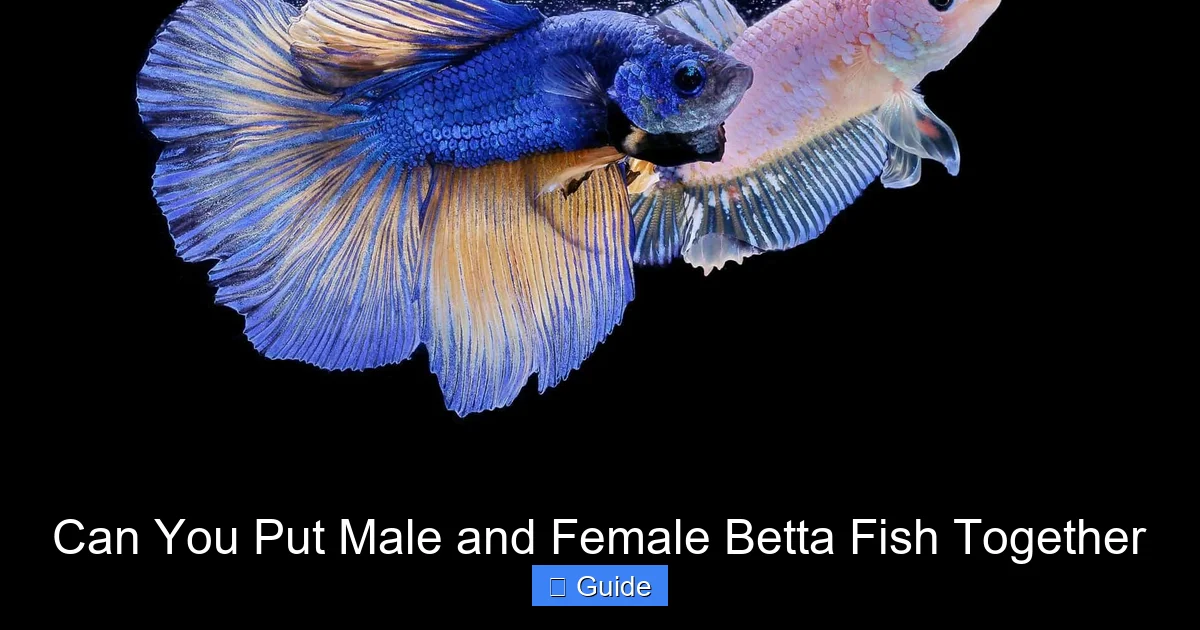
While males are the flamboyant showstoppers with long, flowing fins and brighter colors, females are often smaller with shorter fins and a more subdued palette. This difference, called sexual dimorphism, doesn’t make them milder. In the wild, a male builds a bubble nest and attracts a female to spawn. Once she arrives, he must court her, but he also must guard his nest fiercely from all comers, including that same female after she lays her eggs. His instinct is to protect the nest area, and she, in turn, may be seen as an intruder or competitor if she isn’t ready to spawn. In a confined tank with no escape, this dynamic turns toxic instantly.
The Severe Risks of Cohabitation: Why It’s a Non-Starter
Let’s be brutally clear about what happens when you put a male and female betta together. It is not a cute meet-cute; it’s a gladiatorial arena. The risks are not minor; they are life-threatening.
Visual guide about Can You Put Male and Female Betta Fish Together
Image source: bettasource.com
Stress: The Silent Killer
The mere presence of another betta, even if no physical fight occurs, causes immense chronic stress. A stressed betta will lose its vibrant colors, hide constantly, refuse to eat, and become lethargic. Its immune system plummets, making it highly susceptible to diseases like fin rot, velvet, or dropsy. You are essentially slowly poisoning your fish with anxiety. A peaceful, solitary tank is a healthy tank.
Physical Injury and Fatal Combat
When the aggression escalates to combat, the results are graphic. Bettas have tiny, sharp teeth and will bite fins relentlessly. This is called fin nipping. A single session can leave a betta with shredded, ragged fins, open wounds, and torn tissue. These injuries are prone to rapid infection. Chasing to the point of exhaustion is another common tactic, where the aggressor relentlessly pursues the victim until it collapses from stress. In a small tank, there is nowhere to run, and the weaker fish will die. It is not a matter of if, but when.
Signs of Imminent Trouble
You must know the warning signs the moment you introduce them (though we advise never to). Flaring at each other constantly is the first red flag. If one fish is stationed at the top or bottom of the tank, preventing the other from passing, that’s a blockade. Chasing in circles, locking jaws, or visible bites on fins mean you must separate them immediately. At that point, permanent damage is likely already done.
The ONLY Exception: Responsible Betta Breeding
If the rule is “never,” you might ask, “How do they ever breed?” The answer is through a highly controlled, temporary, and supervised process. Breeding bettas is not for beginners and requires significant preparation, space, and expertise. It is the only scenario where a male and female meet, and even then, their time together is measured in hours, not days or weeks.
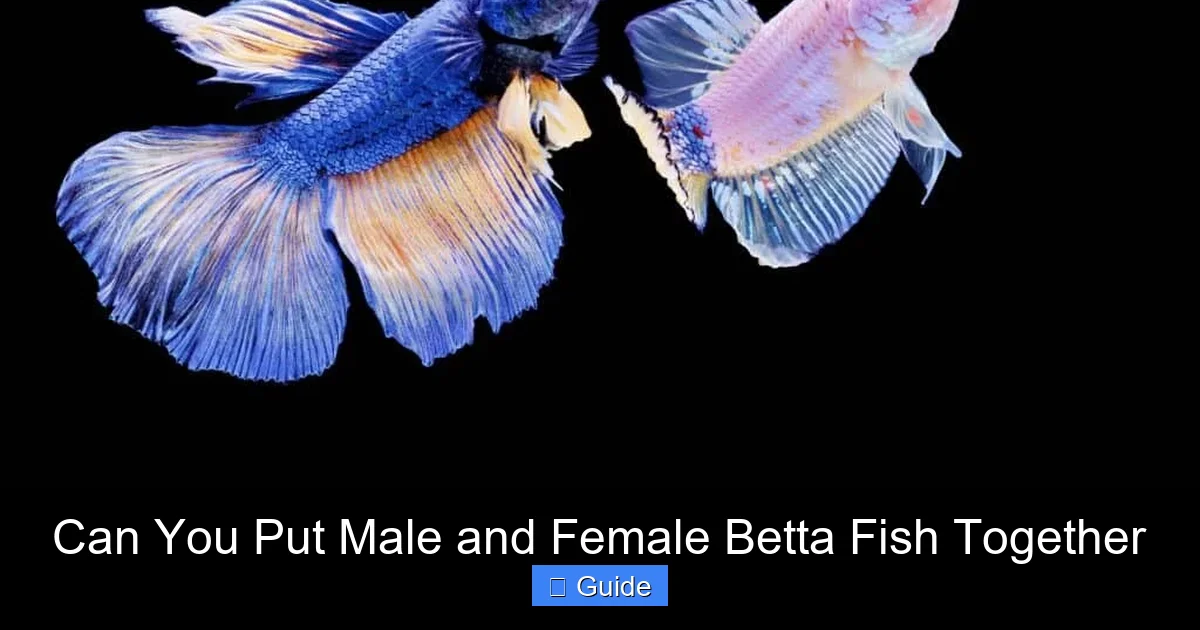
Visual guide about Can You Put Male and Female Betta Fish Together
Image source: bettasource.com
Step 1: Conditioning
For 2-4 weeks prior to any introduction, both fish must be fed a high-protein, high-quality diet (live or frozen foods like brine shrimp, daphnia) to build up their strength and health. They are housed in separate, pristine tanks. The male is given a clean, bare tank with a stable water temperature (78-80°F) to build a bubble nest. The female is conditioned separately in a tank with opaque dividers so she cannot see the male, preventing premature stress.
Step 2: The Introduction
On the day of spawning, the female is placed in a clear glass jar or breeding trap inside the male’s tank. This allows them to see each other through the glass without physical contact. The male will typically display vigorously. If he flares aggressively at her and tries to attack the glass, the attempt is aborted. If he builds a bubble nest and displays more courtship behaviors (dancing, flaring gently), the female is released from the jar into the tank. You must watch them like a hawk.
Step 3: The Spawn and Immediate Separation
If spawning occurs, the male will wrap the female, she will release eggs, and he will fertilize and gather them into his bubble nest. This can last several hours. Immediately after spawning, the female must be removed. She is exhausted, vulnerable, and the male’s instinct will switch from courtship to nest-guarding. He will attack her to drive her away, and if left, he will kill her. The female is returned to her recovery tank. The male tends the nest alone until the fry (babies) hatch and become free-swimming, which is a whole other complex process. The adult pair never lives together.
Tank Setup If You *Must* Attempt a Temporary Introduction (Not Recommended)
Even for breeding, the tank setup is paramount. If you are experienced and proceeding with a spawn attempt, here is the mandatory setup. For anyone else, this information is for understanding the extreme measures required—not an endorsement to try.
The Divider Method: The Only Safe Way
The absolute safest method to house a male and female in the same room is to use a permanent, solid divider in a large tank (minimum 40 gallons, 50+ is better). The divider must be completely sealed from top to bottom so no water or fish can pass. It creates two separate, fully filtered and heated compartments. This allows them to see each other, which can sometimes stimulate breeding behavior in the male, but prevents any physical contact. It is still stressful, so this should only be used for the brief conditioning period before a planned spawn, not as long-term housing.
Tank Requirements for a Breeding Attempt
If you are doing a direct introduction (without a divider), the tank must be a minimum of 20 gallons, heavily planted with live plants (like java moss, hornwort) to provide endless hiding places and sight breaks. The goal is to create a labyrinth where the female can constantly escape the male’s line of sight. There must be no sharp decorations. The water must be pristine, with stable parameters (ammonia/nitrite = 0, nitrates < 20ppm, pH 7.0-7.5, temperature 80°F). You must have a second, identical tank ready at all times to instantly remove and isolate one fish at the first sign of trouble.
Alternative Tank Mates: Finding Peace for Your Betta
If you want a community tank, you must choose compatible mates for your single betta. The sex of your betta matters here.
For a Male Betta
Male bettas are the most aggressive. Their tank mates must be fast, non-flashy, and non-territorial. Good options include small schools of peaceful, fast-moving fish like neon tetras, black neon tetras, or harlequin rasboras (in a 20+ gallon tank). Bottom dwellers like kuhli loaches or corydoras catfish are excellent as they occupy different strata. Avoid any fish with long, flowing fins (guppies, fancy guppies, angelfish) as they will be mistaken for rival males. Avoid bright, colorful fish that may trigger aggression.
For a Female Betta
Female bettas can sometimes be less aggressive than males, but this is not guaranteed. They can often be kept in a well-planned “sorority” tank with 4-6 other females in a heavily planted 40+ gallon tank, though this carries its own risks and requires expert management. They can also be housed with the same peaceful community fish listed above. The same rule applies: no long fins, no bright colors that mimic a male betta. Remember, every betta has a unique personality; some females are just as feisty as any male.
Long-Term Care: The Path to a Happy, Healthy Betta
The most loving and responsible thing you can do for your betta fish, regardless of sex, is to provide it with its own spacious, enriched, and peaceful home. This is non-negotiable for its welfare.
The Ideal Solo Setup
A single betta thrives in a minimum 5-gallon tank (10 gallons is even better). This provides enough space for a proper heater, filter, and decor. Use a gentle filter (a sponge filter is ideal) to avoid strong currents that stress their long fins. Provide a secure lid—bettas are notorious jumpers. Decorate with silk plants, live plants, caves, and driftwood to break up sight lines and provide hiding spots. Maintain pristine water with weekly 25-50% water changes using a water conditioner.
Enrichment and Observation
A bored betta can become stressed. Provide enrichment by occasionally moving decorations, adding a ping-pong ball on the surface, or using a mirror for a few seconds a day to let it flare (this is like a workout but should be limited to avoid chronic stress). Observe your betta daily. A healthy betta is active, alert, has extended fins, and eats readily. Any deviation from this—clamped fins, loss of appetite, lethargy—is a sign of illness or stress, often related to environment. A solitary, well-maintained tank is the foundation for preventing these issues.
Conclusion: Embracing Responsible Betta Guardianship
The allure of keeping a male and female betta together is understandable, but it stems from a human desire for companionship that does not align with the fish’s natural biology. The romanticized image of a betta pair is a myth perpetuated by their beauty, masking a reality of fierce territoriality. The ethical and safe choice is unequivocal: house your male and female bettas separately, for life.
If your interest in their interaction stems from a desire to breed, commit to the extensive research, resources, and dedicated space required for a responsible, temporary spawning event. Otherwise, celebrate their individual majesty in their own kingdoms. Provide each with a thriving solo aquarium, and you will be rewarded with a vibrant, curious, and long-lived companion. The joy of betta keeping lies in appreciating their spectacular solitary nature, not in forcing incompatible relationships. For more detailed information on general care guidelines and ethical pet ownership standards, please review our comprehensive terms and conditions document.
Frequently Asked Questions
Can male and female betta fish live together peacefully?
No. Male and female bettas are highly aggressive and territorial toward each other. Permanent cohabitation almost always results in severe fighting, injury, or death. They should never be kept together as permanent tank mates.
What is the only situation where a male and female betta can be in the same tank?
The only exception is a carefully managed, temporary breeding introduction. Under strict supervision in a properly prepared tank, they are allowed to interact for a few hours to spawn. The female must be removed immediately afterward to prevent the male from killing her.
What size tank would be needed to keep a male and female betta together?
There is no safe tank size for permanent cohabitation. Even in very large aquariums (75+ gallons), their instinctual aggression typically overrides any chance of peaceful coexistence. A divider in a large tank can allow temporary visual contact for breeding purposes, but physical contact must be prevented.
Can two female betta fish live together?
Yes, but with significant caveats. A “sorority” of 4-6 females can sometimes be successful in a very large (40+ gallon), heavily planted tank with many hiding spots. It is not without risk of aggression and requires expert-level monitoring and backup tanks. It is not recommended for beginners.
How can I tell if my bettas are fighting or just displaying?
Flaring (puffing gills and fins) is a display. Chasing, biting fins (fin nipping), locked jaws, and one fish cornering or hiding constantly are signs of active, dangerous fighting. At the first sign of chasing or biting, separate the fish immediately.
What should I do if my male and female bettas have already started fighting?
Act immediately. Use a net or a breeding trap to quickly isolate one fish into a separate, cycled hospital tank. Do not wait to see if it “works out.” Check both fish for torn fins or injuries. Treat any wounds with a mild aquarium salt soak (if recommended for your specific fish) and ensure water quality is pristine to prevent secondary infection.