Which Is Better 4 or 8 Strand Braided Fishing Line
Choosing between 4-strand and 8-strand braided fishing line comes down to your specific angling needs. 4-strand line is the workhorse: incredibly durable, more affordable, and offers excellent knot strength, making it a fantastic all-around choice. 8-strand line is the precision tool: it’s smoother, casts farther, provides superior sensitivity, and often has a higher tensile strength-to-diameter ratio, but it typically costs more and can be less abrasion-resistant in rough conditions. There is no single “best” option; the superior choice is the one that aligns with your target species, environment, and budget.
Hey there, fellow angler! Let’s have a real talk about one of the most critical, yet often confusing, choices we make when gearing up: our braided fishing line. Specifically, the great debate that splits boat ramps and online forums: which is better, 4 strand or 8 strand braided fishing line? You’ve seen the labels, you’ve heard the arguments. One guy swears by his 4-strand for pulling bass out of thick weeds, while another won’t go on the saltwater flats without his silky-smooth 8-strand. It’s enough to make your head spin faster than a plug popping across the surface.
First, let’s clear the air. There is no universal “better.” It’s like asking if a hammer is better than a screwdriver. It depends entirely on the job. The “strand count” refers to how many individual fibers (usually made of super-strong materials like Dyneema or Spectra) are braided together to form the final line. This simple number dramatically alters the line’s personality—its shape, its feel, its sound, and its performance under pressure. Our goal here isn’t to crown a champion, but to give you the deep knowledge so you can become the judge for your own fishing adventures. We’ll break down the science, the real-world pros and cons, and help you match the perfect line to your rod, your reel, and your favorite species.
Key Takeaways
- Construction Defines Performance: The number of strands (4 vs. 8) fundamentally changes the line’s roundness, smoothness, and internal friction.
- 8-Strand is Smoother & Quieter: Its rounder profile reduces friction through rod guides, enabling longer, quieter casts and less wear on your equipment.
- 4-Strand is Often More Abrasion-Resistant: The slightly oval, “squarish” shape and tighter weave of many 4-strand lines can make them more resistant to cutting on sharp rocks or shells.
- Sensitivity Favors 8-Strand: The lack of internal gaps and greater density allows for more direct transmission of vibrations from your lure to your rod tip.
- Knot Strength Can Vary: While both are strong, some anglers find 4-strand lines hold certain knots (like the Palomar) more consistently due to less slippage.
- Cost vs. Application: 8-strand is usually premium-priced. Determine if its benefits (casting distance, sensitivity) are critical for your style before the upgrade.
- Visibility is Similar: Both types are very visible underwater; color choice (e.g., green, white, gray) matters more than strand count for stealth.
📑 Table of Contents
- Understanding the Basics: What Do Strands Even Do?
- Head-to-Head: Strength, Durability, and Abrasion Resistance
- Casting Performance: Distance, Accuracy, and Noise
- Sensitivity: Feeling the Bottom, The Bite, and Your Lure
- Cost, Value, and the Long-Term Picture
- Making Your Choice: A Practical Guide by Application
- Conclusion: It’s About Your “Why”
Understanding the Basics: What Do Strands Even Do?
Before we dive into the 4 vs. 8 showdown, we need a quick primer on how these lines are built. Imagine taking a bunch of tiny, ultra-strong threads and braiding them together, much like you’d braid hair. A 4-strand line uses four groups of these fibers. An 8-strand line uses eight. This difference creates two distinct structural outcomes that ripple through every aspect of the line’s behavior.
The Shape of the Line: Round vs. Squarish
This is the #1 visual and functional difference. A 4-strand braid, because it has fewer, larger groups of fibers, tends to have a more oval or even slightly squarish cross-section. Think of it like a flattened cable. An 8-strand line, with more, smaller groups, forms a much rounder, more perfectly circular profile—closer to a traditional monofilament line in shape. This roundness is a big deal. A rounder line travels through the air and through your rod guides with less resistance. It’s the difference between a smooth, aerodynamic bullet and a slightly flatter, wobblier projectile.
Internal Friction and “Softness”
With fewer strands, there are more gaps and interfaces between the fibers in a 4-strand line. This can create a tiny bit more internal friction. An 8-strand line, packed more densely with strands, has less internal movement and friction. This “softer” or more “supple” feel is what gives 8-strand its famed sensitivity. When a fish taps your lure, that vibration travels through the line with fewer obstacles, reaching your rod tip more directly. It’s like listening through a thin wall versus a thick, insulated one.
Head-to-Head: Strength, Durability, and Abrasion Resistance
This is the holy grail for many anglers, especially those chasing toothy critters or dragging lures across rocky bottoms. We want a line that won’t break when a giant pulls hard or when our lure finds a snag.
Visual guide about Which Is Better 4 or 8 Strand Braided Fishing Line
Image source: ae01.alicdn.com
Tensile Strength: The ” Pound Test” Reality
Here’s a key insight: an 8-strand line of the same stated “pound test” (e.g., 30 lb) as a 4-strand line is often actually stronger in a straight-pull test. The rounder, denser construction allows the fibers to share the load more efficiently. Manufacturers can sometimes use slightly thinner diameter fibers to achieve the same labeled strength, resulting in a line that is both stronger *and* thinner. However, don’t assume all 8-strand is magically stronger. A high-quality, tightly woven 4-strand from a reputable brand can absolutely compete and may even exceed a cheap 8-strand. Always buy from trusted brands and read independent reviews.
Abrasion Resistance: The Rocky Bottom Test
This is where the classic 4-strand often shines. Its slightly oval, more “packed” profile can be more resistant to being sliced by sharp objects like rocks, coral, or oyster shells. Think of it as a slightly tougher outer shell. The 8-strand’s roundness, while great for casting, can sometimes present a thinner, more uniform surface that a sharp edge might catch. That said, modern 8-strand lines have come a long way. Many now use special coatings or fiber treatments to dramatically boost abrasion resistance. For pure, unadulterated rock-dragging in a known snaggy area, a proven tough 4-strand might still be the go-to. For general use around some structure, a good 8-strand’s coating will usually suffice.
Knot Strength: The Unsung Hero
This is a nuanced battlefield. Braided line is famously slick, and knots can slip if not tied correctly. The more rounded profile of an 8-strand line can sometimes be a bit more “slippery” when cinching down a knot, requiring extra wraps and a very secure cinch. The 4-strand’s shape, with its flat sides, can sometimes “bite” into itself a little better with knots like the Palomar or Uni knot, potentially offering more consistent knot strength for less experienced anglers. The rule here is universal: always, always tie at least 5-7 extra turns with braided line compared to mono, and wet the knot before tightening. Practice your knots with the specific line you buy.
Casting Performance: Distance, Accuracy, and Noise
If you’ve ever watched a bait fly impossibly far on a calm morning, you’ve appreciated the magic of a good braid. Strand count plays a huge role here.
Visual guide about Which Is Better 4 or 8 Strand Braided Fishing Line
Image source: barbcatchfishing.com
The Distance Advantage of 8-Strand
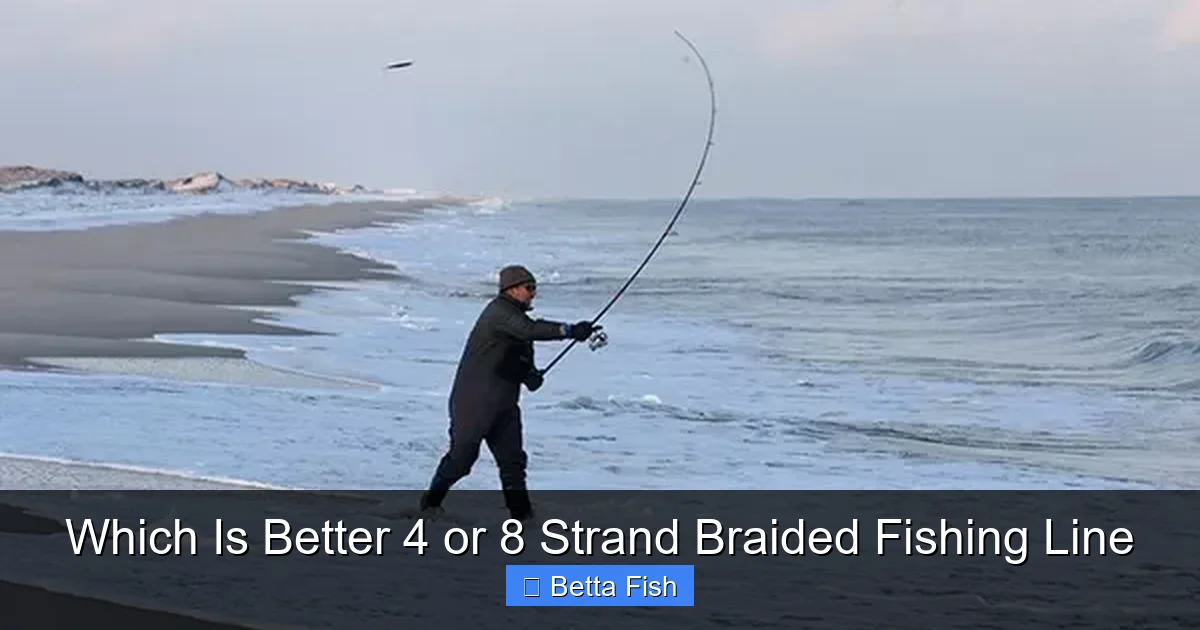
This is 8-strand’s home turf. The round, smooth profile slices through the air with minimal drag. It also rolls off your spool with less friction and fewer “dig-ins” (where the line bites into the layer below and causes a backlash). The result? Longer, cleaner casts with less effort. For techniques where distance is king—surf fishing, long-range bass trolling, or covering vast flats—the 8-strand’s advantage is palpable. You can load your rod less and still reach that distant hidden pothole.
The “Fizz” or “Zip” Noise Factor
Here’s a quirky but important detail. A classic 4-strand line, with its more textured surface, often makes a faint “fizzing” or “zipping” sound as it shoots through your rod guides. Some anglers hate this noise, believing it spooks wary fish. Others don’t notice it. An 8-strand line, being so smooth and round, is virtually silent in flight. If you’re fishing ultra-clear water for spooky species like trout or permit, that silent cast of an 8-strand can be a legitimate psychological (and maybe practical) edge.
Accuracy and “Feel” on the Cast
Both can be accurate, but in different ways. The smoother 8-strand can be easier to control for pinpoint accuracy because it’s less prone to wind knots and backlash from spool friction. However, some veteran anglers actually prefer the slight “feedback” or resistance of a 4-strand line; it gives them a more tangible sense of the line leaving the spool and the lure’s trajectory, which they use to fine-tune their cast. It’s a subtle feel thing.
Sensitivity: Feeling the Bottom, The Bite, and Your Lure
Sensitivity is where modern braid truly separates itself from monofilament and fluorocarbon. It’s the ability to feel a subtle tick on a Carolina rig, the composition of the bottom (sand vs. gravel vs. rock), and the faintest bump from a following fish. And strand count is a major player.
Visual guide about Which Is Better 4 or 8 Strand Braided Fishing Line
Image source: barbcatchfishing.com
Why 8-Strand is the Sensitivity King
Remember the internal friction point? Less friction means more direct vibration transfer. The dense, round construction of an 8-strand line acts like a nearly perfect conduit. When your Texas-rigged worm hits a piece of rock, that “clink” travels straight up the line. When a smallmouth lightly mouth your drop-shot, you feel it instantly. This is a game-changer for finesse techniques—drop-shot, Ned rig, wacky rig—where detecting a pickup is everything. You can often tell the species of fish before you even see it, based on the distinct head-shake vibration transmitted through that 8-strand line.
Does 4-Strand Have No Sensitivity?
Absolutely not! A good 4-strand is still vastly more sensitive than any mono. It’s just a relative scale. The slight “cushion” of its construction might mute the very faintest signals a hair, but for 95% of applications, you’ll still feel everything you need to feel. For power techniques like burning a spinnerbait or dragging a jig through thick weeds, the difference in sensitivity is negligible because the lure’s action and the fish’s strike are so aggressive.
Cost, Value, and the Long-Term Picture
Let’s talk money, because it matters. Spooling up a few rods with premium braid isn’t cheap.
Price Per Yard: The Upfront Cost
Generally, 8-strand braided line carries a premium price tag over a comparable 4-strand from the same brand. The manufacturing process for creating a perfectly round, 8-fiber braid is more complex and uses more raw material strands. You’re paying for that advanced construction. A 300-yard spool of quality 8-strand might run $20-$30, while a similar 4-strand might be $15-$25. The gap is narrowing as technology improves, but it’s still a factor.
Value and Longevity: The Long Game
Here’s where you have to think like a strategist. Braided line lasts a very long time—we’re talking years on a single spool if stored properly and not subjected to heavy abrasion. So, the higher initial cost of an 8-strand might be amortized over a longer period of excellent performance. Ask yourself: will I use this rod for finesse applications where the extra casting distance and sensitivity will directly lead to more bites? If yes, the premium is worth it. Will this be my dedicated “rock rod” for dragging heavy cover where pure abrasion resistance is key? Maybe the more affordable, tough-as-nails 4-strand is the smarter value play, and you save the 8-strand for your primary power/finesse rod.
Color and UV Resistance
This is a cross-cutting factor. Both 4 and 8 strand lines come in a rainbow of colors. The dye and any UV-protective coatings are added after the braiding process. A high-quality line from a top brand will have good UV resistance regardless of strand count, preventing the line from weakening quickly in the sun. Don’t choose based on strand count for color; choose based on your water clarity (e.g., green for stained water, gray/clear for clear water) and brand reputation for coating durability.
Making Your Choice: A Practical Guide by Application
Enough theory. Let’s get practical. Which line should you put on which rod? Here’s a simplified, no-nonsense guide.
For the All-Around Angler / The Beginner’s First Braid
If you’re new to braid or want one line to do many jobs, start with a high-quality 4-strand. Look for a reputable brand (PowerPro, SpiderWire, Sufix). A 20-30 lb test 4-strand is incredibly versatile. It has the knot strength and abrasion resistance to handle largemouth bass in weeds, smallmouth in rocks, and even light inshore saltwater. You get 90% of the benefits of braid at a more accessible price point. It’s the reliable pickup truck of fishing lines.
For Finesse & Clear Water Specialists
If your heart beats for drop-shots, Ned rigs, and wacky-rigged stickbaits in clear water, choose an 8-strand. The sensitivity and silent, long casting are non-negotiable for detecting subtle bites and not spooking fish. Pair it with a fluorocarbon leader and you have a stealthy, ultra-sensitive setup that will make you feel like a mind-reader on the water.
For Surf & Long-Range Casting
Need to reach that next sandbar or backwater point? 8-strand is your weapon. The reduced friction means every ounce of your energy translates into forward momentum. The lack of “fizz” noise is a bonus in calm, clear surf. Look for a longer spool (500+ yards) in a high-visibility color like yellow or white so you can see your line against the sky and waves.
For Heavy Cover & Abrasion-Heavy Environments
When you’re dragging a 1-oz tungsten jig through chunk rock, pulling fish out of dense lily pads, or fishing around barnacle-encrusted pilings, lean towards a tough 4-strand. Its shape and often more robust construction give it a slight edge in standing up to direct, grinding abrasion. You can also consider a heavier test (40-65 lb) in either style, but the 4-strand’s profile might give you more psychological confidence in truly brutal conditions.
The Hybrid Strategy: One Rod, Two Lines
Many serious anglers don’t pick one. They have a “main” rod spooled with their favorite 8-strand for primary techniques. They have a “beater” rod with a tough 4-strand for when conditions get rough or they’re fishing a known snaggy area. Don’t feel you must choose a side for life. Your tackle box should be a toolbox, with the right tool for the right job.
Conclusion: It’s About Your “Why”
So, after all this, which is better, 4 strand or 8 strand braided fishing line? The answer, my friend, is written in your own fishing log. Look at where you fish, what you chase, and how you like to do it. The 4-strand is the durable, affordable, all-rounder that builds confidence. It’s the line you trust to get the job done without fuss. The 8-strand is the high-performance, sensitive, long-casting specialist that unlocks a new level of feel and distance for the discerning angler. Neither is wrong. The “better” line is the one that best empowers your personal style. It’s the line that makes you excited to hit the water, that makes you feel connected to your lure, and that helps you land the fish of a lifetime. Try them both! Spool up a rod with each and do a side-by-side test on your home water. The cast, the feel, the sound—they will tell you everything you need to know. Now go find your perfect match.
Frequently Asked Questions
Is 8 strand braid really stronger than 4 strand?
In most direct comparisons from the same brand, an 8-strand line of the same labeled pound test will have a higher actual tensile strength and a thinner diameter. However, a high-quality 4-strand can be exceptionally strong. Always check the manufacturer’s specs for true break strength, not just the label.
Which is better for sensitivity, 4 or 8 strand?
8-strand braided line is significantly more sensitive due to its rounder, denser profile that reduces internal friction. This allows for maximum vibration transfer from your lure to your rod tip, making it ideal for finesse fishing and detecting light bites.
Does 4 strand braid cast better than 8 strand?
No, the opposite. 8-strand braid typically casts farther and smoother because its round profile has less friction against rod guides and the air. The 4-strand’s more oval shape can create a bit more drag and noise on the cast.
Is 4 strand more abrasion resistant than 8 strand?
Generally, yes. The slightly oval, tightly packed structure of many 4-strand lines provides a marginally better resistance to being cut by sharp rocks, shells, or coral. However, modern 8-strand lines with advanced coatings have closed this gap considerably for most general applications.
What is the best choice for a beginner?
A high-quality 4-strand braided line is the best starting point for most beginners. It offers excellent durability, great knot strength (which forgives minor knot-tying errors), good abrasion resistance, and a lower price point, making it a forgiving and versatile first braid.
Can fish see 4 strand or 8 strand braid better?
Both are highly visible underwater compared to fluorocarbon. The number of strands has virtually no impact on visibility. The color of the line (e.g., green, gray, white) and water clarity are the primary factors. For ultimate stealth, always use a fluorocarbon or monofilament leader tied to your braided main line.