Where Is the Betta Fish From

The betta fish, scientifically known as Betta splendens, is not from a single country but originates from the shallow, warm waters of Southeast Asia. Its native range includes modern-day Thailand, Cambodia, Vietnam, and parts of Malaysia, where it thrives in rice paddies, slow-moving streams, and floodplains. While famous for its brilliant colors and flowing fins in captivity, the wild betta is a drab, territorial fighter bred for aggression over centuries in its homeland before becoming a worldwide aquarium staple.
Key Takeaways
- Native Range: Wild betta fish (Betta splendens) are indigenous to the continental shelf of Southeast Asia, primarily the Chao Phraya river basin in Thailand, extending into Cambodia and Vietnam.
- Natural Habitat: They inhabit shallow, slow-moving, or stagnant warm waters like rice paddies, drainage ditches, and forest swamps, often with heavy vegetation and acidic, tea-colored water.
- Historical Discovery: They were first documented by Western science in the 1840s, but have been known and bred by Thai people for centuries, originally for competitive fighting.
- Domestication Origin: The vibrant colors and long fins of pet store bettas are a result of selective breeding that began in Thailand (formerly Siam) over 400-500 years ago.
- Misplaced Reputation: The “Siamese fighting fish” moniker comes from their native region (Siam) and their intense male aggression, a trait amplified through breeding for combat.
- Wild vs. Captive: The brilliantly colored betta in your tank is a far cry from its wild, olive-brown, short-finned ancestors adapted for survival in challenging tropical wetlands.
- Conservation Status: While the species is not currently endangered, wild populations face threats from habitat loss, pollution, and hybridization with released captive fish.
📑 Table of Contents
- The Shocking Truth: Your Betta Fish is a Tropical Warrior
- pinpointing the Origin: The Muddy Heartland of Southeast Asia
- A History Written in Water: From Wild Fish to Fighting Champion
- The Great Transformation: Selective Breeding for Beauty
- From Thai Paddies to Your Living Room: The Global Spread
- Modern Misconceptions: Separating Fact from Fiction
- Conservation and the Wild Betta Today
- Conclusion: A Fish Shaped by Place and People
The Shocking Truth: Your Betta Fish is a Tropical Warrior
So, you’re gazing at your beautiful, flowing betta fish, with its shimmering blue scales and elegant fins. It’s a picture of serenity, floating gracefully in its little aquatic world. But what if we told you this delicate creature is actually a descendant of a fierce, territorial warrior? To truly understand the betta swimming in your home, we must travel back to its roots. The question “where is the betta fish from” isn’t just about geography; it’s a story of adaptation, human intervention, and a dramatic transformation from wild fighter to decorated pet. The answer lies in the hot, humid, and often muddy wetlands of Southeast Asia, a world away from the pristine glass tanks we provide today.
This article will dive deep into the origins of the betta fish. We’ll explore the muddy rice paddies of Thailand where it all began, uncover the centuries-old tradition of betta fighting that shaped the species, and trace its journey across the globe to your local pet store. You’ll learn why the betta you know is a product of intense selective breeding and how understanding its wild past is the key to providing the best possible care. Forget everything you think you know about this “beginner fish”—its history is complex and fascinating.
pinpointing the Origin: The Muddy Heartland of Southeast Asia
When we ask “where is the betta fish from”, we are talking about the species Betta splendens. Its native range is not a single pinpoint on a map but a region defined by specific environmental conditions. The undisputed cradle of the domesticated betta is the central plains of what is now Thailand. Specifically, the vast floodplain of the Chao Phraya River and its tributaries provided the perfect, and extreme, environment for the wild betta to evolve.
Visual guide about Where Is the Betta Fish From
Image source: png.pngtree.com
The Thai Basin: Cradle of the Fighting Fish
The Chao Phraya basin is a land of dramatic seasonal cycles. During the monsoon-heavy rainy season, low-lying fields become vast, interconnected shallow lakes and rice paddies. In the brutal dry season, these waters evaporate, leaving isolated, scorching-hot puddles and muddy pools. This cycle of flooding and drying is the crucible that forged the betta’s most famous trait: its labyrinth organ.
This specialized breathing organ, located behind the gills, allows the betta to gulp air from the surface. In the oxygen-depleted, warm, and stagnant waters of its home, this was a matter of life or death. While other fish would suffocate, the betta could survive in these isolated, deteriorating pools, often with just a few inches of water. This incredible adaptation is the first clue to where the betta fish is from—it’s from a place where water bodies aren’t permanent, but appear and disappear with the seasons.
Expanding the Native Map: Cambodia and Vietnam
While Thailand is the epicenter, the natural distribution of Betta splendens extends east and northeast into neighboring Cambodia and Vietnam. Populations in the Mekong River basin share the same historical roots and adaptations. In these regions, you find wild bettas in similar habitats: the edges of flooded forests, slow-moving streams choked with vegetation, and the ubiquitous agricultural ditches and ponds. The political borders of today are irrelevant to the fish; the continuous habitat across this part of Southeast Asia allowed for a single, widespread species to develop. So, a complete answer to where the betta fish is from must include this broader Indochinese peninsula region.
A Home of Extremes: Water Chemistry and Temperature
It’s not just the hydrology that defines the betta’s home. The water chemistry is often acidic and “soft” (low in minerals), stained dark brown by tannins from decaying vegetation—think of a cup of strong tea. Temperatures are consistently high, often exceeding 80°F (27°C) and can spike much higher in shallow pools. This environment explains why your betta thrives in warm water and is sensitive to cold. It also explains their preference for heavily planted tanks; in the wild, dense vegetation is their only cover from the sun and predators. The betta’s origin is a masterclass in surviving in what seems to us like hostile conditions.
A History Written in Water: From Wild Fish to Fighting Champion
Knowing where the betta fish is from geographically is only half the story. The other half is how humans in that region discovered and began to shape the fish thousands of years ago. The betta’s journey from obscure wetland fish to global icon began not with its beauty, but with its aggression.
The Ancient Sport of Betta Fighting
Long before Westerners had a name for it, people in the Siam region (the old name for Thailand) were collecting and pitting wild bettas against each other. This wasn’t a brutal free-for-all; it was a structured, popular pastime, similar to cockfighting. Warriors would select the most aggressive, persistent males from the wild—the ones that would not back down. These fights were not usually to the death but to surrender, with one fish eventually fleeing and refusing to re-engage. The betting was on the fish’s tenacity and fighting spirit, not on how quickly it would kill its opponent.
This practice, which may date back over 500 years, was the first and most powerful form of selective breeding. Only the most aggressive males were kept and bred. Over generations, this human-mediated selection drastically amplified the betta’s innate territorial and combat behaviors. The very trait that makes keeping two males together impossible was carefully honed by our ancestors. So, when we ask “where is the betta fish from” in a cultural sense, the answer is the fighting pits and village ponds of historical Thailand.
The First Western Eyes: Documentation and Naming
The outside world remained largely ignorant of the Siamese fighting fish until the mid-19th century. The first written scientific description came in 1849 from a Frenchman, Pierre Carbonnier, who received specimens from Thailand. He named it Macropodus pugnax, meaning “large-footed fighter.” A few years later, in 1897, the British ichthyologist George Albert Boulenger reclassified it into its own genus, giving it the name Betta splendens. “Betta” is believed to derive from “ikan bettah,” a Malay word for a warrior fish, and “splendens” is Latin for “shining” or “glorious”—a nod to its iridescence. The name “Siamese fighting fish” directly ties the animal to its country of origin (Siam) and its primary historical function. This formal naming cemented Thailand as the definitive source in scientific literature.
The Great Transformation: Selective Breeding for Beauty
The betta that exists today in aquariums worldwide is almost unrecognizable compared to its wild ancestor. The shift from a drab, combat-focused fish to a living jewel is a relatively recent chapter in its history, and it happened almost exclusively in Thailand.
From Fighter to Fancy: The Birth of the Ornamental Betta
By the late 19th and early 20th centuries, some Thai breeders began to appreciate the betta’s aesthetic potential beyond its fighting spirit. They started selecting not just for aggression, but for vibrant color patterns and, later, for longer, more flowing fins. This was a slow, meticulous process. Early color variants were likely subtle—a splash of red here, a hint of blue there. The iconic “halfmoon” tail, where the fins spread a full 180 degrees like a fan, was a monumental breeding achievement that didn’t become widespread until the 1960s and 70s. The long, drooping “veiltail” came earlier. Every color (red, blue, turquoise, yellow, white, black, and every multicolored mosaic) and fin type (halfmoon, plakat, crowntail, doubletail, delta) is a result of this dedicated human artistry. The epicenter of this ornamental revolution remained in Thailand, which to this day is the global hub for high-quality betta breeding and export.
Wild Type vs. Fancy: A Stark Comparison
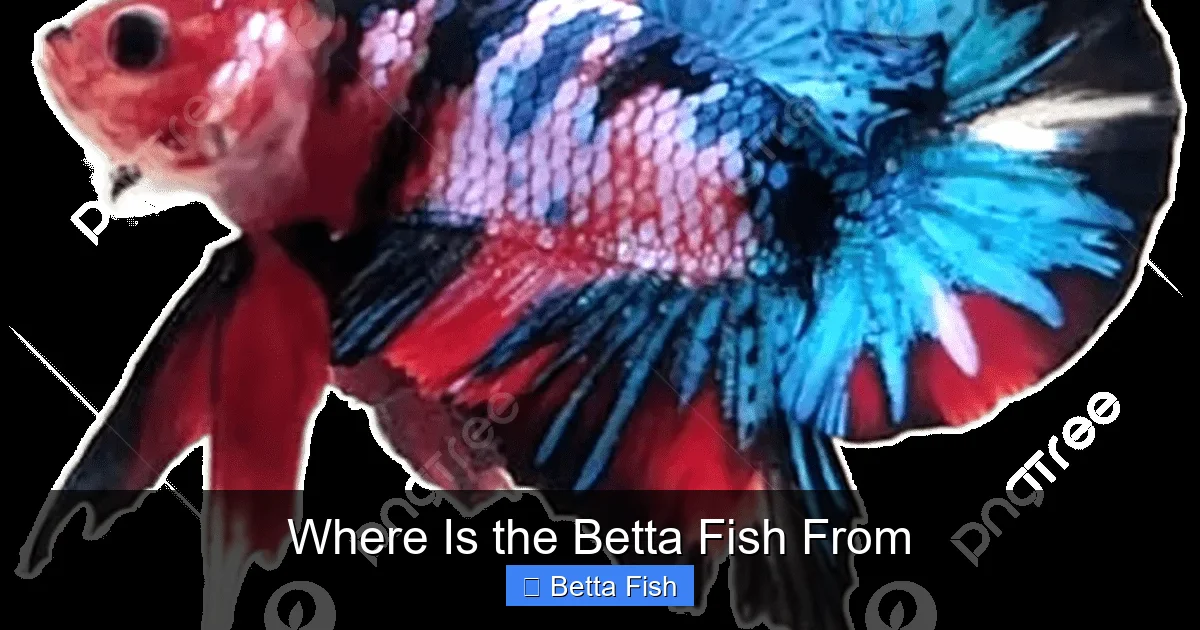
To understand the magnitude of this change, compare a wild-caught betta to a store-bought one. A wild Betta splendens is small (about 2 inches), with a stocky body, short, rounded fins, and a dull coloration of olive green, brown, or grey with faint blue or red streaks—perfect camouflage in the murky vegetation. Its aggression is real but focused on territory. A modern ornamental betta, particularly a halfmoon, is a spectacle of exaggerated form: fins that can be three times the length of its body, in colors so bright they seem to glow. This dramatic physical change comes at a cost; the fancy fins are prone to tearing and bacterial infections, and the genetic pool can be less robust. Knowing this history explains why some bettas are more delicate—they are the product of breeding for form over function.
From Thai Paddies to Your Living Room: The Global Spread
The journey from the Chao Phraya River basin to a glass bowl in Des Moines or London is a story of global trade, colonial exploration, and the 20th-century pet boom.
Arrival in Europe and America
Bettas first arrived in Europe in the 1870s and 1880s, imported by aquarium enthusiasts. They were initially displayed as curiosities—exotic fighters. Their introduction to the United States followed shortly after, around 1910-1920. For decades, they were a niche fish, kept by serious hobbyists who appreciated their behavior and challenge. The common name “Siamese fighting fish” stuck firmly in the West, forever linking the animal to its geographic origin.
The Pet Store Phenomenon
The betta’s explosion into a ubiquitous pet happened in the latter half of the 20th century. Several factors converged: the development of efficient international air freight (allowing live fish transport from Thailand), the rise of large chain pet stores, and a brilliant marketing strategy. Bettas were sold in tiny containers, sometimes just small cups, because their labyrinth organ allowed them to tolerate poor water conditions briefly. Their incredible colors and the fact they could be kept in “isolation” (a cruel misconception) made them seem like perfect, low-maintenance pets. This mass-market approach, while successful, tragically perpetuated the myth that they belong in tiny, stagnant spaces—the exact opposite of their dynamic, seasonally-flooded wild habitat. The question “where is the betta fish from” became a footnote, replaced by the image of a fish in a cup.
Modern Misconceptions: Separating Fact from Fiction
The popular image of the betta fish is riddled with myths, most of which stem from ignoring its true origins. Understanding where it’s from is the ultimate tool for proper care.
Myth: Bettas Belong in Small Bowls or Vases
This is the most pervasive and harmful myth. The fact that a betta *can* survive in a small volume of water (thanks to its labyrinth organ) is confused with the idea that it *should*. In the wild, even during the dry season, a betta’s “pool” is connected to a vast, complex wetland ecosystem. It has room to explore, hunt insects, and build bubble nests among abundant plants. A tiny bowl is a sensory deprivation tank. It lacks heating, filtration, and space. Proper care requires a minimum of 5 gallons (19 liters) for a single betta, with a heater, filter, and plenty of plants or decor for hiding and resting at the surface. Their origin in expansive, vegetative floodplains demands spacious, warm, and enriched environments.
Myth: They Are Solitary and Can’t Have Tank Mates
Male bettas are indeed fiercely territorial with other males, a trait amplified by centuries of fighting breeding. However, in the wild, a male’s territory is a large, complex area within the vegetation. They are not hermits. In a properly sized, well-planted aquarium, a single male betta can often coexist with peaceful, fast-moving community fish like neon tetras, corydoras catfish, or khuli loaches. The key is providing enough space and visual barriers (plants, driftwood) to break lines of sight, mimicking the dense cover of their native swamp. The idea that they must live alone in total isolation contradicts the social, albeit territorial, structure of their natural habitat.
Myth: They Eat Peacefully from the Surface
Wild bettas are micro-predators. They hunt for insects, insect larvae (like mosquito wrigglers), and tiny crustaceans both at the surface and in the water column. They are not vegetarians. In captivity, a high-quality pellet or flake formulated for carnivores should be the staple, supplemented with occasional treats of frozen or live foods like daphnia, brine shrimp, or bloodworms. Feeding only plant matter or “betta bites” that are mostly fillers is contrary to their carnivorous nature, a direct result of their evolution as insectivores in nutrient-poor tropical waters.
Conservation and the Wild Betta Today
While the domesticated betta is one of the most common pets on the planet, the status of its wild cousin is a more complex story. The Betta splendens in the wild is not currently listed as endangered by the IUCN, but its future is not secure.
Threats to Native Populations
The wetlands of Southeast Asia are under immense pressure. Large-scale agriculture, particularly palm oil and rice farming, has drained and destroyed vast tracts of natural swamp and floodplain habitat. Pollution from agricultural runoff (pesticides, fertilizers) and urban development degrades water quality. Perhaps the most insidious threat is genetic pollution. Pet store bettas are often released into the wild by owners who no longer want them. These captive fish, almost all descended from Thai fighting stocks, can interbreed with wild populations. This introduces genes that may be maladaptive for survival (like extreme finnage that hinders swimming) and dilutes the unique genetic diversity of truly wild, native stocks.
Responsible Ownership and Appreciation
As a betta owner, you are part of this story. Never release your fish into local waterways, no matter how similar the climate seems. It is ecologically irresponsible and harmful to native ecosystems. Furthermore, appreciating the betta’s wild origins should inspire better care. Providing a spacious, warm, planted tank with a varied diet isn’t just “nice”—it’s an attempt to replicate the complex world where the betta fish is from. Supporting ethical breeders who prioritize health and genetic diversity over extreme forms also helps preserve the integrity of the species. By understanding and respecting its origins, we move from being mere owners to being stewards of a remarkable evolutionary legacy.
Conclusion: A Fish Shaped by Place and People
So, where is the betta fish from? The answer is a tapestry woven from geography, ecology, and human culture. It is from the tea-colored, seasonal floodwaters of Thailand’s rice paddies and the swamps of Cambodia and Vietnam. It is from the ancient fighting pits where Thai breeders first shaped its fiery spirit. And it is from the dedicated ornamental farms of modern Thailand that transformed it into the jewel of the aquarium world. The betta in your tank is a living artifact, carrying the DNA of a survivor of extreme environments and the aesthetic legacy of centuries of selective breeding.
Next time you watch your betta flare its gills at its reflection or lazily drift among a java fern, remember its journey. That instinct to defend a patch of space comes from the isolated mud puddles of the dry season. That need to gulp air comes from oxygen-starved tropical waters. That brilliant red or blue color is a human-made masterpiece, but one that would be useless camouflage in its wild home. By learning its true story, we gain a deeper appreciation for this incredible fish. We move beyond the myth of the “cup fish” and embrace our role in providing a slice of its majestic, wild heritage—a warm, clean, and spacious wetland of its own. The betta’s origin story is not just a historical fact; it’s the ultimate guide to understanding and honoring the fish in your care.
Frequently Asked Questions
Are betta fish originally from Thailand?
Yes, the primary native range of the wild betta fish (Betta splendens) is in Thailand, specifically the Chao Phraya river basin. However, their natural habitat also extends into parts of Cambodia, Vietnam, and Malaysia in Southeast Asia.
Why are they called Siamese fighting fish?
They are called Siamese fighting fish because they originate from the historical region of Siam (modern-day Thailand) where they were traditionally bred and fought for sport. The name directly references their geographic origin and their historically aggressive behavior.
What is the natural habitat of a wild betta fish?
Wild bettas live in shallow, warm, stagnant or slow-moving waters like rice paddies, drainage ditches, forest swamps, and the edges of flooded plains. These habitats are heavily vegetated, have acidic, tannin-stained water, and experience dramatic seasonal changes in water level.
How long do betta fish live in the wild versus in captivity?
In the challenging wild environment with predators and habitat fluctuations, bettas typically live 2-3 years. With proper captive care—including a heated, filtered tank, a varied diet, and pristine water—they can live 3-5 years, and sometimes even longer.
Can wild bettas be kept as pets?
While possible, wild-caught bettas are generally not recommended for beginner hobbyists. They are often more stressed, have specific dietary needs, and can be less tolerant of tank conditions than their domesticated counterparts. They are also important to their native ecosystems and should be appreciated in the wild or through conservation efforts.
Are wild bettas endangered?
The wild species Betta splendens is currently listed as “Vulnerable” by the IUCN due to threats from habitat destruction, pollution, and the risk of genetic hybridization from released captive fish. Their wild populations are declining, though they are not yet critically endangered.