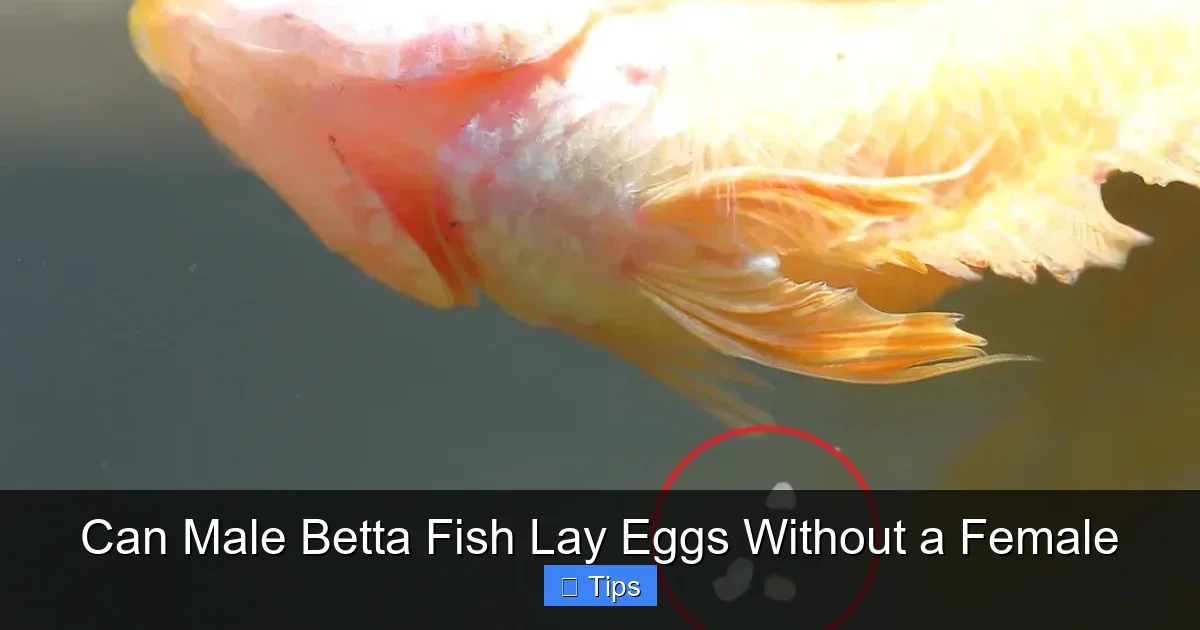
Can Male Betta Fish Lay Eggs Without a Female

No, male betta fish absolutely cannot lay eggs. Egg production is a biological function exclusive to female bettas. The common confusion often stems from a male betta’s natural behavior of building bubble nests, which can be mistaken for egg-laying. Understanding the distinct reproductive roles—where the male fertilizes the female’s externally released eggs and guards the nest—is crucial for any betta owner. Misunderstanding this can lead to improper pairing and serious harm to your fish.
If you’ve ever watched your majestic male betta fish—with his flowing fins and territorial demeanor—and wondered, “Can he lay eggs?” you’re not alone. It’s a surprisingly common point of confusion in the betta-keeping world. The short, definitive answer is a firm no. Male betta fish cannot, under any biological circumstance, lay eggs. Egg production is an exclusively female function in all egg-laying animals, including the Siamese fighting fish (Betta splendens).
So, where does this myth come from? Primarily from two observable behaviors: the male’s construction of intricate bubble nests and the occasional appearance of small, white specks on a fish. These are often misinterpreted by well-meaning but uninformed owners. This guide will dismantle this myth completely, diving deep into the fascinating, precise, and gender-specific biology of betta reproduction. We’ll explore what male bettas actually do during spawning, how to correctly identify the sexes, what to do if you see something concerning, and how to set up for successful, ethical breeding if that’s your goal. By the end, you’ll have a crystal-clear understanding of your betta’s reproductive capabilities and the confidence to provide the best care.
Key Takeaways
- Only female bettas produce eggs: Biologically, egg development occurs in the ovaries of female Siamese fighting fish. Males lack the reproductive organs for egg production.
- Bubble nests are not eggs: The floating clusters of bubbles built by male bettas are nests for fertilized eggs, not the eggs themselves. They are a sign of health and breeding readiness.
- Reproduction is external: Betta fish spawn through external fertilization. The female releases eggs, and the male simultaneously releases sperm to fertilize them in the water column before gathering them into his nest.
- Gender identification is key: You must correctly identify your betta’s sex before attempting to breed. Misidentifying a female as a male (or vice versa) can lead to fatal aggression or failed spawning attempts.
- White spots are not eggs: A male betta may develop small, white, grain-like spots on his vent or fins. These are often “breeding bars” or, more commonly, signs of a bacterial infection like columnaris, not eggs.
- Males guard, females do not: After spawning, the male betta assumes sole responsibility for tending the bubble nest, fanning the eggs, and protecting them. The female should be removed immediately to prevent her from eating the eggs or being attacked.
- A male alone will not spawn: Without a gravid (egg-bearing) female to trigger the process, a male betta will simply build and maintain a bubble nest as part of his natural territory behavior, but no eggs will ever be present.
📑 Table of Contents
- The Unchangeable Biology: Why Males Cannot Produce Eggs
- The Bubble Nest: A Masterpiece of Instinct, Not an Egg Sac
- The Spawning Act: A Synchronized Dance of External Fertilization
- Common Misconceptions and “What Is That?!” Guide
- How to Correctly Sex Your Betta Fish (The Only Way to Be Sure)
- Responsible Breeding: If You Want to Produce Fry
- Conclusion: Understanding to Provide Better Care
The Unchangeable Biology: Why Males Cannot Produce Eggs
To understand why a male betta can never lay an egg, we need a basic lesson in fish anatomy and reproduction. Like all animals, bettas have a reproductive system tailored to their specific role in procreation.
The Female’s Role: The Egg Producer
The female betta possesses a pair of ovaries where ova (eggs) develop. As she matures and becomes ready to spawn—a state called “gravid”—these eggs become visible as a small, soft, white bump or “egg spot” protruding from her vent (the opening just in front of the anal fin). This is the most reliable visual indicator of a female ready to breed. Internally, her body is preparing thousands of tiny, nutrient-rich eggs for release. Her entire biological apparatus is designed for creating and carrying these eggs until they are expelled.
The Male’s Role: The Fertilizer and Protector
The male betta’s reproductive system is fundamentally different. He has testes that produce sperm (milt), but he has no ovaries, no ova, and no mechanism to create or carry eggs. His biological purpose in reproduction is threefold: 1) to build a suitable nest (the bubble nest), 2) to fertilize the eggs externally the moment the female releases them, and 3) to guard and tend to those fertilized eggs until they hatch. He is a dedicated, often single-parent, guardian. The idea of him “laying” something contradicts the very definition of his biological sex.
Practical Example: Think of it like chicken and egg. You would never ask if a rooster can lay an egg. The rooster’s role is to fertilize the egg the hen lays. The betta world operates on the same external fertilization principle. The female “lays” (releases) the eggs into the water; the male immediately fertilizes them. He then collects them and places them into his bubble nest.
The Bubble Nest: A Masterpiece of Instinct, Not an Egg Sac
The most frequent source of the “male betta laid eggs” myth is the bubble nest. Male bettas are labyrinth fish, meaning they have a special organ to breathe air. A key part of their natural breeding behavior is to construct a floating cluster of tiny bubbles at the water’s surface. This is not a random act; it’s an elaborate, instinct-driven construction project.

Visual guide about Can Male Betta Fish Lay Eggs Without a Female
Image source: fishkeepertank.com
Why and How They Build
A male betta builds a bubble nest for one primary reason: to provide a safe, oxygen-rich environment for his future offspring. The bubbles trap air, creating a protected, moist cradle that keeps the eggs from sinking into the substrate where they could rot or be eaten. The quality and size of the nest often indicate the male’s health and vigor. He uses his mouth to gulp air from the surface, coat it with a saliva-like secretion that makes it more stable, and spit it out in a carefully arranged pattern. He will constantly maintain and repair this structure, adding to it even when no female is present.
What It’s NOT
A bubble nest is not an egg sac. It contains no eggs until a female spawns. It is a pre-emptive construction, a “nursery” built in anticipation of a mating opportunity. If you see your male betta building a beautiful nest, it is a sign he is healthy and his instincts are firing correctly. It does not mean he has or will produce eggs on his own. The nest is his contribution to the reproductive process; the eggs must come from a female.
Owner Tip: Don’t destroy a bubble nest! It’s a source of pride for your betta. If you’re not breeding, simply leave it be. He’ll eventually dismantle it and build a new one. If you do plan to breed, a well-constructed nest is a great sign your male is ready.
The “Egg Spot” Confusion: Male vs. Female
Here’s where things get tricky and lead to serious mistakes. Both male and female bettas can develop a small, white, grain-like spot called an “egg spot” or “breeding bar” on their vent. This is not an egg itself, but rather a hormonal change causing a slight whitening of the skin in that area.
- In Females: The egg spot is often more pronounced and, crucially, is accompanied by a visibly distended, soft belly when she is full of mature eggs (gravid). The spot itself is just above the vent.
- In Males: A male can also develop a small, white breeding bar, especially when he is excited or in the presence of a female. However, a male’s body will never become round and distended like a gravid female’s. His body shape remains sleek and torpedo-like.
Critical Error: An owner might see a white spot on their betta, assume it’s a female “laying eggs” or a male “with eggs,” and try to introduce a mate. This is a recipe for disaster. A male betta with a breeding bar is still a male. Putting two males together will result in a fight to the death. Putting a misidentified female (who is actually a male) with a true male will also result in a fight. You must learn the full suite of sexual dimorphism traits (body shape, fin length, beard size, behavior) to be certain.
The Spawning Act: A Synchronized Dance of External Fertilization
Now that we’ve established males don’t produce eggs, let’s walk through what actually happens when a compatible male and female betta come together for spawning. This is a breathtaking, precise, and sometimes violent ritual.

Visual guide about Can Male Betta Fish Lay Eggs Without a Female
Image source: petshun.com
The Courtship and Embrace
The process begins with courtship. The male displays his best colors and flares his gills (operculum) to impress the female. He may lead her to his bubble nest. If she is receptive, she will darken in color and adopt a “submissive” posture. The critical moment is the “nuptial embrace.” The male wraps his body tightly around the female’s midsection, and she responds by curving her body. In this embrace, the female releases a small batch of eggs (10-50 at a time), and the male simultaneously releases sperm (milt) directly onto them, fertilizing them in the open water. This embrace may be repeated dozens of times over several hours until the female has expelled all her eggs (often 100-400 total).
The Male’s Immediate Actions
As soon as the eggs are released and fertilized, the male’s instincts take over completely. He darts down, gathers the fertilized, sticky eggs in his mouth, and carefully places them into the safety of his bubble nest. He is the sole caretaker from this moment forward. The female, her role complete, often floats listlessly or tries to help but is usually driven away by the now fiercely protective male. It is absolutely essential to remove the female within 24 hours, as she may eat the eggs or be killed by the male.
What the Male Does NOT Do
The male does not carry the eggs inside him. He does not “lay” them. He is a meticulous collector and guardian. He will use his mouth to repair any falling bubbles, pick up any eggs that dislodge, and fan the nest with his fins to provide oxygen and prevent fungal growth. This intensive care lasts for 24-36 hours until the eggs hatch into tiny, wriggling fry that still remain in the nest for a day or two, absorbing their yolk sacs.
Common Misconceptions and “What Is That?!” Guide
Let’s address the specific things owners often see that lead to the egg-laying myth.
Visual guide about Can Male Betta Fish Lay Eggs Without a Female
Image source: tankofish.com
“My Male Has a Round Belly!”
This is almost never egg-related. A true, gravid belly is a soft, smooth, and visibly swollen underside, like a small water balloon. A male betta with a round belly is much more likely suffering from:
- Constipation: From overfeeding or poor diet. The belly will feel firm and the fish may be lethargic. Fast for 2-3 days and feed a daphnia or peeled pea.
- Dropsy: A symptom of severe internal infection (often bacterial). The belly is hard, swollen, and scales may protrude like a pinecone. This is usually fatal and requires immediate, aggressive treatment.
- Swim Bladder Disorder: Affects buoyancy, causing the fish to float upside down or sink. The belly may appear swollen due to gas or fluid.
Action: If your male betta has a persistently round, hard belly, research these diseases. It is not pregnancy.
“There Are Little White Grains in His Poop/Water!”
These are almost always undigested food particles (especially from pellets or flakes) or waste. Betta feces should be a short, colored string matching their food. White, stringy, or grain-like waste can indicate internal parasites (like Hexamita) or poor digestion. It is not unfertilized eggs being “laid.”
“He Has White Spots All Over!”
This is a classic symptom of a bacterial infection, most commonly Flavobacterium columnare (Columnaris). It starts as small white spots or patches on the fins, gills, or body and can look like mold or cotton. It is highly contagious and deadly if not treated immediately with antibiotics (like Kanamycin or Furan-2) and pristine water. This has zero connection to reproduction.
How to Correctly Sex Your Betta Fish (The Only Way to Be Sure)
Preventing the “male laying eggs” panic starts with absolute certainty about your fish’s sex. Here is the definitive checklist, observing all traits together.
Physical Characteristics (The “Vent Test” is Key)
- Body Shape: Females are slightly rounder and less streamlined, especially when gravid. Males are sleek and torpedo-shaped.
- Fin Length: Males have dramatically longer, more flowing fins (especially the caudal, dorsal, and anal fins). Females have much shorter, more modest fins. A female with long fins is almost certainly a “half-moon” female, but her body shape and vent will still be female.
- Beard (Operculum): The fleshy flap under the gill plate. Males have a large, prominent beard that they flare when displaying. Females have a very small or non-existent beard.
- Egg Spot: A small, white bump just in front of the vent. Both sexes can have this. Therefore, this is a useless indicator on its own. You must look at the vent itself.
- The Vent (The Decisive Feature): Gently look at the opening just in front of the anal fin.
- Female Vent: Appears as a small, round, protruding “pimple” or bump. It is obvious and distinct.
- Male Vent: Is a very small, almost invisible, slit-like opening. It is flush with the body and has no protruding bump.
Behavioral Clues
- Flaring: Males flare their gills (beard) constantly at their reflection, other fish, or during courtship. Females may flare occasionally but much less frequently and dramatically.
- Bubble Nesting: Almost exclusively a male behavior, though rare females have been known to build weak nests.
- Aggression/Territoriality: Males are vastly more aggressive and territorial. Females can be aggressive but are generally less prone to constant flaring and fighting.
Final Rule: If you are unsure, assume it’s a male. Never, ever place two bettas together without 100% certainty of their sex and a proper, lengthy introduction process in a divided tank. The risk of fatal combat is extremely high.
Responsible Breeding: If You Want to Produce Fry
If your goal is to actually breed bettas after confirming you have a true, gravid female and a healthy, bubble-nesting male, you must do it correctly. This is not for beginners and carries significant responsibility for hundreds of tiny lives.
The Essential Breeding Setup
You need a separate, bare spawning tank (5-10 gallons). Condition the pair with high-quality live or frozen foods (brine shrimp, daphnia) for 2-3 weeks. Introduce the female to the tank in a divider or breeding box so the pair can see each other but not fight. The male should build his nest in this tank. When both are visibly ready (male flaring at female, female dark with prominent egg spot and round belly), release the female. Supervise closely. The spawning embrace will occur. Remove the female immediately after she is chased away or within 24 hours. The male now tends the nest.
The Intensive Care Phase
After spawning, the male will guard the nest for 2-3 days. Do not disturb him. The eggs will hatch into “wigglers.” After another 2-3 days, the fry will become free-swimming. At this precise moment, you must remove the male, or he may eat his own young. Now the real work begins: feeding infusoria or commercial fry food multiple times a day, performing tiny, gentle water changes with a turkey baster, and maintaining perfect water quality for 2-3 months until the fry are large enough to separate. This is a massive, time-consuming commitment.
Important Warning: Breeding bettas is not a way to “make money.” It is a labor of love for experienced keepers. Hundreds of fry will be produced, requiring dozens of new homes. Never breed without a guaranteed, pre-arranged plan for every single offspring.
Conclusion: Understanding to Provide Better Care
The question “Can male betta fish lay eggs?” is a perfect gateway to understanding the fundamental, non-negotiable biology of these magnificent creatures. The resounding answer is no, and now you know the detailed why. A male betta’s bubble nest is not a sign of egg-laying; it’s a testament to his instinctual drive to be a provider and protector. A white spot is not an egg; it’s a hormonal signal or, more worryingly, a sign of disease. A round belly is not full of eggs; it’s a sign of constipation, dropsy, or swim bladder issues.
This knowledge empowers you as a caretaker. It prevents the fatal mistake of mis-sexing your fish and forcing incompatible tankmates together. It allows you to interpret your betta’s behaviors correctly—seeing a bubble nest not as a mystery but as a healthy, natural action. It helps you diagnose health problems faster by eliminating reproductive myths. Whether you are a casual owner admiring your betta’s solitary beauty or an aspiring breeder preparing for a spawn, this clarity is the foundation of excellent, responsible betta husbandry. Your male betta’s role is clear, his biology is fixed, and by respecting that, you provide the environment where he can truly thrive, displaying his stunning colors and fascinating behaviors exactly as nature intended.
Frequently Asked Questions
Can a male betta fish fertilize eggs without a female?
No. Fertilization requires the female to externally release her eggs into the water. The male then immediately releases sperm to fertilize them. Without the female’s egg release, there is nothing for the male to fertilize.
What are the small white spots on my male betta’s fins?
These are most likely a sign of a bacterial infection like Columnaris, not eggs. Breeding bars (a hormonal white spot near the vent) can occur in males, but widespread white spots or patches on fins/body are a health concern requiring isolation and antibiotic treatment.
If my male betta builds a bubble nest, does that mean he’s ready to breed?
It means he is healthy and his natural instincts are active. A bubble nest is a prerequisite for breeding, but it is not a guarantee he is ready or that you have a suitable, gravid female to trigger the actual spawning process.
Can a betta be both male and female (hermaphrodite)?
No. Betta splendens are not hermaphroditic. They are gonochoristic, meaning they are born as either male or female and remain that sex for life. There is no natural sex change.
My female betta has a white spot—is that an egg she’s laying?
The white spot itself is just a sign she is reproductively mature. The actual eggs are internal. You will know she is “gravid” (full of eggs) by her visibly round, swollen belly, not just the spot. She releases the eggs only during the spawning embrace with a male.
What should I do if I think my male betta has “laid” something?
First, do not panic. It is biologically impossible. Carefully observe your fish. Check for signs of illness: is the belly hard (dropsy) or swollen with stringy poop (constipation/parasites)? Are there white patches (infection)? Is he lethargic or not eating? The “something” is almost certainly waste, a symptom of disease, or you are misinterpreting a bubble nest. Focus on water quality, diet, and observe behavior. If concerned, isolate the fish and research the specific symptoms.