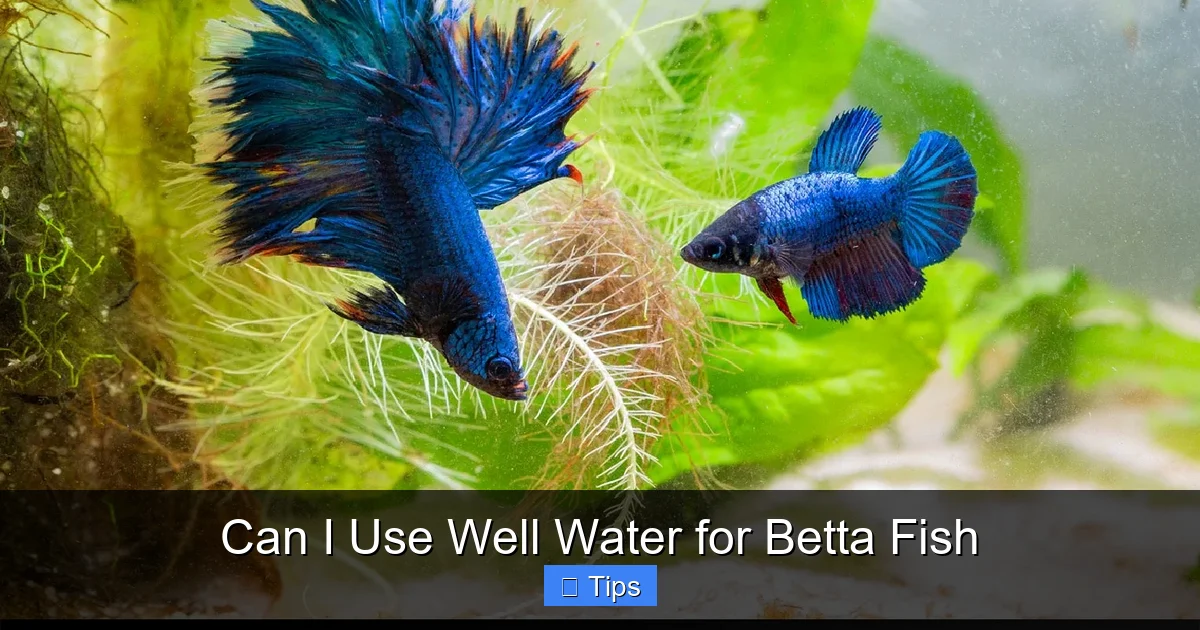
Can I Use Well Water for Betta Fish
Yes, you can often use well water for betta fish, but it requires careful preparation and ongoing monitoring. Well water varies dramatically in pH, hardness, and mineral content, and may contain contaminants like nitrates, iron, or heavy metals that are harmful to bettas. You must test your specific well water thoroughly and treat it to match a betta’s precise needs for a stable, clean environment. Without this diligence, well water can lead to stress, illness, and a shortened lifespan for your fish.
So you’ve got a beautiful, feisty betta fish with his flowing fins and personality plus, and you’re setting up his perfect home. You’ve picked out the tank, the plants, the adorable little castle. Then you hit a practical question: “What water do I actually put in there?” If you live in a rural area or on a property with a private well, the tap water that flows from your kitchen sink is well water. It’s convenient, it’s free (after the initial drilling and pump costs), and it’s what you drink and bathe in. But is it safe for your betta? The short answer is: it can be, but it’s rarely as simple as just filling the tank. Your well water is a unique chemical cocktail, and understanding its composition is the single most important step in determining if it’s suitable for your Siamese fighting fish. This guide will walk you through everything you need to know, from the science of betta water to practical, step-by-step treatment methods.
Let’s be clear from the start: betta fish are not “hardy” in the way people often mistakenly believe. They are tropical fish native to the slow-moving, warm, plant-choked waters of Thailand and Cambodia. Those environments are soft, acidic, and incredibly stable. Your well water, sourced from deep underground, is the polar opposite—it’s often mineral-rich, alkaline, and can contain a variety of dissolved gases and elements that your betta’s body has never encountered. Using untreated well water is like serving a gourmet meal that’s accidentally laced with something toxic; the fish might eat it, but the long-term consequences can be severe. Our goal is to transform your well water from a potentially hazardous source into a stable, clean, betta-friendly home. This involves testing, understanding, and sometimes, modifying what comes out of your spigot.
Key Takeaways
- Test First, Always: Never assume your well water is safe. Use a comprehensive liquid test kit to check pH, GH, KH, nitrates, nitrites, ammonia, and heavy metals before use.
- Contaminants Are the Biggest Risk: The primary danger in well water isn’t typically hardness, but unseen contaminants like agricultural runoff (nitrates), natural iron/manganese, or hydrogen sulfide (“rotten egg” gas).
- pH is Critical and Tricky: Betta fish prefer a stable, slightly acidic pH (6.5-7.5). Well water is often alkaline (high pH) due to minerals. Adjusting pH must be done gradually and with products designed for aquariums.
- Filtration & Aeration are Non-Negotiable: Even if water parameters are perfect, a proper filter (like a sponge filter) is essential to process waste and provide gentle water movement and oxygenation.
- Consider a “Blend & Condition” Approach: Many successful betta keepers with well water blend it with reverse osmosis (RO) water to control hardness/pH, then use a complete water conditioner to detoxify any remaining contaminants.
- Stability Trumps Perfection: A stable, slightly “off” parameter is far better for a betta than constant, drastic corrections trying to hit an “ideal” number. Avoid wild swings.
- Regular Re-Testing is Part of Ownership: Well water composition can change with seasons or groundwater shifts. Test your tank water weekly and your source well water monthly.
📑 Table of Contents
- Understanding the Betta Fish’s Ideal Water World
- The Reality of Well Water: What’s Actually Flowing From Your Faucet?
- The Essential First Step: Comprehensive Water Testing
- From Problem to Solution: Treating Your Well Water for Bettas
- Putting It All Together: A Practical Step-by-Step Workflow
- When Well Water Might Not Be the Best Choice: Alternatives
- Conclusion: Patience, Testing, and Observation Are Your Best Tools
Understanding the Betta Fish’s Ideal Water World
Before we critique your well water, we must first define the target. What does a betta actually need to thrive? It’s more than just “clean water.” It’s a specific chemical profile that mimics their natural habitat. Think of it as a comfort zone with very narrow boundaries.
The Non-Negiable Parameters: pH, Hardness, and Temperature
Three parameters rule the betta kingdom: pH, General Hardness (GH), and Carbonate Hardness (KH). pH measures how acidic or alkaline the water is. Bettas thrive in slightly acidic to neutral water, with an ideal range of 6.5 to 7.5. The key is stability; a constant pH of 7.0 is far better than a pH that swings between 6.5 and 7.8 every week. General Hardness (GH) measures the concentration of dissolved calcium and magnesium ions. This is “water hardness.” Bettas prefer soft to moderately soft water, typically 3-10 dGH (degrees of General Hardness). Very hard water (15+ dGH) can stress them, affect their slime coat, and make breeding difficult. Carbonate Hardness (KH), sometimes called “alkalinity,” measures the water’s buffering capacity—its ability to resist pH swings. A KH of 3-5 dKH is ideal for bettas. Too low (KH < 2), and your pH can crash dangerously. Too high (KH > 10), and the water is stubbornly alkaline and hard to adjust.
Then there’s temperature. Bettas are tropical fish. They need a consistent water temperature between 78°F and 80°F (25.5°C – 26.5°C). An aquarium heater is almost always necessary, even in warm climates, because room temperature fluctuates and is rarely this stable. Cold water slows their metabolism and immune system, making them susceptible to disease like dropsy.
The Invisible Enemies: Ammonia, Nitrite, and Nitrate
Beyond the basic chemistry, the nitrogen cycle is the foundation of a healthy aquarium. Fish waste and decaying food produce ammonia (NH3/NH4+), which is acutely toxic. Beneficial bacteria in your filter convert ammonia to nitrite (NO2-), which is also highly toxic. Finally, another bacteria converts nitrite to nitrate (NO3-), which is much less toxic but still needs to be managed through regular water changes. In a properly cycled tank, ammonia and nitrite should always read 0 ppm. Nitrate should be kept below 20 ppm for bettas, with 10 ppm being an excellent target. This is where your well water source comes into play. If your well water already contains nitrates (common in agricultural areas due to fertilizer leaching), you are starting your cycle with a pollutant already present, making it much harder to achieve a safe tank.
The Reality of Well Water: What’s Actually Flowing From Your Faucet?
Well water is groundwater that has been pumped from an aquifer. It’s not treated like municipal water. This means it contains whatever minerals, gases, and potential contaminants are present in your specific patch of subterranean rock and soil. There is no “standard” well water. Your neighbor a mile away could have completely different water chemistry. This variability is the core challenge.

Visual guide about Can I Use Well Water for Betta Fish
Image source: wallpapers.com
Common Characteristics (and Problems) of Well Water
Let’s break down the typical profile. High pH and High Alkalinity (KH): This is the most common issue. As groundwater flows through limestone (calcium carbonate) and other mineral-rich bedrock, it dissolves these minerals, becoming hard and alkaline. A pH of 7.8-8.5 and KH of 15+ dKH is not uncommon in well water. This directly conflicts with a betta’s preference for softer, more acidic conditions. High Iron and Manganese: These metals are dissolved from the earth. While not immediately lethal at low levels, they can be toxic in higher concentrations. They also stain aquarium glass and decorations orange-brown and can promote the growth of unsightly iron bacteria. Nitrates and Nitrites: As mentioned, if your well is near fertilized fields, septic systems, or has high organic matter in the aquifer, nitrate levels can be elevated. The EPA maximum contaminant level for drinking water is 10 ppm; for a sensitive betta, you want 0 ppm from your source water. Hydrogen Sulfide (The Rotten Egg Smell): This gas is produced by sulfur-reducing bacteria in low-oxygen groundwater. It’s not just smelly; it’s toxic. It can also acidify water in a harmful way. Other Potential Contaminants: Depending on your region, this list can include arsenic, radon, volatile organic compounds (VOCs), pesticides, or high levels of total dissolved solids (TDS). A standard pet store test kit won’t catch these; you need a comprehensive well water test from a certified lab.
The Danger of “Natural” Assumptions
It’s easy to think, “I drink this water, so it must be fine.” Human digestive and filtration systems are vastly different from a fish’s gills and osmoregulatory system. We are not absorbing water directly into our bloodstream through a delicate membrane designed for gas exchange. Fish are in constant, intimate contact with their environment. Contaminants that pass through us unnoticed can be acutely toxic to them. Furthermore, our tolerance for chlorine/chloramine in tap water (which well water usually lacks) is irrelevant; the betta’s tolerance for high mineral content or specific ions is what matters. Never use your own consumption as the sole benchmark for your betta’s safety.
The Essential First Step: Comprehensive Water Testing
You cannot manage what you do not measure. Guessing with well water is a recipe for a sick or dead betta. Testing is not optional; it’s the mandatory first chapter of your well-water-for-bettas story.

Visual guide about Can I Use Well Water for Betta Fish
Image source: infishtank.com
Testing Your Source Water: The Lab Test is King
Start with a professional comprehensive well water analysis from an accredited environmental laboratory. This is a one-time investment (typically $100-$300) that gives you a complete baseline report. You’ll order a kit, collect a sample from your well (following strict instructions to avoid contamination), and mail it in. The report will detail: pH, alkalinity, hardness (calcium, magnesium), iron, manganese, sulfate, chloride, nitrate, nitrite, ammonia, TDS, and often specific contaminants of concern in your area (like arsenic). This lab report is your blueprint. It tells you exactly what you’re working with. Keep this document forever as a reference point for future changes.
Ongoing Testing: Your Aquarium Test Kit
While the lab test tells you about the source, you need to monitor the water inside the betta tank. Invest in a high-quality liquid reagent test kit (like the API Freshwater Master Test Kit or similar). Strips are notoriously inaccurate and useless for precise parameter tracking. With your liquid kit, you must test for:
- Ammonia (NH3/NH4+): Must be 0 ppm.
- Nitrite (NO2-): Must be 0 ppm.
- Nitrate (NO3-): Aim for <20 ppm, ideally <10 ppm.
- pH: Track the daily/weekly stability.
- Alkalinity (KH): Crucial for understanding pH buffering. Some kits test this separately.
- General Hardness (GH): Important for long-term mineral balance.
Test your tank water weekly without fail. Test your source well water monthly after initial treatment to ensure nothing has changed in the aquifer.
From Problem to Solution: Treating Your Well Water for Bettas
Armed with your lab report and aquarium test kit, you can now formulate a treatment plan. The strategy depends entirely on your water’s specific flaws. Here are the primary tools in your water-conditioning toolbox.
Visual guide about Can I Use Well Water for Betta Fish
Image source: fishlaboratory.com
The Universal First Step: A Premium Water Conditioner
This is non-negotiable, even for well water. A water conditioner (dechlorinator) does more than just remove chlorine (which well water usually doesn’t have). A high-quality conditioner like Seachem Prime or Tetra AquaSafe Plus performs several vital functions:
- It detoxifies ammonia, nitrite, and nitrate for 24-48 hours, making them temporarily harmless. This is crucial if your well water has any traces of these compounds.
- It neutralizes heavy metals (like copper, lead, iron) that may be present.
- It helps protect your betta’s slime coat from stress and damage.
- It makes tap (or well) water safe for fish immediately upon addition.
Always dose your conditioner based on the volume of new water you are adding during a water change, not the entire tank volume. For example, if you are changing 2 gallons in a 5-gallon tank, dose for 2 gallons.
Taming High pH and Hardness: The Dilution Strategy
If your lab report shows high pH (above 7.8), high KH, or high GH, your best and safest bet is usually not to fight it with chemicals. Chemical pH reducers (like pH Down) cause violent swings and are very hard to control in water with high buffering capacity (high KH). Instead, use a dilution method:
Blend with Reverse Osmosis (RO) Water. RO water is essentially pure H2O—it has had all minerals and contaminants removed. You can purchase it from aquarium stores, some grocery stores (in the water section), or install a small RO/DI unit at home. By blending your well water with RO water, you dilute the hardness and alkalinity, giving you precise control.
Example Blend: Let’s say your well water has a pH of 8.2 and GH of 20 dGH. Start with a 50/50 blend (50% well water, 50% RO water). Test the blend. If the pH is still 7.8 and GH is 12, try 25% well / 75% RO. The goal is to find a blend that yields a stable pH in the 7.0-7.5 range and a GH below 12 dGH. Once you find your ideal blend ratio (e.g., 1 part well : 3 parts RO), stick to it for all water changes. You will then add your water conditioner to this blended water before it touches the tank.
Why this is superior: It creates stable, soft water without the chemical warfare of pH adjusters. It also reduces any dissolved solids (TDS) from your well. The only downside is the cost and storage of RO water, but for a single betta tank, a few gallons a week is manageable.
Dealing with Specific Contaminants: Iron, Sulfur, Nitrates
Iron/Manganese: If your well water has high iron (visible staining on fixtures, reddish tint), an RO system will remove it effectively. Some specialized filter media like Birm or KDF can also oxidize and filter these metals, but RO is simpler for a small tank. Hydrogen Sulfide: The rotten egg smell. This requires addressing at the source (aeration/filtration in your well system) or using an RO system. Activated carbon can help adsorb some of it, but RO is more thorough. Elevated Nitrates: If your lab test shows nitrates > 5 ppm in the source water, blending with RO water is again your best solution to bring that number down to near zero. Water changes alone will not solve a high-nitrate source problem; you’ll be adding nitrates back in with every change.
The Role of Filtration and Live Plants
No water treatment plan is complete without proper tank maintenance. A gentle sponge filter is the gold standard for bettas. It provides excellent biological filtration (housing the beneficial bacteria that process ammonia/nitrite) and gentle water flow/oxygenation without stressing the betta’s long fins. A hang-on-back (HOB) filter with a spray bar or baffle can also work. Live plants are a fantastic natural supplement. Plants like Anubias, Java Fern, Marimo Moss Balls, and Floating Frogbit will absorb nitrates and other dissolved organics, helping to polish the water and create a more natural ecosystem. They are not a replacement for filtration and water changes, but they are a powerful aid.
Putting It All Together: A Practical Step-by-Step Workflow
Let’s make this concrete. Here is a weekly routine for a betta keeper using treated well water.
- Gather Your Tools: You need: your lab report, a liquid aquarium test kit, a water conditioner (Seachem Prime), containers for blending/storing water, and a source of RO water (or a plan to make it).
- Determine Your Blend: Based on your lab report, decide on a well:RO ratio (e.g., 1:3). Mix this blend in a clean, dedicated container (a food-grade bucket is perfect). Let it sit for 24 hours to reach room temperature and allow any gases to off-gas.
- Condition the Water: On water change day (e.g., 25-50% weekly), take the pre-mixed, room-temperature blended water. Dose the appropriate amount of water conditioner for the volume you will be adding.
- Test Your Tank Water: Before the change, test your tank’s ammonia, nitrite, nitrate, pH, and KH. Record these numbers in a logbook or app.
- Perform the Water Change: Using a gravel vacuum, siphon out the old water, being careful not to disturb the substrate too much. Gently pour the new, conditioned, blended water back into the tank. Avoid shocking the fish with temperature or flow differences.
- Post-Change Check: After an hour, re-test your tank’s pH and temperature to ensure stability.
- Monthly Source Check: Once a month, test your raw well water (the 100% straight from the tap source) for pH, GH, KH, and nitrates with your liquid kit. Compare to your initial lab report. Has anything shifted significantly? This is your early warning system.
This routine creates predictability. Your betta lives in water with a stable, known chemistry. You are not reacting to crises; you are maintaining a system.
When Well Water Might Not Be the Best Choice: Alternatives
Despite your best efforts, some well water sources are fundamentally unsuitable for bettas without extreme and expensive intervention. What are your options?
The “Blending” Middle Ground (Already Covered)
For most moderate well water issues, blending with RO water is the most practical and effective solution. It gives you control. The cost of RO water is minimal for a 5-gallon betta tank.
Going Full Reverse Osmosis (RO/DI)
If your well water is extremely problematic—very high in TDS, multiple contaminants, or you want absolute control—you can treat all your aquarium water with a dedicated RO/DI (Reverse Osmosis/Deionization) system. This creates pure water. You then must re-mineralize it. You cannot put pure RO water in a tank; it will leach minerals from the fish and be lethally unstable. You add a precisely measured re-mineralizer (like Seachem Equilibrium for GH, and Seachem Alkaline Buffer for KH/pH) to the pure RO water to create a custom, perfect betta water formula from scratch. This offers total control but is more complex and requires careful dosing. It’s overkill for many but the ultimate solution for impossible source water.
Using Bottled Spring Water (A Cautionary Tale)
Some people suggest using bottled spring water. This is generally not recommended. The mineral content is proprietary and unknown, often high in sodium or other ions not ideal for freshwater fish. It’s also expensive and environmentally wasteful. It’s an unpredictable mystery solution, which is the opposite of what you want. Distilled water is pure and must be re-mineralized, so it’s just home-use RO.
Conclusion: Patience, Testing, and Observation Are Your Best Tools
So, can you use well water for betta fish? The definitive answer is: Yes, but only if you treat it with the respect and rigor it demands. Your well water is not a generic “fresh” water source; it is a unique geological product that requires a tailored approach. The path to success is built on three pillars: knowledge (from a lab test and understanding betta needs), treatment (using conditioners, blending, or RO as dictated by your report), and vigilance (through consistent testing and observation).
Watch your betta. Is he active? Does he flare at his reflection? Does he eat eagerly? Are his fins pristine? These are signs of a happy, healthy fish in good water. Is he lethargic, clamped at the bottom, not eating, or developing frayed fins or white spots? These are cries for help, often pointing directly to water quality issues. Your well water can absolutely provide a beautiful, thriving home for your betta. It just requires you to be the scientist, the engineer, and the dedicated caretaker. Start with that lab test. It’s the first and most important investment you can make in your betta’s long, colorful life.
Frequently Asked Questions
Can I just use my well water straight from the tap for my betta?
No, you should never use untreated well water. It likely has an unsuitable pH, hardness, or hidden contaminants like nitrates or metals that can harm or kill your betta. Always test and condition it first.
My well water smells like rotten eggs. Can I still use it?
The smell indicates hydrogen sulfide gas, which is toxic to fish. You must address this, typically by using a reverse osmosis (RO) system to remove the gas and minerals, or by aerating the well water extensively before use, though RO is more reliable.
Do I need to buy a reverse osmosis (RO) system for my well water?
Not necessarily. Many well waters can be made suitable by blending with store-bought RO water to dilute hardness and alkalinity. A full RO/DI system is only needed for extremely poor source water or if you want complete, precise control over every parameter.
How often should I test my well water and my betta tank water?
Test your tank water weekly for ammonia, nitrite, nitrate, pH, and KH using a liquid test kit. Test your raw source well water monthly for pH, GH, KH, and nitrates to monitor for changes in your aquifer.
Will a water conditioner make my hard, alkaline well water safe for my betta?
A water conditioner is essential for detoxifying ammonia, nitrite, nitrate, and heavy metals, but it does not lower pH or hardness. It’s a critical first step, but you must still address high pH/hardness through dilution with RO water or other methods.
My well water test showed 10 ppm nitrate. Is that safe?
For drinking water, 10 ppm is the EPA limit, but for a sensitive betta, it’s too high. You want 0 ppm from your source water. You should blend this water with RO water to reduce the nitrate contribution to your tank, aiming for a source concentration below 5 ppm.