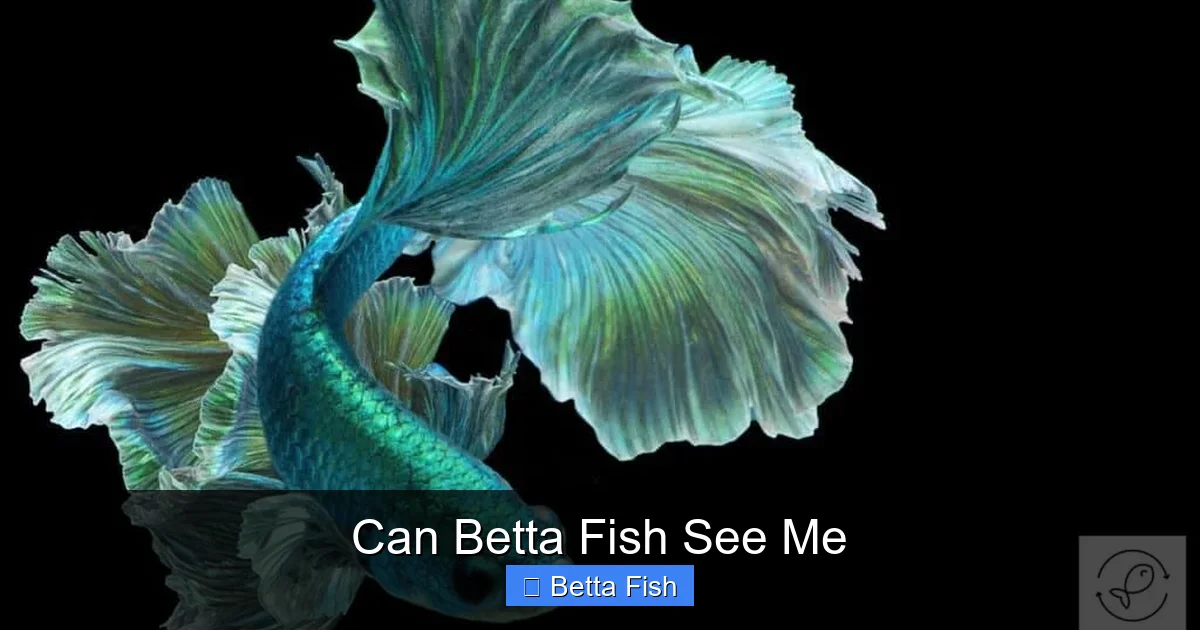
Can Betta Fish See Me
Yes, betta fish can see you—and their vision is more sophisticated than most people realize. While their eyesight differs from human vision, bettas can detect movement, distinguish colors, and may even learn to recognize their owners over time. Understanding how your betta sees the world helps you build a stronger bond and create a better environment for your colorful companion.
- Betta fish have functional vision: They can see objects, movement, and colors outside their tank, including their owners standing nearby.
- Their eyes are positioned for wide-angle viewing: Betta eyes sit on the sides of their head, giving them nearly 360-degree awareness of their surroundings.
- Bettas see colors differently than humans: They have excellent color vision and can perceive some ultraviolet light that humans cannot.
- Movement detection is their superpower: Betta fish are highly attuned to motion, which is key to how they identify threats, food, and familiar people.
- Recognition goes beyond just seeing: Bettas can learn to associate their owner’s presence with feeding time and may “react” when you approach the tank.
- Water clarity and lighting matter: Poor tank conditions, murky water, or harsh lighting can significantly affect how well your betta sees.
- Distance and refraction limit clarity: Like all fish, bettas have limited ability to focus on distant objects due to the way light bends through water and glass.
📑 Table of Contents
- Introduction: The Curious World of Betta Fish Vision
- How Betta Fish Eyes Work
- What Can Betta Fish Actually See?
- Color Vision in Betta Fish
- Can Betta Fish Recognize Their Owners?
- How Lighting and Environment Affect Betta Vision
- Practical Tips for Interacting With Your Betta
- Common Myths About Betta Fish Vision
- Conclusion: Your Betta Sees More Than You Think
Introduction: The Curious World of Betta Fish Vision
You’re standing in front of your aquarium, watching your betta fish glide gracefully through the water. It turns toward you. Its little mouth opens and closes. Its fins flare slightly. And you can’t help but wonder—can my betta fish actually see me?
This is one of the most common questions betta owners ask, and the answer is more fascinating than you might expect. Betta fish don’t just “see” in the way we casually think about it. Their visual system is uniquely adapted to their underwater world, and it shapes everything from how they find food to how they react when you walk into the room.
In this article, we’ll dive deep into the science of betta fish vision. You’ll learn exactly what your betta can and cannot see, how their eyes work, what colors they perceive, and whether they can truly recognize you as their owner. By the end, you’ll have a whole new appreciation for the way your betta experiences the world—and you might never look at your aquarium the same way again.
How Betta Fish Eyes Work
The Anatomy of a Betta’s Eye
Betta fish have eyes that are positioned on the sides of their head. This placement isn’t random—it’s a survival adaptation. In the wild, bettas live in shallow rice paddies, ponds, and slow-moving streams in Southeast Asia. Having eyes on the sides of their head gives them an incredibly wide field of vision, nearly 360 degrees. This helps them spot predators approaching from almost any direction.

Visual guide about Can Betta Fish See Me
Image source: aquariumnexus.com
Each eye has a rounded lens that is perfectly suited for underwater vision. Human eyes are designed to focus light through air, but a betta’s lens is spherical, which bends light correctly as it passes through water. This means bettas see their underwater world with impressive clarity—at least for objects that are relatively close.
How Fish Eyes Differ From Human Eyes
One of the biggest differences is the shape of the lens. Human eyes have a flatter lens that changes shape to focus on objects at different distances. Betta fish have a rigid, round lens that moves closer to or farther from the retina to focus—kind of like adjusting a camera lens by sliding it in and out rather than changing its shape.
Another key difference is that bettas lack eyelids. They can’t blink. They can’t close their eyes to sleep in the way we do. Instead, they enter a rest period where they become less responsive, often settling near the bottom or floating near the surface. Their eyes remain open the entire time.
Bettas also have a structure called the tapetum lucidum in some related fish species, though it’s less prominent in bettas compared to deep-sea fish. This reflective layer behind the retina helps gather more light, which is useful in dim environments. If you’ve ever noticed your betta’s eyes catching light in a certain way, this is part of the reason why.
What Can Betta Fish Actually See?
Seeing Beyond the Glass
Here’s the big question: when your betta looks toward the glass, does it see you? The answer is yes—but not exactly the way you see yourself in a mirror. Light passes from the air, through the glass, and into the water. Each time light crosses between materials with different densities, it bends slightly. This is called refraction.
Because of refraction, your betta sees a slightly distorted version of the outside world. Shapes may appear shifted or magnified depending on the angle. But the good news is that bettas are perfectly capable of detecting large objects, movement, and color contrasts outside the tank. When you stand in front of the aquarium, your betta absolutely knows something is there.
Movement Detection
If there’s one thing betta fish excel at, it’s detecting movement. Their eyes are wired to notice even the slightest motion in their environment. In the wild, this ability helps them spot both prey (like insects landing on the water surface) and predators (like birds swooping overhead).
This is why your betta often swims excitedly when you approach the tank. It’s not just responding to vibrations or sound—it’s seeing you move. The combination of your body’s outline shifting against the background and the motion of your hands near the glass creates a visual signal that your betta picks up instantly.
Perceiving Depth and Distance
Betta fish have a more limited ability to judge distance compared to humans. Their eyes, being on opposite sides of their head, give them excellent peripheral vision but reduce their binocular vision (the overlapping field where both eyes see the same object). Binocular vision is what helps humans perceive depth so accurately.
For bettas, objects that are very close—within a few inches—appear in sharper focus. Objects farther away become blurrier. This is why your betta may react strongly when you put your face right up to the glass but seems less interested in things happening across the room. The closer you are, the clearer you appear to your fish.
Color Vision in Betta Fish
Do Bettas See in Color?
Absolutely—and they may actually see more colors than you do. Betta fish possess cone cells in their retina that allow them to perceive a wide spectrum of colors. Research on related freshwater fish species suggests that bettas can see colors ranging from deep reds and oranges all the way into the ultraviolet range.

Visual guide about Can Betta Fish See Me
Image source: a-z-animals.com
Ultraviolet light is invisible to the human eye, but many fish species can detect it. While specific studies on betta fish UV vision are limited, their close relatives in the gourami family have been shown to perceive UV wavelengths. This means your betta may be seeing patterns on other fish, reflections in the water, or even subtle details in their environment that are completely invisible to you.
Why Color Matters to Your Betta
Color plays a huge role in a betta’s life. Male bettas are famous for their brilliant hues—fiery reds, electric blues, deep purples, and iridescent greens. These colors aren’t just for human enjoyment. In the wild, color signals health, dominance, and readiness to mate.
When a male betta flares its gills and spreads its fins, it’s putting on a color display designed to intimidate rivals or attract females. The fact that bettas can see such a rich spectrum of color means they’re experiencing these displays in vivid detail. A rival’s bright red fin isn’t just “red” to a betta—it’s a complex visual signal packed with information.
This is also why many betta owners report that their fish react differently to different colored objects or clothing. Wearing a bright red shirt near the tank might get a more intense response than wearing a dull gray one. Your betta isn’t being dramatic—it’s genuinely perceiving a different visual stimulus.
Can Betta Fish Recognize Their Owners?
Beyond Simple Vision
Seeing and recognizing are two different things. So can your betta actually recognize you specifically? The evidence strongly suggests yes. While bettas don’t have the complex brain structures that mammals use for facial recognition, they are capable of associative learning.
Research and owner experiences show that bettas can learn to associate specific people with positive outcomes, like feeding time. If you’re the primary person who feeds your betta, your fish likely learns to associate your appearance—your shape, your movement patterns, even the specific way you approach the tank—with the arrival of food.
This is why many betta owners notice their fish swimming to the front of the tank when they walk into the room but ignoring other people entirely. It’s not magic. It’s learning. Your betta has figured out that you are the food person, and it responds accordingly.
Signs Your Betta Recognizes You
There are several behaviors that suggest your betta recognizes you as its owner:
- Swimming to the front of the tank when you approach, especially around feeding time
- Following your finger along the glass when you move it slowly
- Displaying excitement—rapid swimming, flaring, or “dancing” when you’re near
- Ignoring strangers or showing less interest in people who don’t regularly interact with the tank
- Reacting to your routine—becoming active at the times you usually feed or check on them
These behaviors don’t just happen randomly. They’re learned responses built up over time through consistent interaction. The more you engage with your betta, the stronger these patterns become.
The Role of Routine and Conditioning
Bettas are creatures of habit. They thrive on routine, and their ability to learn patterns is one of their most underrated traits. If you feed your betta at the same time every day, stand in the same spot, and perhaps even tap the glass or say something before feeding, your betta will begin to anticipate food based on those cues.
This is a form of classical conditioning—the same principle that Pavlov used with his famous dogs. Your betta doesn’t just see you. It connects your presence with a specific outcome. Over time, the mere sight of you approaching the tank triggers an anticipatory response. Pretty impressive for a fish, right?
How Lighting and Environment Affect Betta Vision
The Importance of Proper Tank Lighting
Your betta’s ability to see you—and everything else—depends heavily on the lighting conditions in and around the tank. Too little light and your betta’s vision becomes limited. Too much light and it can cause stress, algae growth, and discomfort.
Bettas naturally inhabit shallow, warm waters with plenty of plant cover. Dappled sunlight filtering through vegetation creates the ideal lighting environment. In your home aquarium, a moderate LED light on a timer (8–10 hours per day) mimics this natural cycle. This keeps your betta comfortable and ensures its eyes function optimally.
Avoid placing your tank in direct sunlight. It might seem like a good idea, but direct sun causes temperature fluctuations, promotes algae blooms, and can create harsh glare that makes it difficult for your betta to see clearly. A spot with indirect natural light supplemented by a gentle aquarium light works best.
Water Clarity and Visibility
Clean water isn’t just important for your betta’s health—it’s essential for its vision. Murky or cloudy water scatters light and reduces visibility, making it harder for your betta to see objects, food, and yes, you. Regular water changes, a good filter, and avoiding overfeeding all contribute to crystal-clear water.
If you notice your betta seems less responsive when you approach the tank, check your water quality first. Poor water conditions can cloud your betta’s vision and also cause stress, which makes your fish less likely to react to external stimuli. Keeping the tank clean is one of the simplest ways to ensure your betta can see you clearly.
Can Betta Fish See in the Dark?
This is another common question, and the answer is nuanced. Bettas can detect some light in very dim conditions, but their vision is significantly reduced in complete darkness. They rely more on their lateral line system—a series of sensory organs that detect vibrations and water movement—to navigate in low light.
That said, bettas do need a period of darkness each day to rest. Leaving the tank light on 24/7 disrupts their circadian rhythm and can lead to stress and health problems. If you’re curious about how your betta handles low-light conditions, you can read more about whether betta fish can see in the dark.
Practical Tips for Interacting With Your Betta
How to Use Vision to Build Trust
Now that you know your betta can see you, let’s talk about how to use that knowledge to build a stronger relationship with your fish. Here are some practical tips:
- Approach the tank slowly and consistently. Sudden movements can startle your betta. Move calmly and predictably so your fish learns to associate your presence with safety, not danger.
- Feed at the same time each day. Consistency is key. Your betta will learn your schedule and start anticipating your arrival.
- Use finger tracking exercises. Slowly move your finger along the outside of the glass. Many bettas will follow it. This is a simple form of enrichment that stimulates their visual tracking abilities.
- Sit near the tank regularly. The more time you spend near the aquarium, the more comfortable your betta becomes with your presence. Over time, it may even seem to “watch” you as you go about your day.
- Avoid tapping the glass. While it might seem like a fun way to get your betta’s attention, tapping creates stressful vibrations. Use visual cues instead.
Enriching Your Betta’s Visual Environment
A visually stimulating environment keeps your betta engaged and healthy. Consider adding:
- Live or silk plants that create visual barriers and hiding spots
- Floating decorations that create shadows and interesting patterns on the water surface
- Colored gravel or ornaments that provide visual contrast
- A varied background on the outside of the tank to reduce reflections while still providing visual interest
A bored betta is an unhealthy betta. Providing a rich visual environment encourages natural behaviors like exploring, hunting, and displaying. It also makes your tank more enjoyable for you to watch.
Common Myths About Betta Fish Vision
Myth: Betta Fish Have a 3-Second Memory
This is perhaps the most persistent myth in the fish-keeping world. The idea that bettas (or any fish) have a memory of only a few seconds has been thoroughly debunked by scientific research. Studies have shown that bettas can remember associations, recognize patterns, and learn from experience for months, not seconds.
Your betta’s ability to recognize you, anticipate feeding time, and respond to specific cues is living proof that their memory is far more capable than this myth suggests. If a betta truly had a 3-second memory, it would never learn to associate you with food—and yet, countless owners witness this exact behavior every single day.
Myth: Betta Fish Can’t See Outside the Tank
As we’ve covered extensively, this is simply not true. Bettas can absolutely see outside the tank. The combination of their wide-angle vision, excellent motion detection, and color perception means they’re well aware of what’s happening in the room around them. They may not see every detail with perfect clarity, but they can detect shapes, movement, and color contrasts well enough to respond meaningfully.
Myth: Bettas Are Aggressive Because They “See Their Own Reflection”
There’s a grain of truth here, but it’s often misunderstood. Bettas flare at their reflection because they perceive another betta in their territory—not because they’re confused. Their vision is good enough to detect the shape, color, and movement of what appears to be a rival. The aggression is a natural territorial response, not a sign of poor eyesight.
That said, if your tank has highly reflective surfaces on all sides, constant exposure to “rivals” can cause chronic stress. Using a background on at least one or two sides of the tank helps reduce unnecessary flaring while still allowing your betta to enjoy its environment.
Conclusion: Your Betta Sees More Than You Think
So, can betta fish see you? The answer is a resounding yes. Their eyes are well-adapted to their environment, capable of detecting movement, perceiving a rich spectrum of colors, and even learning to recognize the person who feeds them every day. While their vision works differently from ours, it’s perfectly suited to their needs—and it allows them to be far more aware of their surroundings than most people give them credit for.

Visual guide about Can Betta Fish See Me
Image source: bettafisher.com
Understanding how your betta sees the world changes the way you interact with your fish. You start to notice the subtle ways it responds to your presence. You appreciate the importance of lighting, water clarity, and a visually enriching environment. And you realize that the bond you feel with your betta isn’t one-sided—your fish genuinely knows who you are.
The next time you stand in front of your aquarium and your betta swims toward you, remember: it’s not just reacting to a vague shape. It’s seeing you, recognizing you, and choosing to engage. And that’s a pretty special connection for a person and a fish to share.
Frequently Asked Questions
Can betta fish see me through the glass?
Yes, betta fish can see through the glass of their aquarium. Light passes through the glass and water, allowing your betta to detect shapes, movement, and colors on the other side. The image may be slightly distorted due to refraction, but your betta can clearly perceive you standing nearby.
Do betta fish recognize their owners?
Betta fish can learn to recognize their owners through associative learning. They connect your appearance and routine with feeding time and positive interactions. Many bettas swim to the front of the tank when their primary caregiver approaches while ignoring strangers.
What colors can betta fish see?
Betta fish have excellent color vision and can perceive a wide spectrum, including reds, blues, greens, and possibly ultraviolet light. Their color perception is actually richer than human vision in some ways, which plays an important role in how they communicate and display to other bettas.
Can betta fish see in the dark?
Betta fish have very limited vision in complete darkness. They can detect some light in dim conditions but primarily rely on their lateral line system—which senses vibrations and water movement—to navigate when it’s dark. They also need a regular period of darkness each day to rest properly.
Why does my betta fish follow my finger on the glass?
Your betta follows your finger because it detects the movement and may associate it with feeding time or interaction. This behavior shows that your betta’s vision is working well and that it’s engaged with its environment. It’s also a simple form of enrichment that many bettas enjoy.
How far can a betta fish see?
Betta fish see objects most clearly within a few inches to a couple of feet. Their ability to focus on distant objects is limited compared to humans due to the way their spherical lenses work and the refraction of light through water and glass. However, they can detect large movements and shapes at greater distances.