Which Betta Fish Is More Aggressive
Wild betta fish (Betta splendens) and their short-finned Plakat descendants are significantly more aggressive than the long-finned, selectively bred varieties like Halfmoons. Male bettas are inherently more territorial than females, but individual personality and tank environment are the ultimate determinants of aggression levels. Understanding these factors is key to selecting a compatible betta and providing a stress-free home.
So, you’re thinking about adding a Betta splendens to your home. You’ve been mesmerized by those flowing, colorful fins in the pet store. But then you hear the stories—the fish that flares at its own reflection, the one that attacked a tank mate, or the legendary “Siamese fighting fish” reputation. It leads to the burning question on every new owner’s mind: which betta fish is more aggressive? Is it the brilliant red Halfmoon? The sleek blue Plakat? What about the females? The answer, as you’ll soon see, is wonderfully complex and deeply important for your success as a betta keeper. Let’s dive in.
First, let’s shatter one myth right away: all bettas are not created equal in the aggression department. While they all carry the genetic legacy of the wild fighting fish, centuries of selective breeding have created a spectrum of behaviors. Think of it like dog breeds. A Border Collie and a Bulldog have the same species classification, but their energy levels and drives are worlds apart. The same is true for the betta fish you can buy today. The key is understanding where that aggression comes from and what it really means for your aquarium.
Key Takeaways
- Wild & Plakat Bettas Are Most Aggressive: Genetics favor aggression in short-finned, functional-finned types bred for fighting or survival.
- Long-Finned Show Bettas Are Typically Less Reactive: Generations of selective breeding for color and finnage have often reduced extreme territorial aggression.
- Gender Plays a Major Role: Males are almost always more territorial and aggressive towards other males than females.
- Environment Dictates Expression: A small, barren tank will make any betta more aggressive than a spacious, planted, well-decorated aquarium.
- Individual Personality Is Paramount: There is wide variation; some “show” males are feisty, and some “fighter” types are surprisingly docile.
- Aggression Is Often a Symptom of Stress: Poor water quality, incorrect temperature, or inadequate hiding spots can trigger defensive aggression.
- Management Beats Prediction: Your focus should be on creating an ideal environment and observing your specific fish, not just relying on breed stereotypes.
📑 Table of Contents
- The Root of the Flare: Understanding Betta Aggression
- Wild Bettas vs. Captive-Bred: The Genetic Divide
- Breed Variations: Plakat, Halfmoon, and Everything In Between
- Gender Matters: Male vs. Female Aggression
- The Environment Is Everything: Tank Size, Setup, and Tank Mates
- Managing Aggression: Practical Tips for a Peaceful Betta
- Conclusion: Knowledge Over Assumption
The Root of the Flare: Understanding Betta Aggression
Before we compare types, we must understand why bettas are aggressive. Their aggression is primarily territorial and possessive. In the wild, the stagnant, shallow rice paddies and ditches of Southeast Asia are resource-rich but spatially limited. A male betta’s entire survival and reproductive strategy depends on claiming and defending a small patch of this habitat—a prime spot with a bubble nest, good cover, and access to food. Any intruder, especially another male, is a direct threat to his territory, his nest, and his genetic legacy. This instinct is hardwired.
Two Types of Aggression: Territorial vs. Reactive
It’s useful to separate betta aggression into two main categories. Territorial aggression is the classic “I own this patch of water, and you are not welcome” behavior. It’s directed at other fish that enter the betta’s claimed space. Reactive aggression is different. It’s a stress response. A betta might flare at a sudden movement outside the tank, at its own reflection (a perpetual “intruder”), or at a fast-moving, flashy fish that triggers its prey instinct. A fish displaying reactive aggression is often anxious and insecure, not necessarily a dominant tank boss. Much of what we perceive as “meanness” is actually a betta feeling threatened and reacting defensively.
The Myth of “Mean” vs. “Nice”
Calling a betta “mean” or “nice” is a human label that doesn’t capture the fish’s reality. A flaring, chasing betta is not “evil”; it is a perfectly functioning Betta splendens expressing its natural instincts. Our job as keepers is to manage the environment so those instincts don’t lead to chronic stress, injury, or death—for the betta or its tank mates. The most “aggressive” betta in a 5-gallon bare tank might become a curious, peaceful community member in a 20-gallon heavily planted tank with clear territories. The behavior is a product of the fish and its surroundings.
Wild Bettas vs. Captive-Bred: The Genetic Divide
This is the single most important comparison. The bettas in your local store are Betta splendens, but they are lightyears removed from their wild cousins.
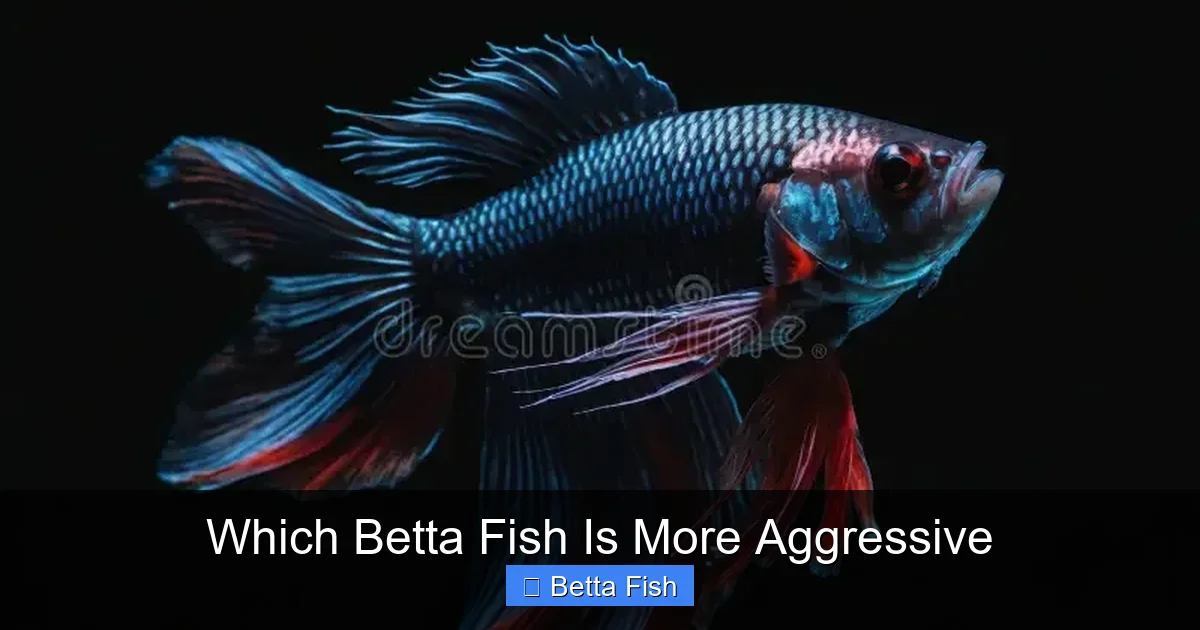
Visual guide about Which Betta Fish Is More Aggressive
Image source: thumbs.dreamstime.com
The Wild Betta (Betta splendens)
Found in the shallow waters of Thailand, Cambodia, and Malaysia, the wild betta is a master of survival. It is a short-finned, muted-colored fish (browns, greens, reds) that can gulp air from the surface. Its aggression is 100% functional. It fights to defend a tiny territory against rivals, to protect a bubble nest, and to secure food. This aggression is intense, direct, and often to the death in the wild. If you could put a wild male in a tank with a captive-bred male, the wild fish would almost certainly dominate and potentially kill the other due to its pure, unaltered survival instincts and often higher stamina. In the hierarchy of aggression, the true wild-type betta is at the very top.
The Captive-Bred Betta
For over 600 years, bettas have been bred for fighting in Thailand (then Siam). These “Plakat” fighters were selected for aggression, stamina, and large, functional gill covers (cheeks). When they were introduced to the West in the late 1800s, the focus shifted. Breeders began selecting for color and, later, for long, flowing fins. This created the “show” bettas we know today: Halfmoons, Double Tails, Rosetails, etc.
Here’s the critical point: Generations of selecting for beauty often inadvertently selected against extreme, unmanageable aggression. A fish with massive, delicate fins is not built for high-speed combat in tight spaces. Breeders also culled overly aggressive individuals from breeding programs to make the fish more suitable for life in small containers. So, while the genetic potential for aggression is still there, its expression is often muted in these modern varieties. A brightly colored, long-finned Halfmoon from a reputable breeder is statistically less likely to be an unrelenting terror than a short-finned, bright-colored Plakat from a fighting line. But, and this is a big but, there are always exceptions.
Breed Variations: Plakat, Halfmoon, and Everything In Between
Now we get to the heart of your question, comparing the common types you’ll find for sale. Remember, these are general trends, not absolute laws.

Visual guide about Which Betta Fish Is More Aggressive
Image source: diyseattle.com
The Plakat (PK)
The Plakat, meaning “plated” or “cut fin” in Thai, is the short-finned betta. It looks most like the wild ancestor. Its fins are sturdy, functional, and end in a sharp point. Plakats are widely considered the most aggressive of the common captive varieties. Why? They retain more of the original body plan. They are more active swimmers, have better muscle tone, and their fins are not a hindrance. They are also the type most commonly associated with “fighter” or “king” bettas, which are lines specifically bred for aggression and sold by specialty breeders. A Plakat from a fighting strain will be a powerhouse. A Plakat from a show line might be more mellow. But on average, expect a Plakat to have a higher “spark” and stronger territorial instincts than a long-finned cousin. They are also the most likely to jump, so a secure lid is non-negotiable.
The Halfmoon (HM)
The Halfmoon is the iconic betta, with a 180-degree tail spread that forms a perfect semi-circle. This is the king of the show world. The intense selective pressure for large, symmetrical, flowing fins has had an effect. These fish are often less athletic and more “floaty.” Their aggression is frequently less about active patrolling and chasing and more about flaring from a favorite perch. A well-bred Halfmoon from a quality show line can be surprisingly peaceful, even sociable in a community tank. However, don’t mistake beauty for weakness. Many Halfmoons, especially males from less selective breeding (like those from big-box stores), will still be fiercely territorial. The finnage can also make them targets for nippy tank mates. They are generally less aggressive than Plakats, but not passive.
Other Long-Finned Variants
Variants like the Double Tail (DT), Rosetail (RT), and Feathertail take the Halfmoon’s finnage even further, often with multiple tail lobes or excessive branching. These fish are the furthest removed from the wild type. Their aggression levels can be even more variable. Some are incredibly docile “lap cats” of the betta world. Others can be surprisingly feisty, perhaps compensating for their cumbersome fins with a strong will. The massive finnage requires pristine water to prevent rot, and a stressed fish with fin issues will be grumpy. They are, on average, the least likely to exhibit extreme aggression, but their delicate nature means they are less suitable for community tanks with active fish.
The “King” Betta
This is a marketing term, not a formal breed. “King” bettas are typically large, stocky Plakats or short-finned variants with thick bodies and bold colors. They are often, but not always, from lines with a fighting background. They carry the reputation of being particularly aggressive and powerful. Treat them with the same caution you would a Plakat from a known fighter strain. They are not a beginner’s community fish.
Gender Matters: Male vs. Female Aggression
This is a clear-cut distinction. Male betta splendens are the ones with the legendary aggression. It is a sexually dimorphic trait. Males build bubble nests and will fiercely defend a territory where they can court a female and raise young. Their aggression is directed outward—at other males, at flashy fish that look like rivals, and at anything they perceive as an intruder.
Visual guide about Which Betta Fish Is More Aggressive
Image source: aquatic-eden.com
Female bettas also have the capacity for aggression. They can be territorial, especially around a nest or a preferred hiding spot. In the wild, a dominant female might even lead a “sorority” of females in a larger territory. However, their aggression is generally less intense, less frequent, and less lethal than that of males. They are more likely to establish a loose pecking order through displays and chases rather than relentless fighting. This is why female betta sororities (groups of 4-6 females in a large, heavily planted tank) are possible, though they require expert-level setup and monitoring. A single female in a community tank is often a much safer bet than a single male. But be warned: some females can be just as feisty as any male. Always observe behavior over gender alone.
The Environment Is Everything: Tank Size, Setup, and Tank Mates
This is the most crucial section. You can have a “docile” Halfmoon in a 2.5-gallon bowl, and it will become a stressed, flaring, aggressive nightmare. You can have a “feisty” Plakat in a 10-gallon jungle and it will be a curious, confident explorer. The environment is the dial that turns the genetic volume up or down.
Tank Size: Non-Negotiable
The “one-gallon per fish” rule is disastrous for bettas. A bare minimum is 5 gallons, and 10 gallons is significantly better. A larger tank dilutes a betta’s territory. In a 5-gallon tank, the betta’s “domain” might be the entire water column. In a 20-gallon tank, the betta might claim a corner or a specific plant cluster, and other fish can swim in the “no-fly zone” without triggering a response. More space = less constant friction.
Aquascaping: Creating Boundaries
A betta needs to feel secure, not exposed. A tank with a open water column is like putting a person in a blank, white room—it’s stressful. Use live plants (like Anubias, Java Fern, Cryptocoryne) or soft silk plants to create visual barriers and break lines of sight. This allows other fish to avoid the betta’s “personal space.” Provide caves, driftwood, and leaf litter. A betta that can dart into a hiding spot is a less anxious betta. The goal is to make the tank feel larger by creating micro-habitats within it.
Temperature and Water Quality
Bettas are tropical fish. They need a stable temperature of 78-80°F (25.5-26.5°C). A cold betta is a sluggish, lethargic, and often irritable betta. A sudden temperature drop can trigger a stress response that looks like aggression. Invest in a reliable heater. Ammonia and nitrite must be at 0 ppm. Poor water quality burns their gills and makes them feel terrible, leading to flaring at anything that moves. A clean tank is a peaceful tank.
Tank Mates: Compatibility is a Spectrum
Choosing tank mates is not about finding fish the betta “won’t kill.” It’s about finding fish that won’t trigger the betta’s territorial or predatory instincts. Avoid:
- Other Anabantoids: Gouramis (especially Dwarf, Pearl, or Opaline) are close relatives that look and act like bettas. They are almost guaranteed to fight.
- Long, Flowing Fins: Fancy Guppies, some Angelfish, or other bettas will be mistaken for rival males and attacked.
- Fast, Nippy Fish: Tiger Barbs, Serpae Tetras, or Danios might fin-nip the betta, causing stress and retaliation.
- Brightly Colored, Active Fish: They can look like rivals or prey.
Better choices are often bottom-dwellers (Corydoras catfish, Kuhli loaches, Bristlenose plecos) that occupy a different stratum of the tank and are less likely to venture into the betta’s mid-level territory. Small, schooling, non-nippy tetras like Ember Tetras or Cardinal Tetras (in a properly sized school of 6+) can work, as they are fast and stay in a group, reducing the chance one is singled out. Shrimp (Amano, Ghost) and snails (Nerite, Mystery) are often good, but a very aggressive betta may still hunt them. The only true rule is: have a backup plan. Be prepared to separate if aggression occurs.
Managing Aggression: Practical Tips for a Peaceful Betta
So you have your betta. Maybe it’s flaring at everything. Here is your action plan.
1. The Reflection Test: Friend or Foe?
If your betta constantly flares at the side of the tank, it’s reacting to its own reflection. This is stressful. First, try to eliminate the reflection by angling the tank lights differently or using a background on the outside walls. If that fails, a temporary tank divider (like a piece of acrylic) can be placed inside to break up the reflection line. Some bettas simply habituate to their reflection over time, but many never do. This is a sign of a fish that is highly territorial and may not be a good candidate for a community tank.
2. The Introduction Protocol
Never just drop a new fish into a betta’s established tank. Use a divider in the tank for a week or two so they can see but not touch each other. Observe. If the betta constantly flares, postures, and tries to get through the divider, the risk of violence is high. If it occasionally notices the other fish but mostly ignores it, the chances are better. For adding a betta to a community, a quarantine tank is best. Rearrange the entire community tank’s decor a few days before adding the betta. This disrupts established territories and makes the tank “new” for everyone, reducing the likelihood that the resident fish will feel their space is being invaded by a newcomer.
3. Recognize the Signs of Stress vs. Dominance
A flaring, chasing betta with erect fins is asserting dominance. A constantly hidden, pale, clamped-fin betta is terrified and being bullied (by tank mates or an overly aggressive betta). The goal is to see confident, curious behavior: the betta exploring, resting on a leaf, coming to the front for food. If you see chronic stress, you must intervene—remove the aggressor or the victim, or increase space/hiding places.
4. When to Separate
If you see sustained chasing (more than a few minutes at a time), nipped fins, loss of appetite, or hiding, it’s time to act. Have a hospital tank or a “spare” tank ready. Be prepared to rehome a fish if it’s not working. A betta that cannot coexist peacefully with any other fish is not a failure; it’s a betta with a strong personality that needs to be a solo centerpiece. That’s a perfectly valid and beautiful setup.
Conclusion: Knowledge Over Assumption
So, which betta fish is more aggressive? The most accurate answer is: a wild male Plakat from a fighting strain. It carries the purest, most intense version of the instinct. At the other end of the spectrum would be a long-finned, double-tail female from a show breeding program. But this spectrum is wide and overlaps infinitely. You cannot look at a fish and know for sure. A stunning, flowing Halfmoon might be a tank-bound bully. A plain-looking Plakat might be a gentle soul.
Your power as a betta keeper lies not in predicting aggression based on looks, but in managing the environment to minimize its negative expression. Provide ample space, lush planting, perfect water, and appropriate companions. Observe your individual fish. Its personality will emerge. You might have a curious community member, a majestic solo showman, or a fiery little guardian. All are valid. By understanding the roots of their behavior—the wild genetics, the breed history, the gender differences, and the overwhelming power of the environment—you move from being a fearful observer to a confident caretaker. You provide not just a tank, but a territory where your betta can be itself, safely and beautifully.
Frequently Asked Questions
Are female betta fish less aggressive than males?
Yes, on average, female betta splendens are less aggressively territorial than males. However, females can still be territorial, especially in small spaces. A sorority (group of females) requires a large, heavily planted tank (20+ gallons) and careful monitoring, as aggression can still occur.
Can I keep two male bettas together?
No. Two male bettas in the same tank will almost certainly fight, often to the death. They are intensely territorial towards their own species. The only exception is using a permanent, solid divider that creates two completely separate compartments within one tank, with no visual or water flow contact.
Do long-finned bettas like Halfmoons get along better with tank mates?
They can be *better* candidates, but it’s not a guarantee. Their cumbersome fins sometimes reduce their ability to chase effectively, and selective breeding may have softened their instincts. However, their flowing fins make them targets for fin-nippers, so tank mate selection is still critical. Always observe the individual betta’s behavior.
What’s the best tank size to reduce betta aggression?
Bigger is always better. A 5-gallon tank is the absolute minimum for a single betta. A 10-gallon or larger tank provides much more space to establish territories and dilute aggression, making community setups more viable. A well-aquascaped 20-gallon is ideal for a betta with small, peaceful tank mates.
My betta flares at me when I put my hand in the tank. Is it aggressive?
Not necessarily. Flaring at a large, sudden object (your hand) is often a defensive, reactive aggression. It’s a fear response. To reduce this, move slowly, use a soft net for cleaning, and ensure your betta has plenty of hiding places to feel secure. Consistent, calm handling can help it habituate.
How can I tell if my betta is stressed or just being territorial?
A territorially dominant betta will be active, brightly colored, flare from a chosen perch, and chase intruders away from its space. A stressed betta will be pale, clamp its fins, hide constantly, lose its appetite, and may be the victim of bullying from other fish. The key is the betta’s overall activity level and confidence in its environment.