How Can I Train My Betta Fish
Training your betta fish is easier than most people think. With patience, consistency, and positive reinforcement, you can teach your betta to follow your finger, eat from your hand, and even perform fun tricks. This guide covers everything you need to know about how can I train my betta fish, from basic bonding exercises to advanced trick training. You will learn proven techniques that real fish owners use every day.
If you have ever watched your betta fish float around its tank and thought, “I wish I could teach that fish something,” you are not alone. How can I train my betta fish is one of the most searched questions among betta owners. The good news is that betta fish are surprisingly intelligent creatures. They can learn to follow your finger, eat from your hand, and even perform little tricks with the right approach.
Many people underestimate betta fish intelligence. They think of fish as simple pets that just swim around and eat. But bettas are far more curious and responsive than most owners realize. With a little time and the right technique, you can build a real connection with your fish. This guide walks you through every step of the training process in plain, easy-to-follow language.
Whether you are a complete beginner or have had bettas for years, there is always something new to learn. Let us dive into the world of betta fish training and discover what your fish is truly capable of.
Key Takeaways
- Betta fish are smarter than you think: They can learn tricks, recognize their owner, and respond to cues with consistent training.
- Positive reinforcement works best: Use food rewards and a calm environment to encourage good behavior.
- Start with simple exercises: Finger following and hand feeding build trust before moving to complex tricks.
- Patience is essential: Training sessions should be short (5-10 minutes) and done daily for the best results.
- Avoid common mistakes: Overfeeding, long sessions, and sudden changes can stress your fish and stall progress.
- Health comes first: A healthy, well-fed betta in clean water will always train better than a stressed fish.
📑 Table of Contents
- Why Betta Fish Are Smarter Than You Think
- How Can I Train My Betta Fish: The Basics
- Common Tricks You Can Teach Your Betta Fish
- Best Training Techniques for Betta Fish
- How Often Should You Train Your Betta Fish?
- Common Mistakes to Avoid When Training Your Betta
- Expert Insights on Betta Fish Training
- Conclusion
Why Betta Fish Are Smarter Than You Think
Before you start training, it helps to understand why betta fish can learn at all. Bettas belong to the gourami family, and they have relatively complex brains for fish. In the wild, they build bubble nests, hunt for food, and defend territory. All of these behaviors show a level of problem-solving and memory that surprises many people.
When you ask yourself how can I train my betta fish, the answer starts with understanding their natural abilities. Bettas can recognize patterns, remember feeding times, and even identify their owner. Studies on aquarium fish have shown that species like bettas can associate certain actions with outcomes. This is the foundation of all fish training.
The Science Behind Betta Learning
Fish learning works through a process called associative learning. This means your betta connects a specific action with a result. For example, if your betta swims to the front of the tank every time you tap gently on the glass, and then gets fed, it starts to associate that tap with food. Over time, the tap alone becomes a signal that means “food is coming.”
This same principle is what professional trainers use for all kinds of animals, from dogs to dolphins. The only difference with bettas is that the signals need to be simple and consistent. Fish do not understand complex commands. But they are excellent at picking up on repetition and routine.
How Can I Train My Betta Fish: The Basics
The foundation of any successful betta fish training program is trust. Your fish needs to feel safe and comfortable in its environment before it will pay attention to you. Without that foundation, no amount of treats or signals will work.
Step 1: Build Trust First
Start by spending time near the tank. Sit by the tank for a few minutes each day. Let your betta get used to your presence. Avoid making sudden movements or loud noises. The goal is to become a familiar, non-threatening presence in your fish’s world.
After a few days, try placing your hand on the outside of the tank. Do not tap or poke. Just let your betta see your hand. Most bettas will eventually stop flinching and start curiously watching you. This is your first sign that training is going well.
Step 2: Use a Target Stick
A target stick is one of the simplest and most effective tools for betta fish training. You can make one using a chopstick or a thin wooden stick. Dip the tip in a small amount of fish-safe food, then hold it in the water.
When your betta touches the stick with its nose, reward it immediately with a small piece of food. Repeat this several times a day in short sessions. Within a week or two, most bettas will actively follow the target stick around the tank. This is the building block for almost every trick you will teach.
Step 3: Add Verbal or Visual Cues
Once your betta reliably follows the target stick, you can start adding a cue. This could be a specific hand signal, a gentle tap on the glass, or even a short word like “come.” The key is to always use the same cue every time.
Give the cue, then use the target stick to guide your betta. When it responds correctly, reward it right away. Over time, your betta will start to respond to the cue alone, without needing the target stick. This is the moment when training starts to feel truly rewarding.
Common Tricks You Can Teach Your Betta Fish
Now that you understand the basics, let us look at some specific tricks you can teach. Each one builds on the skills your betta has already learned. Start with the easiest trick and only move to the next one once your fish has mastered the previous step.
Trick 1: Following Your Finger
This is the simplest and most popular trick. Just place your finger on the outside of the tank and move it slowly. Most bettas will follow your finger with their eyes and body. Reward your fish with a tiny food treat each time it follows. Within a few days, your betta should be swimming right behind your finger as you move it around the glass.
Trick 2: Eating From Your Hand
Hand feeding is a great way to bond with your betta. Start by dropping food near your hand in the water. Gradually move your hand closer to the fish each day. Eventually, your betta will feel brave enough to eat directly from your fingers. This trick requires patience but creates an amazing connection between you and your fish.
If you are wondering how can I train my betta fish to eat from my hand, the secret is consistency. Do it at the same time every day. Keep your hand still and let the fish come to you. Never chase or grab your betta. That will only set back your progress.
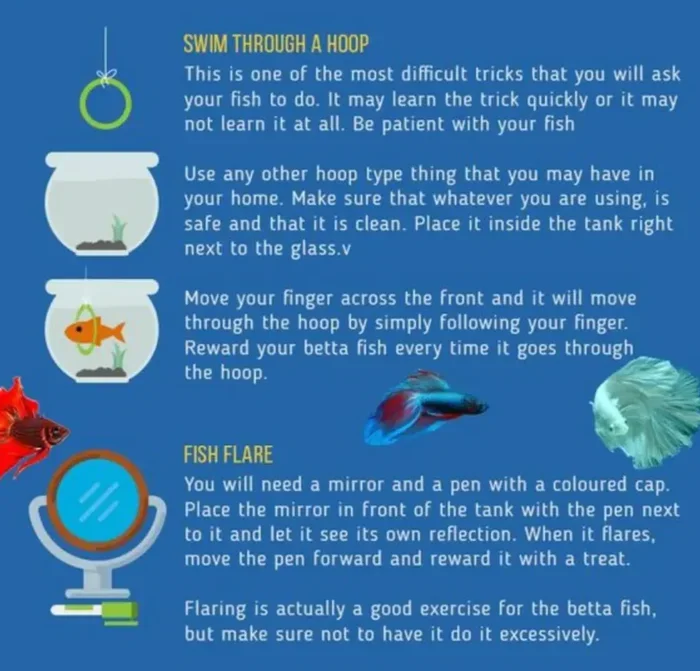
Trick 3: Swimming Through a Hoop
This is a slightly more advanced trick but very impressive to watch. You can make a small hoop from a pipe cleaner or bend a wire into a circle. Hold it in the water and use your target stick to guide your betta through it. Reward immediately when your fish swims through. With practice, your betta will go through the hoop on cue.
Trick 4: Jumping for Food
Some bettas can be trained to jump up to grab food from above the waterline. This trick requires a calm, still tank surface. Hold a piece of food just above the water and wait. Your betta may eventually leap up to get it. Be careful not to overdo this trick, as jumping can sometimes cause stress or injury if done too often.
Best Training Techniques for Betta Fish
Not all training methods work equally well. Some techniques produce faster results, while others are more reliable over time. Here is a closer look at the most effective approaches for betta fish training.
Positive Reinforcement
Positive reinforcement means rewarding the behavior you want to see. For bettas, the reward is almost always food. Use small, high-quality pieces of food like bloodworms or brine shrimp. These are considered premium treats that most bettas love.
The timing of the reward matters a lot. You must give the treat within one or two seconds of the correct behavior. If you wait too long, your betta will not connect the reward with the action. Keep training sessions short, ideally 5 to 10 minutes. Bettas have short attention spans, and longer sessions will only frustrate both of you.
Clicker Training
Clicker training is a method used by many animal trainers, and it works well for fish too. The idea is simple. You use a small clicker device to make a distinct sound, and then immediately give a food reward. After several repetitions, your betta will learn that the click means a treat is coming. You can then use the click to mark the exact moment your fish does something right.
Some owners use a penlight flashlight instead of a clicker. The light flash serves the same purpose as the click sound. Choose whichever signal your betta responds to best. Every fish is different, and what works for one may not work for another.
Shaping Behavior
Shaping is a technique where you break a complex trick into small steps. You reward each small step until your betta can do the full behavior. For example, if you want to teach your betta to swim through a hoop, you first reward it for just swimming toward the hoop. Then reward it for getting closer. Then reward it for touching the hoop. Finally, reward it for swimming all the way through.
This method takes more time but produces very reliable results. It is the same approach used by professional animal trainers around the world. How can I train my betta fish using shaping? Start small, reward often, and build up gradually.
How Often Should You Train Your Betta Fish?
Consistency matters more than frequency when it comes to betta training. A short daily session is far better than one long session once a week. Aim for 5 to 10 minutes per day, ideally at the same time each day. Bettas thrive on routine, and they will start to anticipate training time.
Watch your fish for signs of stress during training. If your betta starts hiding, flashing against decorations, or refusing food, stop the session and try again the next day. Training should always be a positive experience for both you and your fish.
Also make sure your betta fish tank is clean and well-maintained. A stressed fish in poor water conditions will not train well. Regular water changes and proper filtration go a long way toward keeping your betta healthy and ready to learn. If you are concerned about water quality, check out whether can I use purified water in my betta fish tank to ensure the best environment for your fish.
Common Mistakes to Avoid When Training Your Betta
Even the most enthusiastic fish owners make mistakes. Here are the most common errors that can slow down or derail your training progress.
- Training for too long: Bettas get tired quickly. Sessions longer than 10 minutes can cause stress and reduce their willingness to participate.
- Using the wrong rewards: Not all foods work equally well as training treats. Use something your betta loves and only gives during training time.
- Changing cues too often: Consistency is everything. If you use a different signal each time, your betta will get confused.
- Skipping days: Training works best with daily practice. Skipping too many days can cause your betta to forget what it has learned.
- Getting frustrated: Fish can sense your energy. If you are stressed or impatient, your betta will feel it and become less responsive.
Remember that every fish learns at its own pace. Some bettas pick up tricks in just a few days, while others take weeks. The most important thing is to keep the experience positive and enjoyable for your fish.
Expert Insights on Betta Fish Training
Experienced betta owners and aquatic specialists agree on a few key principles. First, always train a healthy fish. If your betta seems lethargic or unwell, skip the training session and focus on its health. You can learn more about recognizing illness in our article on how can I tell if my betta fish is sick.
Second, every betta has its own personality. Some are bold and curious, making them natural candidates for training. Others are shy and cautious, and they may need more time to warm up. Do not compare your fish to others. Simply work at your betta’s pace and celebrate every small victory.
Finally, training is not just about tricks. It is a way to enrich your betta’s life and strengthen the bond between you. Even if your fish never learns to swim through a hoop, the time you spend together will make your pet happier and more responsive. And if you ever want to explore more advanced training, check out our guide on can I teach my betta fish tricks for additional ideas and techniques.
Conclusion
How can I train my betta fish? The answer is simpler than you might think. With patience, consistency, and positive reinforcement, almost any betta can learn to follow commands, eat from your hand, and perform simple tricks. Start with trust-building exercises, use a target stick and rewards, and keep sessions short and enjoyable. Avoid common mistakes like overtraining and inconsistent cues. Most importantly, enjoy the process and celebrate every small success along the way.
Your betta fish is capable of more than you give it credit for. Put in the time, stay patient, and you will be amazed at what your fish can learn. Happy training!
Frequently Asked Questions
How long does it take to train a betta fish?
Most bettas can learn basic tricks within 2 to 4 weeks of daily training. However, every fish is different. Some pick up tricks quickly, while others need more time. Consistency and patience are the most important factors in how fast your betta learns.
What is the best food to use as a training reward for bettas?
Small pieces of bloodworms, brine shrimp, or daphnia work best as training treats. These are high-value foods that most bettas find irresistible. Use them only during training sessions to keep your fish motivated and excited to participate.
Can betta fish really learn tricks?
Yes, betta fish can absolutely learn tricks. They are intelligent fish that can associate cues with actions and rewards. Simple tricks like following your finger, eating from your hand, and swimming through a hoop are all achievable with consistent training.
How do I know if my betta fish is stressed during training?
Signs of stress include hiding, flashing against decorations, refusing food, or staying at the bottom of the tank. If you notice any of these behaviors, stop training immediately and give your fish time to relax. A stressed fish will not learn effectively.
Can I train my betta fish to recognize me?
Yes, bettas can learn to recognize their owner over time. They associate your presence, voice, and movements with feeding and positive experiences. Many owners report that their bettas swim to the front of the tank when they approach, which is a clear sign of recognition.
Is it okay to train my betta fish every day?
Yes, daily training is fine as long as sessions are short, ideally 5 to 10 minutes. Bettas respond well to routine, and consistent daily practice helps them learn faster. Just make sure your fish is healthy and well-rested before each session.