Betta fish have surprisingly good vision and can detect sounds despite lacking external ears. Their eyes allow them to see colors and movement clearly, while their inner ears and lateral line system help them sense vibrations and sounds in the water. Understanding how your betta perceives its environment can help you create a better habitat and build a stronger bond with your fish.
Key Takeaways
- Betta fish have excellent color vision: They can see a wide range of colors, including some that humans cannot perceive, thanks to specialized cells in their eyes.
- They can see in low light but not complete darkness: Bettas rely on ambient light and struggle to navigate in pitch-black conditions.
- Betta fish can hear sounds: They lack external ears but possess inner ears and a lateral line system that detects vibrations and sound waves in water.
- They respond to their owner’s voice: Bettas can learn to recognize vibrations and sounds associated with feeding time or their owner’s presence.
- Sudden loud noises can stress bettas: Excessive vibrations and loud sounds near the tank can cause anxiety and health issues.
- Vision plays a key role in betta behavior: Their sight drives feeding responses, territorial displays, and interactions with tank mates.
- Understanding their senses improves care: Knowing how bettas see and hear helps you design a more comfortable and enriching environment.
📑 Table of Contents
- Can Betta Fish See and Hear? Understanding Your Betta’s Senses
- How Betta Fish See: The Anatomy of Their Eyes
- Can Betta Fish See Color?
- Can Betta Fish See in the Dark?
- Can Betta Fish Hear? Understanding Their Auditory System
- How Well Can Betta Fish Hear?
- How Sound and Vision Affect Betta Behavior
- Practical Tips for Betta Owners
- Conclusion
Can Betta Fish See and Hear? Understanding Your Betta’s Senses
If you have ever watched your betta fish swim up to the glass when you approach the tank, you might have wondered — can they actually see you? And what about when you talk near the aquarium or tap on the glass? Can they hear you too? These are great questions, and the answers might surprise you.
Betta fish are fascinating creatures with senses that are uniquely adapted to their underwater world. While they do not experience sight and hearing the same way humans do, they are far from blind or deaf. In fact, bettas rely heavily on both vision and their ability to detect sound and vibration to survive, find food, and interact with their environment.
In this article, we will take a deep dive into how betta fish see and hear. You will learn about the anatomy of their eyes, how they perceive color and light, and how their hearing works without traditional ears. By the end, you will have a much better understanding of how your betta experiences the world around it.
How Betta Fish See: The Anatomy of Their Eyes
The Structure of a Betta Fish Eye
Betta fish have eyes that are positioned on the sides of their heads. This placement gives them a wide field of view, which is essential for spotting both predators and prey in the wild. Unlike humans, whose eyes face forward, a betta’s lateral eye placement allows them to see nearly 360 degrees around them. This is a huge survival advantage in the shallow rice paddies and slow-moving streams where they originate.

Visual guide about Can Betta Fish See and Hear
Image source: dsflyfishing.com
Their eyes contain many of the same basic components as human eyes, including a lens, retina, and cornea. However, there are some key differences. For example, betta fish have a spherical lens that is denser than a human lens. This helps them focus light properly underwater, where light behaves differently than it does in air. Their retinas contain both rod cells and cone cells, which allow them to detect light levels and colors.
How Well Can Betta Fish See?
Bettas have relatively good vision for a fish. They can see objects clearly at close to moderate distances, which is important for identifying food, recognizing other fish, and navigating their environment. However, their vision is not as sharp as human vision, especially at longer distances. Think of it this way — your betta can see you clearly when you are standing right in front of the tank, but you might appear blurry from across the room.
One interesting thing about betta vision is that they are particularly good at detecting movement. This makes sense from an evolutionary standpoint. In the wild, the ability to spot a moving insect on the water’s surface or a rival betta approaching from the side could mean the difference between eating and going hungry, or between defending territory and losing it.
Can Betta Fish See Color?
A World Full of Color
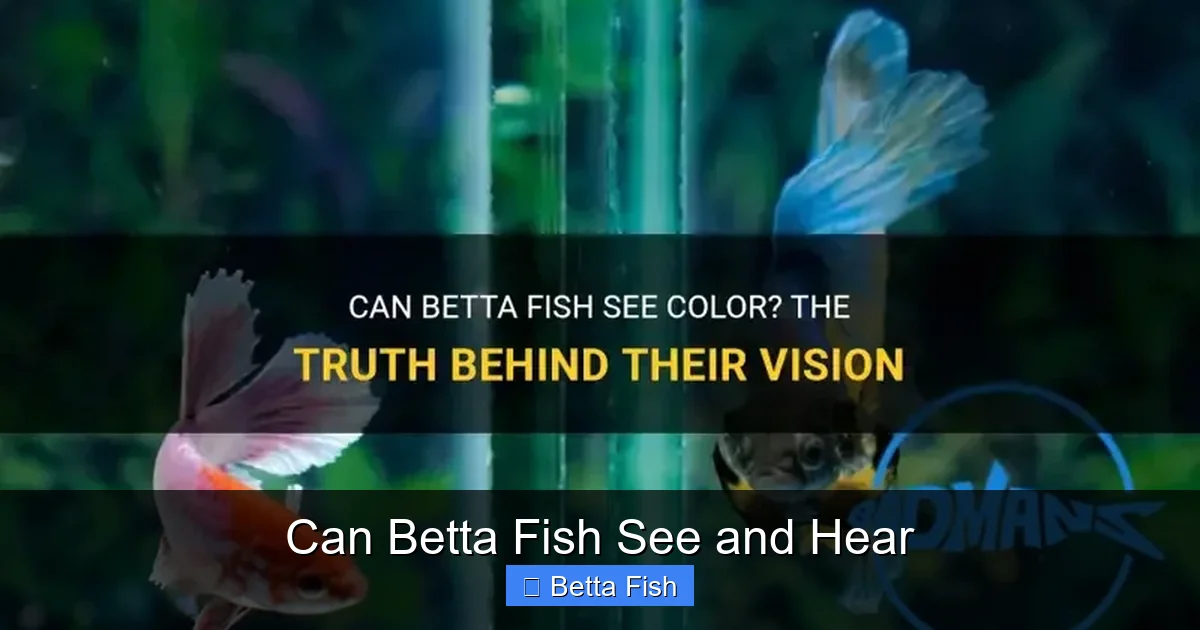
Yes, betta fish can see color — and they see a lot of it. In fact, their color vision is believed to be even more advanced than that of humans. While humans have three types of cone cells in their retinas (allowing us to see red, green, and blue), betta fish have four or more types of cone cells. This means they can perceive a broader spectrum of colors, including ultraviolet light, which is invisible to the human eye.

Visual guide about Can Betta Fish See and Hear
Image source: bettafishbay.com
This advanced color vision is one reason why betta fish are so visually striking. In the wild, male bettas use their brilliant colors to attract mates and intimidate rivals. Their ability to see a wide range of colors helps them evaluate potential mates and competitors. When you see your betta flaring its gills and spreading its fins at another fish, it is using its excellent color vision to assess the situation.
Why Color Matters in the Tank
Understanding that bettas see color can help you make better choices when setting up their tank. Brightly colored decorations and plants can provide visual stimulation, which is important for a fish that relies so heavily on sight. However, be mindful of overly bright or reflective surfaces, as these can sometimes stress a betta by making it think there is another fish in its territory.
If you are considering adding tank mates to your betta’s aquarium, it is worth noting that their color vision plays a role in how they react to other fish. Brightly colored fish like guppies might trigger an aggressive response because your betta perceives them as a rival. You can learn more about compatible companions in our guide on what other fish can live with betta fish.
Can Betta Fish See in the Dark?
Low Light vs. Complete Darkness
This is a common question among betta owners, and the answer is a bit nuanced. Betta fish can see in low light conditions, but they cannot see in complete darkness. Their eyes contain rod cells, which are specialized for detecting low levels of light. This allows them to navigate dimly lit environments, such as the murky waters of their natural habitat at dusk or dawn.
Visual guide about Can Betta Fish See and Hear
Image source: ekk4j69ebaa.exactdn.com
However, in total darkness, bettas are essentially blind. They cannot see food, obstacles, or other fish. This is why it is important to provide your betta with a regular day-night light cycle. Most aquarium experts recommend 8 to 12 hours of light per day, followed by a period of darkness that mimics natural nighttime conditions.
Tips for Managing Light in Your Betta Tank
Here are some practical tips for ensuring your betta has the right lighting:
- Use an aquarium light with a timer: This ensures your betta gets a consistent light cycle, which supports its natural circadian rhythm.
- Avoid placing the tank in direct sunlight: While some natural light is fine, too much direct sunlight can cause algae blooms and temperature fluctuations.
- Provide hiding spots: Plants, caves, and other decorations give your betta places to retreat if the light feels too bright.
- Don’t leave the room lights on all night: Bettas need darkness to rest properly. A dark period of 8 to 10 hours is ideal.
For a more detailed look at this topic, check out our article on can betta fish see in the dark.
Can Betta Fish Hear? Understanding Their Auditory System
Do Betta Fish Have Ears?
At first glance, it might seem like betta fish do not have ears. You will not see any external ear structures on the sides of their heads like you would on a dog or a cat. But the truth is, bettas do have ears — they are just internal. Inside their heads, betta fish have inner ear structures that detect sound waves and vibrations traveling through the water.
Visual guide about Can Betta Fish See and Hear
Image source: petshun.com
These inner ears contain small bones and sensory cells that convert sound vibrations into nerve signals. The brain then interprets these signals, allowing the betta to “hear” what is happening around them. While their hearing is not as sophisticated as that of mammals, it is perfectly adapted to life underwater, where sound travels faster and differently than it does in air.
The Lateral Line System
In addition to their inner ears, betta fish have another remarkable sensory tool called the lateral line system. This is a series of sensory organs that run along the sides of their body, from head to tail. The lateral line detects changes in water pressure and vibration, giving the betta a kind of “sixth sense” for movement and sound in its environment.
Think of the lateral line as a built-in motion detector. When another fish swims nearby, when you tap on the glass, or when food hits the water’s surface, the lateral line picks up those vibrations and alerts the betta. This system is especially useful in murky water or at night when visibility is low.
How Well Can Betta Fish Hear?
Detecting Sounds and Vibrations
Betta fish are quite sensitive to sound and vibration. They can detect a range of frequencies, particularly low-frequency sounds that travel well through water. This means that loud noises near the tank — like a slamming door, a bass-heavy speaker, or even a vacuum cleaner running nearby — can be felt and heard by your betta.

Visual guide about Can Betta Fish See and Hear
Image source: forfishlovers.com
Research on fish hearing in general suggests that most freshwater fish, including bettas, are most sensitive to frequencies between 100 and 1,000 Hz. Human speech falls within this range, which means your betta can likely detect the sound of your voice, especially if you speak near the tank. Whether they understand what you are saying is another matter entirely — but they can certainly sense that something is happening.
Can Your Betta Recognize Your Voice?
Many betta owners swear that their fish responds to their voice. While there is no scientific proof that bettas can recognize specific words, they can learn to associate certain sounds and vibrations with events — most commonly, feeding time. If you always tap on the glass or speak to your betta before feeding it, the fish will eventually learn to associate that sound with food and swim to the surface in anticipation.
This kind of associative learning is well-documented in fish. It is the same principle behind Pavlov’s famous dog experiment. Over time, your betta may swim to the front of the tank when it hears you approaching, not because it understands your words, but because it has learned that your presence often means food is coming.
If you are curious about this topic, our article on can my betta fish hear me goes into more detail.
How Sound and Vision Affect Betta Behavior
Vision and Aggression
One of the most well-known traits of betta fish is their aggression, particularly among males. This behavior is closely tied to their vision. Male bettas are highly territorial, and they use their excellent color vision to identify rivals. When a male betta sees another male — or even its own reflection in the glass — it may flare its gills, spread its fins, and display vibrant colors as a warning.

Visual guide about Can Betta Fish See and Hear
Image source: articles.hepper.com
This is why it is generally not recommended to keep two male bettas in the same tank. Their vision makes it nearly impossible for them to ignore each other, and the resulting stress and fighting can lead to serious injury or even death. If you are wondering about keeping multiple bettas together, our guide on can you keep multiple betta fish together covers this topic in depth.
Sound and Stress
Just as vision can trigger aggression, sound and vibration can trigger stress in betta fish. Sudden, loud noises can startle a betta, causing it to dart around the tank, hide, or even jump out of the water. Chronic exposure to loud sounds — like a tank placed next to a television or stereo — can lead to long-term stress, which weakens the immune system and makes the fish more susceptible to disease.
To keep your betta calm and healthy, place its tank in a quiet area of your home. Avoid tapping on the glass, and try to minimize sudden loud noises near the aquarium. If you have children, teach them to be gentle around the tank. A peaceful environment will go a long way toward keeping your betta happy.
Using Sound and Vision for Enrichment
On the flip side, you can use your betta’s senses to provide mental stimulation and enrichment. Here are some ideas:
- Talk to your betta regularly: Over time, it may learn to associate your voice with positive experiences like feeding.
- Use a variety of colorful decorations: Plants, rocks, and caves in different colors can make the tank more visually interesting.
- Introduce new objects occasionally: A new plant or decoration gives your betta something new to explore with its eyes and lateral line.
- Feed at consistent times: This helps your betta establish a routine and reduces stress.
Practical Tips for Betta Owners
Creating a Sensory-Friendly Environment
Now that you understand how betta fish see and hear, you can use this knowledge to create a better home for your fish. Here are some practical tips:
- Provide a consistent light cycle: Use a timer on your aquarium light to give your betta 8 to 12 hours of light per day.
- Avoid sudden changes: Bettas are sensitive to sudden changes in light and sound. Gradual transitions are always better.
- Choose tank mates carefully: If you add other fish, avoid species with bright colors or long fins that might trigger your betta’s territorial instincts.
- Keep the tank in a quiet location: Away from speakers, televisions, and high-traffic areas.
- Use a gentle filter: Strong water flow can create excessive vibration and stress. Bettas prefer calm water.
Signs Your Betta Is Stressed
Pay attention to your betta’s behavior. If it is constantly hiding, refusing to eat, or displaying faded colors, it might be stressed. Common causes of stress include:
- Loud or sudden noises near the tank
- Excessive light or complete darkness for extended periods>
li>Seeing its own reflection too often (from a glass tank in a bright room) - Aggressive tank mates
- Poor water quality
Addressing these issues promptly can help your betta recover and thrive.
Conclusion
Betta fish are far more perceptive than many people realize. Their eyes allow them to see a rich world of colors, detect movement, and navigate their environment with impressive accuracy. Their inner ears and lateral line system give them the ability to hear sounds and feel vibrations, making them aware of what is happening both inside and outside their tank.
Understanding how your betta sees and hears is not just interesting — it is practical. It helps you create a tank environment that reduces stress, provides stimulation, and supports your fish’s overall health. From choosing the right lighting to placing the tank in a quiet spot, every decision you make can be informed by a deeper understanding of your betta’s senses.
The next time your betta swims up to greet you at the glass, remember — it can see you, it can sense your presence, and it might even recognize the sound of your voice. That is a pretty special connection for a fish that fits in the palm of your hand.
Frequently Asked Questions
Can betta fish see me?
Yes, betta fish can see you. Their eyes are adapted for clear vision at close to moderate distances, and they are especially good at detecting movement. When you approach the tank, your betta can see your shape and motion, which is why many bettas swim to the front of the tank when their owner is nearby.
Can betta fish hear me talk?
Betta fish can detect the vibrations and sound waves produced by your voice, especially low-frequency sounds. While they do not understand words, they can learn to associate your voice with feeding time or other routine events. Over time, your betta may respond when it hears you speaking near the tank.
Can betta fish see in complete darkness?
No, betta fish cannot see in complete darkness. They have rod cells that allow them to see in low light conditions, but they need some ambient light to navigate. This is why providing a regular day-night light cycle is important for their health and well-being.
Do betta fish have ears?
Betta fish do not have external ears, but they do have inner ear structures inside their heads. These inner ears detect sound waves and vibrations in the water. They also have a lateral line system along their body that senses changes in water pressure and movement.
Can loud noises hurt my betta fish?
Loud noises and sudden vibrations can stress betta fish significantly. Chronic exposure to loud sounds can weaken their immune system and lead to health problems. It is best to place your betta’s tank in a quiet area away from speakers, televisions, and other sources of loud noise.
Why does my betta flare at its reflection?
Betta fish flare at their reflection because their excellent color vision makes them perceive the reflection as another betta. This is a territorial display, especially common in male bettas. To reduce this behavior, try adjusting the lighting in the room or moving the tank to a location where reflections are minimized.

