Which Is Better Braided or Mono Fishing Line
Choosing between braided and mono fishing line for Betta fish hinges on their specific behavior and habitat. Monofilament is generally superior for Betta due to its stretch, forgiveness, and lower visibility in clear water, which matches their wariness. Braided line excels in heavy cover and sensitivity but often requires a fluorocarbon leader to avoid spooking these observant fish.
So, you’re gearing up for a day of Betta fishing. You’ve got your favorite lightweight rod, your tiny jigs, and your hat on straight. But then you stand in the tackle aisle, staring at a wall of fishing line. Braided? Monofilament? Which one is actually going to help you catch more of those beautiful, feisty little fighters? It’s a fundamental question that plagues anglers of all levels, and the answer isn’t as simple as “braid is better.” For a species as unique and particular as the Betta—often called the “Siamese fighting fish” in the wild—your line choice can make a dramatic difference between a frustrating day and a memorable one. Let’s unravel the tangled web of braided versus monofilament line, specifically through the lens of targeting these incredible fish.
First, a quick reality check. While Betta are famous in the aquarium world, in many parts of Asia and increasingly in the southern United States, they are a legitimate and exciting freshwater gamefish. They inhabit shallow, slow-moving waters—rice paddies, canals, ditches, and the margins of ponds and lakes—often choked with vegetation like water hyacinth, duckweed, and lily pads. They are sight feeders with surprisingly good vision, notorious for their cautious, investigative strikes on small prey. They also possess a small, somewhat delicate mouth and a habit of making violent, head-shaking runs when hooked. These traits aren’t just curiosities; they are the blueprint for selecting your fishing line.
Key Takeaways
- Monofilament is typically the better all-around choice for Betta fishing: Its inherent stretch acts as a shock absorber for their soft mouths and reduces the chance of a hook pulling out during a fierce head shake.
- Visibility is critical: Betta have excellent eyesight. Thin, stiff braid is highly visible underwater; a mono or fluorocarbon leader is almost always necessary when using braid for Betta.
- Stretch vs. Sensitivity: Mono’s stretch provides a safety buffer for light-wire hooks, while braid’s zero-stretch offers supreme sensitivity to detect the subtle, curious pecks of a Betta.
- Abrasion resistance favors braid: For fishing in dense lily pads or roots where Betta ambush, braided line’s superior strength-to-diameter and abrasion resistance is a major advantage.
- Knot tying and management differ: Braid requires specific knots (like the Palomar) and can be tricky on small reels, while mono is more forgiving and easier to handle with standard knots.
- Consider the rod and reel: Braid’s thin diameter can overfill small spinning reels meant for mono. Match your line choice to your tackle’s intended capacity.
- There is no single “best” line: The optimal choice depends entirely on your specific fishing scenario: clear open water vs. thick vegetation, light jigs vs. moving baits.
📑 Table of Contents
- The Core Science: What Are These Lines Actually Made Of?
- The Visibility Factor: Can Betta See Your Line?
- Stretch and Shock Absorption: Protecting Your Hookset
- Abrasion Resistance and Toughness: Fighting the Weeds
- Knot Strength, Handling, and the “Feel” Factor
- The Decision Matrix: Which Line for Which Betta Scenario?
- Conclusion: It’s About the System, Not Just the Line
The Core Science: What Are These Lines Actually Made Of?
Before we dive into performance, we need to understand what we’re dealing with. The fundamental difference between braid and mono is in their construction, which dictates every other characteristic.
Monofilament: The Single-Strand Workhorse
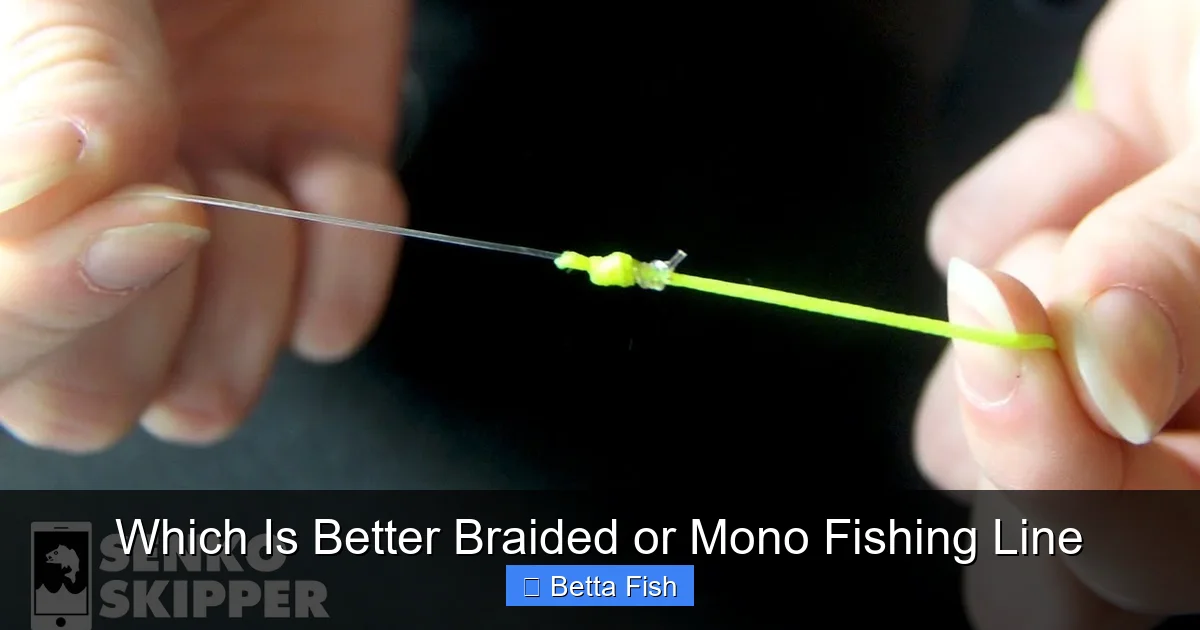
Monofilament, or “mono,” is exactly what its name implies: a single strand of nylon polymer. It’s been the default fishing line for decades, and for good reason. The manufacturing process extrudes molten nylon into a single, uniform strand. This construction gives mono its signature characteristics: inherent stretch, buoyancy, and memory (its tendency to retain the shape of the spool). It’s also generally more visible underwater than other types. Its strength is measured in pound-test, and it has a relatively thick diameter compared to other lines of the same strength. Think of mono as a reliable, all-purpose rubber band—forgiving, easy to use, and gets the job done.
Braided Line: The Modern Super-Fiber
Braided line, often called “braid,” is a completely different beast. It’s not a single strand. It’s constructed by weaving together multiple (usually 4, 8, or 16) extremely fine fibers of a synthetic material, most commonly Dyneema or Spectra (brand names for ultra-high-molecular-weight polyethylene). These fibers are then often coated with a polymer like epoxy or thermal bonding. This weave creates a line that is incredibly strong for its diameter, has virtually no stretch, sinks rather than floats, and has very low memory. Its diameter is dramatically smaller than mono of the same tensile strength. If mono is a rubber band, braid is a steel cable—thin, direct, and unyielding.
The Visibility Factor: Can Betta See Your Line?
This is arguably the most critical factor when fishing for Betta. These are not indiscriminate eaters. In the clear, shallow waters they prefer, they inspect everything. A suspicious, glinting line in front of a natural-looking bait is an instant deal-breaker.
Visual guide about Which Is Better Braided or Mono Fishing Line
Image source: m.media-amazon.com
How Monofilament Stacks Up
Traditional mono is quite visible. Its thick diameter and often opaque or translucent colors (like green, clear, or blue) can be seen by fish. However, its softness and tendency to “relax” in the water column can sometimes make it slightly less obtrusive than a stiff braid. More importantly, modern “invisible” or “camo” monofilaments use advanced polymers and multi-color blending to break up the line’s outline, offering better stealth. For Betta fishing in clear water, a high-quality, low-visibility mono in a clear or very light green tint is a perfectly acceptable, often excellent, choice right out of the package.
The Braid Visibility Problem (And The Solution)
Here’s the big drawback: braided line is a visibility nightmare for wary fish like Betta. It’s thin, but it’s also stiff and often has a shiny, almost metallic appearance due to the woven fibers. It does not relax; it cuts through the water like a wire. In clear water, a Betta will see that thin, dark line long before it sees your bait. The universal solution is to use a leader. A leader is a short length (12-24 inches) of another, more invisible material—usually fluorocarbon or even mono—tied between your braid main line and your lure or hook. Fluorocarbon is the gold standard here because it is virtually invisible underwater (it has a refractive index close to water), sinks, and is abrasion-resistant. For Betta, a 4-6 lb test fluorocarbon leader is the secret weapon when using braid.
Stretch and Shock Absorption: Protecting Your Hookset
Betta are famous for their explosive, acrobatic fights. They don’t just run; they shake, jump, and make sudden directional changes. This behavior puts unique stress on your line and, most importantly, your hook.
Visual guide about Which Is Better Braided or Mono Fishing Line
Image source: allfishinggear.com
Monofilament’s Forgiving Nature
Mono has significant stretch—typically 15-25%. This is a massive advantage when using the tiny, light-wire hooks (size 10-14) common for Betta. When a Betta thrashes its head, that stretch acts like a shock absorber. It cushions the sudden jerk, dramatically reducing the chance that the hook’s point will tear back out of the fish’s small mouth. It’s more forgiving of imperfect hooksets. If you set the hook a split second late or with too much force, mono’s stretch can save the day. It’s like having a built-in safety net for delicate presentations.
Braided Line’s “No Give” Reality
Braid has virtually zero stretch—less than 5%. This is a double-edged sword. On one hand, it provides an incredibly direct connection. You feel every tick, every bump, every subtle inhalation of a Betta investigating your micro-jig. There’s no “buffer” between you and the fish. On the other hand, that same lack of stretch means every violent head shake is transmitted directly to your hook. With a light-wire hook, this greatly increases the risk of the hook straightening or pulling free. This is why, if you use braid for Betta, you must be extremely precise with your hookset—a sharp, upward flick of the wrist—and you must use a sharp, quality hook. The zero-stretch also makes braid more prone to breaking if you hook a Betta and it immediately surges into thick, abrasive cover; there’s no stretch to absorb the initial shock of the line rubbing against stems and roots.
Abrasion Resistance and Toughness: Fighting the Weeds
Betta habitat is rarely open sand. It’s a jungle. Your line will constantly rub against the stems of water hyacinth, the edges of lily pads, and the woody roots of shoreline vegetation. Abrasion resistance is non-negotiable.
Visual guide about Which Is Better Braided or Mono Fishing Line
Image source: landedfishing.com
Braided Line’s Dominance
This is braid’s home turf. The woven Spectra or Dyneema fibers are incredibly tough and resistant to cuts and scrapes from vegetation and even fish teeth (though Betta don’t have teeth that threaten line). Furthermore, because a 20 lb test braid has a diameter similar to 6-8 lb test mono, you can use a much stronger line without sacrificing casting distance or lure action. You can fish 30 lb braid through the nastiest lily pad mat with confidence that a Betta’s frantic run won’t snap you off on a stem, whereas a 6 lb mono might get sliced in half. For this specific application—fishing isolated pockets in heavy cover—braid is arguably superior.
Monofilament’s Trade-Off
Mono is more susceptible to abrasion. A sharp stem or a rough edge can nick mono, creating a weak point that will fail under pressure. To compensate, you often have to upsize your mono test (e.g., using 8-10 lb test for a scenario where you’d use 20 lb braid), which has drawbacks: it’s thicker, casts less efficiently with light lures, and is more visible. However, modern abrasion-resistant monos have improved significantly. For Betta fishing along the edges of weed beds rather than inside the thickest mats, a good 6-8 lb abrasion-resistant mono is perfectly serviceable and often preferred for its overall handling characteristics.
Knot Strength, Handling, and the “Feel” Factor
How a line behaves on your specific rod and reel, and how easily you can tie reliable knots with it, matters immensely for a full day of fishing.
Tying On: The Knot Challenge
Braided line is notoriously slippery. Standard mono knots like the improved clinch knot will often slip and fail with braid. You must use knots specifically designed for braid, such as the Palomar knot, the Double Uni knot (for joining to leader), or the FG knot. These knots require more steps and practice to tie correctly. Monofilament, conversely, is very knot-friendly. The improved clinch knot, the uni knot, and the loop knot all hold extremely well with mono. For anglers who value simplicity and speed when retying, this is a major point in mono’s favor.
Spooling and Casting: The Practicalities
Braid’s lack of stretch and memory means it lies on the spool perfectly flat and doesn’t develop “bird’s nests” as easily. However, its thin diameter can be a problem. If you spool a small ultralight spinning reel (like those used for Betta) designed for 4-8 lb mono with 20 lb braid, you’ll fit far more line than intended. This can cause issues like the line digging into itself on the cast (“coring”), leading to frustrating tangles. You often need to use a backing of mono or tape on the spool first. Mono is easier to spool correctly on any reel. In terms of casting, braid’s thin diameter and lack of stretch allow for incredibly long, accurate casts with light lures—a huge plus for covering water. However, its stiffness can sometimes make it “slap” the water more on the cast, which might spook ultra-spooky Betta in flat calm conditions. Mono’s stretch and softness often result in a quieter, softer lure entry.
The Decision Matrix: Which Line for Which Betta Scenario?
Enough theory. Let’s put it into practice. Here’s a quick-reference guide for common Betta fishing situations.
- Clear, Open Water or Calm Ponds: Monofilament (4-6 lb test). Its lower visibility and forgiving stretch are perfect for fishing small soft plastics, tiny crankbaits, or live bait to wary, suspended fish. The soft presentation is less likely to alert them.
- Heavy Vegetation / Fishing Pads: Braided Line (15-30 lb test) with a Fluorocarbon Leader (4-6 lb test). Here, you need power to horse a Betta out of the weeds. The braid’s thin diameter cuts through vegetation, its abrasion resistance protects against stems, and its zero-stretch gives you the immediate control needed. The fluorocarbon leader solves the visibility problem.
- Windy Days / Heavy Current (in canals): Monofilament (6-8 lb test). The extra stretch in mono helps absorb the erratic movement of your lure in rough conditions and provides a buffer against sudden surges. Its buoyancy can also help keep a small lure at a desired depth.
- Ultra-Light Presentations (1/64 oz jigs): Monofilament (4 lb test) or Braid with a long (24”) Mono/Fluoro Leader. The weight of the braid itself can pull a 1/64 oz jig down too fast. A long mono leader adds “weightless” feel and acts as a shock absorber for delicate hooks.
- Beginner Anglers / Kids: Monofilament (6-8 lb test). Full stop. It’s easier to tie, more forgiving of mistakes, less prone to catastrophic tangles from overfilling a spool, and the stretch protects hooks from being pulled out by enthusiastic, uncoordinated hooksets.
Conclusion: It’s About the System, Not Just the Line
So, which is better, braided or mono fishing line for Betta? The honest, and perhaps unsatisfying, answer is: it depends. There is no universal champion. For the majority of Betta fishing scenarios—clear to slightly stained water, along weed edges, with small jigs and plastics—a good quality, low-visibility monofilament in the 4-6 lb test range is the simplest and most effective choice. Its combination of manageable visibility, shock-absorbing stretch, and ease of use aligns perfectly with the needs of targeting a small, wary, hard-fighting fish.
Braided line, however, is a powerful tool for specific, challenging situations. When you need to fish aggressively in heavy, abrasive cover and need every ounce of pulling power and abrasion resistance, braid paired with a long fluorocarbon leader is a devastatingly effective setup. It turns your light rod into a winch capable of extracting a Betta from the heart of a lily pad jungle.
Ultimately, your line is one component of a system. Consider your rod’s power, your reel’s size, the lure you’re using, and—most importantly—the specific environment you’re fishing. Many serious Betta anglers carry two setups: one spooled with mono for the clear, open days, and one with braid/fluoro for the weedy, windy days. Understand the fundamental properties we’ve broken down—stretch, visibility, diameter, abrasion resistance—and you can make the perfect, informed choice for your next Betta adventure. Tight lines!
Frequently Asked Questions
Can I use braided line for Betta without a leader?
You can, but it’s not recommended. Braid’s high visibility will likely spook wary Betta in clear water, significantly reducing your bites. A 12-24 inch fluorocarbon or monofilament leader is almost always necessary to achieve good results.
What pound test line is best for Betta?
For monofilament, 4-6 lb test is ideal for most situations. For braided line, you can use a much heavier main line (15-30 lb) because of its thin diameter, but always pair it with a 4-6 lb test fluorocarbon or mono leader to match the Betta’s small mouth and wariness.
Is monofilament better for beginner Betta anglers?
Absolutely. Mono is easier to tie knots with, more forgiving of poor hooksets due to its stretch, and less prone to severe backlashes and tangles on small reels. It’s the most user-friendly and effective starting point.
Why does braided line seem to spook fish more?
Braid is thin, stiff, and often has a shiny, dark appearance that doesn’t blend well with the underwater environment. Its lack of stretch also makes lure movement feel unnatural sometimes. A Betta’s excellent vision will detect this “foreign” object in front of its food.
Does water clarity change which line I should use?
Yes, significantly. In very clear water, mono or a braid/fluoro leader combo is essential. In stained or muddy water, visibility is less of an issue, so you might get away with straight braid, but a leader still provides shock absorption benefits.
My Betta keeps shaking its head and throwing the hook. Should I switch lines?
This is a classic sign of using a line with no stretch (like braid) with a light-wire hook. Switching to monofilament will often solve this problem immediately, as its stretch cushions the violent head shakes and keeps the hook securely in the fish’s mouth.